








WISE 0855-0714
The Coldest Known Brown Dwarf Near the Sun
Quick Reader
| Attribute | Details |
|---|---|
| Name | WISE 0855–0714 |
| Alternative Designation | WISE J085510.83–071442.5 |
| Object Type | Extremely cold brown dwarf |
| Spectral Class | Y-dwarf (≈ Y2–Y3) |
| Constellation | Hydra |
| Distance from Earth | ~7.2 light-years |
| Mass | ~3–10 M♃ (Jupiter masses) |
| Temperature | ~225–270 K (−48 to −5 °C) |
| Luminosity | ~10⁻⁸ L☉ |
| Radius | ~1 R♃ (Jupiter-sized) |
| Discovery | 2014, using the WISE telescope |
| Notable Feature | Third-closest system to the Sun after Alpha Centauri and Barnard’s Star |
| Best Viewed | Infrared only – invisible in visible light |
Introduction – A Frozen World in the Solar Neighborhood
WISE 0855–0714 is one of the strangest and most intriguing objects discovered in the Solar neighborhood. At a distance of only 7.2 light-years, it is the fourth-closest known system to the Sun and belongs to the coldest class of brown dwarfs ever observed: Y-dwarfs.
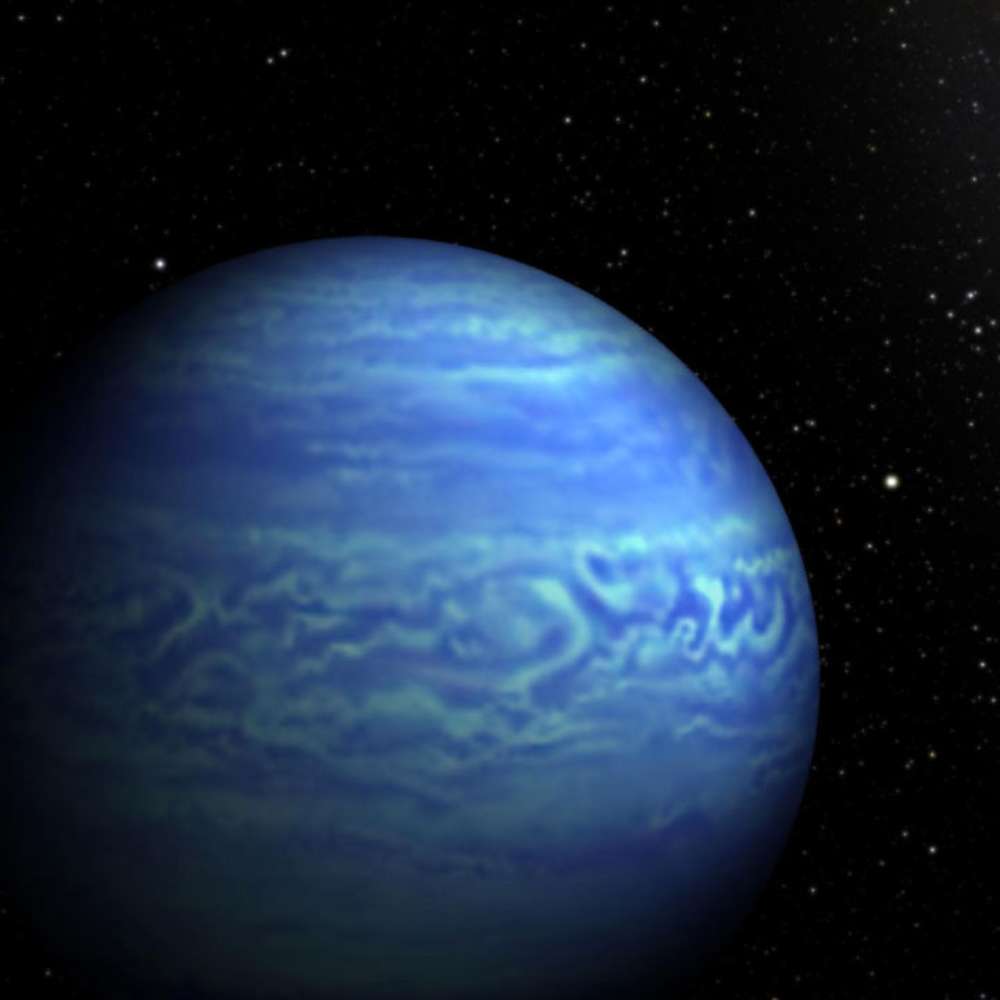
What makes WISE 0855 extraordinary is its temperature. At roughly 225–270 K, it is colder than the average temperature on Earth. In fact, its atmosphere contains water clouds, ice, and possibly weather patterns similar to Jupiter’s—yet this is a failed star drifting freely through interstellar space.
It emits almost no visible light. Instead, it glows faintly in infrared wavelengths, detected only through sensitive space telescopes. Because of its proximity and extreme atmospheric conditions, WISE 0855–0714 offers a rare look at the coldest possible bridge between planets and stars.
What Is a Y-Dwarf? – The Coldest Class of “Failed Stars”
Brown dwarfs are objects too massive to be planets but too small to sustain hydrogen fusion like stars.
Y-dwarfs are the coolest category:
Temperatures similar to Earth or Jupiter
Atmospheres dominated by water, methane, ammonia, and clouds
Low luminosities requiring infrared detection
Masses anywhere from ~3 to 20 Jupiter masses
WISE 0855–0714 is one of the coldest Y-dwarfs ever discovered. Its temperature places it on the boundary between:
Gas giant planets
Sub-brown dwarfs
Low-mass brown dwarfs
Because it is free-floating rather than orbiting a star, it resembles a “rogue Jupiter” traveling alone through space.
Physical Properties – A Jupiter-Sized, Near-Frozen Star
Despite being a brown dwarf, WISE 0855–0714 is only about the size of Jupiter.
Key characteristics:
Mass: 3–10 Jupiter masses
Radius: ~Jupiter-sized
Temperature: Comparable to Earth’s poles
Atmosphere: Water ice clouds, methane, likely ammonia
Interior: Degenerate matter like in larger brown dwarfs
Even though it is planet-sized, its mass is too large to form through normal planet formation processes. Instead, it formed like a star—from a collapsing cloud of gas—but never became hot enough to ignite nuclear fusion.
The result is a “failed star” that shines with only residual heat left over from its formation.
Atmospheric Structure – A Giant, Free-Floating Ice World
Studies using infrared data (Gemini North, Spitzer, Keck) reveal a complex atmosphere.
Expected atmospheric layers:
Upper atmosphere dominated by water vapor and ice crystals
Middle layers with thick water-cloud decks
Methane-rich lower layers
Possible ammonia frost
Patchy cloud systems resembling Jupiter’s belts
WISE 0855–0714 may experience weather patterns such as:
Water cloud storms
Vortex-like circulation
Variable cloud thickness
Its atmosphere is the closest analog we have to the atmosphere of Jupiter outside the Solar System.
Visibility – A Ghost Star We Cannot See
WISE 0855–0714 is so faint that:
It is invisible to optical telescopes, including Hubble
It reflects almost no visible light
Only infrared cameras can detect it
It emits light primarily in the 4–5 micron infrared range, making it extremely difficult to study.
This invisibility is why it remained undiscovered until 2014 despite being one of the Solar System’s nearest neighbors.
Why WISE 0855–0714 Is Scientifically Important
It represents a new frontier in astrophysics.
Key scientific contributions:
Shows how cold a brown dwarf can be
Demonstrates that substellar objects can resemble planets more than stars
Offers insight into cloudy, cold atmospheres like Jupiter’s
Helps define the lower-mass limit of star formation
Provides clues to the population of free-floating planetary bodies near the Sun
WISE 0855–0714 may be just one of many nearby ultra-cool objects that remain undetected due to their faintness.
A Window Into Planet-Like Atmospheres Outside the Solar System
WISE 0855–0714 is the closest object we have that behaves atmospherically like Jupiter.
Because it is not blinded by reflected sunlight and is isolated in space, astronomers can study its thermal emission directly. This makes it an exceptional laboratory for examining the physics and chemistry of ultra-cold atmospheres.
What makes it “planet-like”?
Temperature overlaps with gas giants
Thick water clouds dominate its atmosphere
Methane absorption shapes its infrared spectrum
Low gravity produces broad, deep cloud layers
Patchy cloud patterns create brightness variations
WISE 0855–0714 is therefore the best-known example of a free-floating, Jupiter-like object.
Infrared Spectrum – How We Peer Into a Dark, Frozen Star
WISE 0855–0714 emits almost all of its radiation in a narrow infrared band around 4–5 microns.
Telescopes such as:
Gemini North
Spitzer Space Telescope
WISE (Wide-field Infrared Survey Explorer)
Keck Observatory
have captured faint infrared photons that reveal its atmospheric structure.
Key infrared features:
Deep methane absorption bands
Strong water vapor signatures
Evidence for cloud variability
Limited ammonia detection
No visible-light reflection
This spectral fingerprint confirms that WISE 0855–0714 is colder than any previously measured brown dwarf.
Rotation and Variability – A Weather System in a Frozen Star
Even at its frigid temperatures, WISE 0855–0714 shows signs of atmospheric activity.
Observed variability suggests:
Rotational modulation
Patchy cloud cover
Possibly large-scale storms
Alternating bright and dark zones resembling Jupiter’s belts
The variability detected across multiple nights implies that the object rotates and exhibits dynamic weather patterns.
Astronomers consider WISE 0855–0714 one of the best candidates for studying exoplanet weather directly, because its faint infrared glow offers clean, unblended data from a Jupiter-like atmosphere.
Mass and Formation – A Borderline Between Planet and Star
WISE 0855–0714’s mass is estimated to lie between 3 and 10 Jupiter masses.
This places it near the lower limit of star formation.
Why this matters:
Objects under ~13 Jupiter masses cannot fuse deuterium
Objects above ~3 Jupiter masses are unlikely to form in protoplanetary disks
WISE 0855 is too massive to be a planet but too small to sustain fusion
It likely formed through the same process as stars: gravitational collapse
WISE 0855 is therefore a sub-brown dwarf—a star-like object that never ignited.
Position in the Solar Neighborhood
Despite being so faint, WISE 0855–0714 is one of our closest cosmic neighbors.
Distance ranking among nearby systems:
Alpha Centauri System
Barnard’s Star
Luhman 16AB
WISE 0855–0714
Its proximity suggests the Solar neighborhood likely contains many more ultra-cold objects that remain undetected due to their invisibility at optical wavelengths.
Upcoming infrared missions (JWST, Roman Space Telescope) may reveal a population of similar Y-dwarfs surrounding the Sun.
Why Is It So Hard to Study?
Even though WISE 0855–0714 is close, it challenges astronomers because:
It emits extremely little radiation
Only a narrow infrared window is observable
Earth’s atmosphere blocks the exact wavelengths needed
Its motion through space is rapid (high proper motion)
Its spectrum is near the limits of current detectors
Studying WISE 0855 is essentially the astrophysical equivalent of observing a campfire from hundreds of kilometers away, through fog, using night-vision goggles.
Comparison with Other Ultra-Cool Objects
| Object | Temperature | Distance | Type |
|---|---|---|---|
| Jupiter | ~125 K | 0 | Gas giant |
| WISE 0855–0714 | ~225–270 K | 7.2 ly | Y-dwarf |
| Luhman 16B | ~800–1,300 K | 6.5 ly | L/T dwarf |
| Gliese 229B | ~900 K | 19 ly | T dwarf |
| Typical brown dwarf | 300–1,500 K | Various | L/T/Y classes |
WISE 0855 is uniquely cold—comparable more to planets than to stars.
What WISE 0855–0714 Reveals About the Low-Mass Universe
WISE 0855–0714 is not just a strange nearby object—it represents an entire, previously invisible category of celestial bodies. Its discovery dramatically expanded our understanding of how common ultra-cold, low-mass objects may be in the galaxy.
Key scientific insights:
The Solar neighborhood likely contains many faint, cold substellar objects that remain unseen in optical surveys.
The mass distribution of star formation extends well below the hydrogen-burning limit, into planetary-mass regimes.
Cold atmospheres rich in water clouds are more common than previously believed.
There may be a vast population of “stealth” brown dwarfs, undetectable without deep infrared surveys.
WISE 0855–0714 challenges older assumptions about the lower boundary of star formation and suggests that the Milky Way may contain billions of objects with temperatures similar to Earth’s.
Could WISE 0855–0714 Host Moons or Planets?
While WISE 0855–0714 is essentially a free-floating planetary-mass object, it is theoretically possible for it to have:
Small moons
Captured planetesimals
A disk of debris
Tiny cold companions
However, no such structures have been detected yet.
Because the object emits extremely little light, finding smaller companions will require next-generation telescopes.
Why moons are plausible:
Sub-brown dwarfs can form with circumstellar disks
These disks could form moons similar to the satellite systems of Jupiter or Saturn
Low temperatures would produce icy, stable environments
Such moons, if found, would be incredibly intriguing—cold, dark worlds orbiting a nearly invisible central object.
A Future Target for the James Webb Space Telescope
WISE 0855–0714 is one of the top priority targets for JWST because its spectrum is extremely difficult to capture from the ground.
JWST could reveal:
The full molecular composition of its atmosphere
Water vapor and cloud layers
Ammonia features
Vertical atmospheric structure
Patchy cloud variations (weather mapping)
Precise temperature and thermal emission
Possible evidence of photochemical processes
WISE 0855–0714 may become the first ultra-cold brown dwarf whose atmosphere is mapped in detail.
Could WISE 0855–0714 Be a Rogue Planet Instead of a Brown Dwarf?
This is an open debate.
Arguments for “rogue planet”:
Mass may be as low as 3–5 Jupiter masses
Temperature is near planetary values
Atmosphere resembles Jupiter’s
No fusion has ever occurred
Arguments for “brown dwarf”:
Formation mechanism likely star-like (collapse of a gas cloud)
Not known to orbit a star
Mass could be closer to 10 Jupiter masses
Fits the Y-dwarf spectral profile
The true classification depends on its formation history, which is still unknown. Many astronomers consider it a planetary-mass brown dwarf or a free-floating sub-brown dwarf.
Frequently Asked Questions (FAQ)
Why is WISE 0855–0714 so cold?
Because it is extremely low-mass and emits only residual heat leftover from formation. With no fusion, it cools continuously.
Is it dangerous to the Solar System?
No. It is simply a nearby, faint object with no gravitational influence on the planets.
Can we see it with a telescope?
Not visually. Only infrared telescopes can detect it.
How was it discovered?
Through the motion detected in infrared images from NASA’s WISE space telescope.
Is it the coldest known object outside the Solar System?
Among brown dwarfs, yes—WISE 0855 is one of the coldest ever discovered.
Related Objects and Comparative Study
Luhman 16AB – A nearby binary of warmer brown dwarfs
WISE 1828+2650 – Another extremely cold Y-dwarf
Gliese 229B – A classic T-dwarf companion
Jupiter – The closest analog within our Solar System
Rogue planets – Free-floating worlds that share temperature similarities
Comparing WISE 0855 with these objects helps outline the full diversity of cold, low-mass bodies in the galaxy.
Final Thoughts
WISE 0855–0714 is one of the most remarkable astronomical discoveries of the 21st century.
It is:
As cold as Earth’s polar regions
Planet-like, yet star-formed
One of the Sun’s nearest neighbors
Invisible to optical instruments
A gateway to understanding ultra-cold atmospheres
A reminder of how much of the nearby universe remains hidden
As telescopes like JWST and future infrared missions continue to probe the sky, WISE 0855–0714 may be just the first of many such frozen, faint neighbors waiting to be revealed.