






WMAP
Mapping the Afterglow of the Big Bang
Quick Reader
| Attribute | Details |
|---|---|
| Mission Name | Wilkinson Microwave Anisotropy Probe (WMAP) |
| Space Agency | NASA |
| Mission Type | Cosmic Microwave Background (CMB) Observatory |
| Launch Date | 30 June 2001 |
| Launch Vehicle | Delta II |
| Operating Orbit | Sun–Earth L₂ halo orbit |
| Primary Wavelength | Microwave |
| Observation Period | 2001–2010 |
| Main Objective | High-precision mapping of the CMB |
| Mission Status | Completed |
| Key Outcome | Precision measurement of Universe age, composition, geometry |
WMAP was designed to observe the oldest light in the Universe—the cosmic microwave background—providing a snapshot of the cosmos when it was only about 380,000 years old.
Introduction – Why the Universe Has a Memory
Every structure in the Universe—galaxies, stars, clusters—can trace its origin back to tiny temperature differences imprinted shortly after the Big Bang.
WMAP was the mission that measured those differences with clarity, transforming cosmology from theory-driven to data-driven science.
Before WMAP, cosmologists debated models.
After WMAP, the Universe came with numbers.
What Is the Cosmic Microwave Background?
The Cosmic Microwave Background (CMB) is:
The leftover radiation from the Big Bang
Emitted when the Universe cooled enough for atoms to form
Present everywhere, filling all of space
It appears almost uniform, but contains minute fluctuations—temperature differences of only one part in 100,000.
Those fluctuations are the seeds of all cosmic structure.
WMAP’s mission was to map them with unprecedented precision.
Why WMAP Was Necessary
Earlier missions and experiments detected the CMB, but they had limitations:
Low angular resolution
Partial sky coverage
Uncertain calibration
WMAP was built to answer foundational questions definitively:
How old is the Universe?
What is it made of?
Is space flat, open, or closed?
How did structure begin?
Mission Design – Precision by Stability
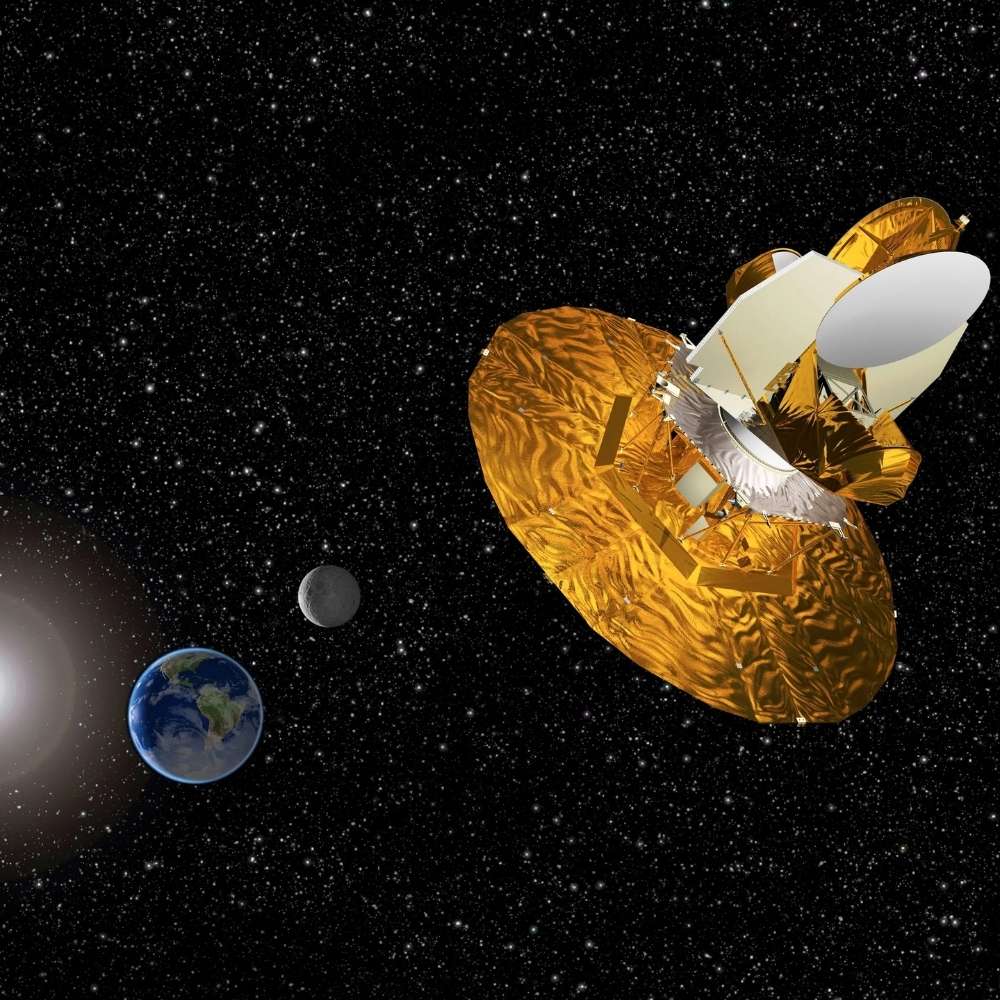
WMAP operated from the Sun–Earth L₂ point, far from Earth’s interference.
This location allowed:
Stable thermal conditions
Continuous sky scanning
Minimal contamination from Earth and Sun radiation
The spacecraft rotated slowly, scanning the sky in overlapping circles.
Over time, these scans combined into full-sky CMB maps with extraordinary accuracy.
How WMAP Measured the Early Universe
WMAP used differential radiometers, comparing the temperature of two sky directions at once.
This method:
Cancelled instrumental drift
Increased sensitivity
Reduced systematic errors
By measuring temperature differences rather than absolute temperature, WMAP achieved the stability required for cosmological precision.
Key Scientific Breakthroughs
WMAP delivered several landmark results:
Age of the Universe: ~13.7 billion years
Composition:
Ordinary matter: ~4–5%
Dark matter: ~23%
Dark energy: ~72%
Geometry: Space is nearly flat
Initial Conditions: Fluctuations consistent with inflation
For the first time, the standard cosmological model was tightly constrained by observation.
Why WMAP Changed Cosmology Forever
WMAP did not merely improve earlier measurements—it locked them in.
Its data:
Ended decades-long parameter debates
Confirmed inflationary predictions
Established the ΛCDM model as the working framework of modern cosmology
From this point forward, cosmology became a precision science.
WMAP vs Earlier CMB Experiments
Before WMAP:
Results varied between experiments
Error bars were large
Models competed without resolution
After WMAP:
Parameters converged
Independent measurements agreed
Theory and observation aligned
WMAP served as the bridge between early detection and modern high-precision cosmology.
Why This Mission Still Matters
Even today:
WMAP data remains scientifically valid
Its results are used as benchmarks
Later missions refined—but did not overturn—its conclusions
WMAP provided the first complete, reliable cosmic blueprint.
WMAP vs Planck – From Precision to Perfection
WMAP and Planck are often mentioned together, but their roles are distinct.
WMAP established the precision era of cosmology.
Planck completed it.
WMAP provided the first reliable full-sky cosmological parameter set. Planck later refined those values with higher resolution and sensitivity—but did not fundamentally change the picture WMAP revealed.
Direct Mission Comparison
| Feature | WMAP | Planck |
|---|---|---|
| Operating Agency | NASA | ESA |
| Launch Year | 2001 | 2009 |
| Angular Resolution | Moderate | Very high |
| Frequency Bands | 5 | 9 |
| Sensitivity | High | Exceptional |
| Sky Coverage | Full sky | Full sky |
| Parameter Precision | Strong | Definitive |
| Scientific Role | Model establishment | Model refinement |
This comparison highlights a key point: Planck did not replace WMAP—it perfected it.
Angular Resolution – Why It Matters
Angular resolution determines how small a structure can be distinguished on the sky.
WMAP could:
Clearly detect large-scale temperature fluctuations
Measure the first few acoustic peaks in the CMB power spectrum
Constrain cosmological parameters with confidence
However, WMAP could not:
Resolve the finest-scale fluctuations
Fully separate foreground contamination at small angular scales
Planck’s higher resolution addressed these limitations—but only because WMAP had already mapped the terrain.
Frequency Coverage and Foreground Removal
One of WMAP’s major strengths was foreground control.
By observing in five microwave frequency bands, WMAP could:
Separate CMB signal from galactic dust
Remove synchrotron and free-free emission
Produce clean cosmological maps
Planck expanded this approach with more bands, but WMAP proved that foreground separation at full-sky scale was achievable.
The Power Spectrum – Where WMAP Excelled
The CMB power spectrum encodes the Universe’s physical properties.
WMAP measured:
The position of the first acoustic peak
The relative heights of multiple peaks
The overall shape of the spectrum
From these measurements, cosmologists derived:
Baryon density
Dark matter density
Expansion rate
Spatial curvature
These were not rough estimates—WMAP delivered tight constraints that held up under later scrutiny.
Confirming Inflation
One of WMAP’s most profound contributions was its support for cosmic inflation.
WMAP data showed:
Nearly scale-invariant fluctuations
Gaussian temperature distributions
No large deviations from inflationary predictions
This strongly favored inflation over competing early-Universe models and eliminated several alternative scenarios.
Polarization Measurements
WMAP also measured CMB polarization, an essential probe of early cosmic processes.
Key outcomes:
Detection of large-scale polarization patterns
Constraints on reionization epoch
Evidence that first stars formed earlier than once believed
Although limited compared to Planck, WMAP’s polarization results were groundbreaking at the time.
What WMAP Could Not Do
Despite its success, WMAP had limitations:
Lower sensitivity to very small angular scales
Limited polarization precision
Reduced ability to probe subtle non-Gaussian signals
These gaps did not undermine WMAP’s conclusions—but they defined the goals for Planck.
Why WMAP Still Holds Scientific Authority
Even today:
WMAP parameters agree closely with Planck results
Its datasets are still cited in research
Its conclusions remain intact
This consistency is rare in science and highlights the mission’s robustness.
WMAP was not an early draft—it was a strong first edition.
WMAP’s Legacy in Modern Cosmology
WMAP transformed cosmology by:
Ending the era of speculative parameter ranges
Establishing the ΛCDM model as observationally grounded
Setting the standard for future space cosmology missions
Every modern cosmological measurement traces its confidence back to WMAP.
WMAP’s Long-Term Scientific Legacy
WMAP was not a temporary step in cosmology—it became a permanent reference point.
Long after the spacecraft stopped operating, its data continues to shape:
Cosmological simulations
Large-scale structure studies
Dark matter and dark energy research
Educational and reference models of the Universe
Few space missions define an entire field. WMAP did.
Did WMAP Settle the Big Bang Model?
WMAP did not prove the Big Bang—it completed it observationally.
Before WMAP:
The Big Bang was strongly supported but loosely constrained
Competing parameter values coexisted
Inflation was plausible but not tightly tested
After WMAP:
The Big Bang model gained precise numerical confirmation
Inflation became the leading early-Universe theory
Alternative cosmologies lost observational support
WMAP transformed consensus into confidence.
Why WMAP Data Still Matters Today
Despite newer missions, WMAP remains relevant because:
Its results are internally consistent
Independent experiments agree with its conclusions
It provides a clean, well-understood baseline dataset
In many analyses, WMAP is used alongside Planck to test robustness and systematics.
Frequently Asked Questions
What did WMAP actually measure?
WMAP measured tiny temperature and polarization differences in the cosmic microwave background across the entire sky.
Is WMAP still operating?
No. The mission ended in 2010 after completing its scientific objectives.
Did Planck replace WMAP?
No. Planck refined WMAP’s measurements but confirmed its conclusions.
How old did WMAP find the Universe to be?
Approximately 13.7 billion years, later refined slightly by Planck.
Why was WMAP placed at Sun–Earth L₂?
To provide a stable thermal and observational environment free from Earth and Sun interference.
Can WMAP data still be accessed?
Yes. All WMAP data is publicly available and widely used in research and education.
WMAP in the Context of Cosmic History
WMAP gave humanity its first accurate portrait of the infant Universe.
By mapping the cosmic afterglow, it connected:
The Universe’s earliest moments
The formation of galaxies
The large-scale structure we observe today
It showed that the cosmos is not random—but governed by precise, measurable laws.
How WMAP Changed Scientific Methodology
WMAP’s success demonstrated that:
Precision cosmology is achievable from space
Systematic errors can be controlled at cosmic scales
The Universe can be measured as reliably as laboratory systems
This philosophy now defines modern observational cosmology.
Related Topics for Universe Map
Cosmic Microwave Background
Planck Mission
Inflation Theory
Dark Matter
Dark Energy
Sun–Earth L₂
These topics together form the backbone of modern cosmological understanding.
Final Perspective
WMAP turned the Universe into a measured system.
Before it, cosmology relied on broad theories and uncertain parameters.
After it, the age, composition, and geometry of the Universe became known quantities.
WMAP did not simply observe the cosmos—it defined its framework.