







Wolf 359
One of the Closest and Faintest Stars to the Sun
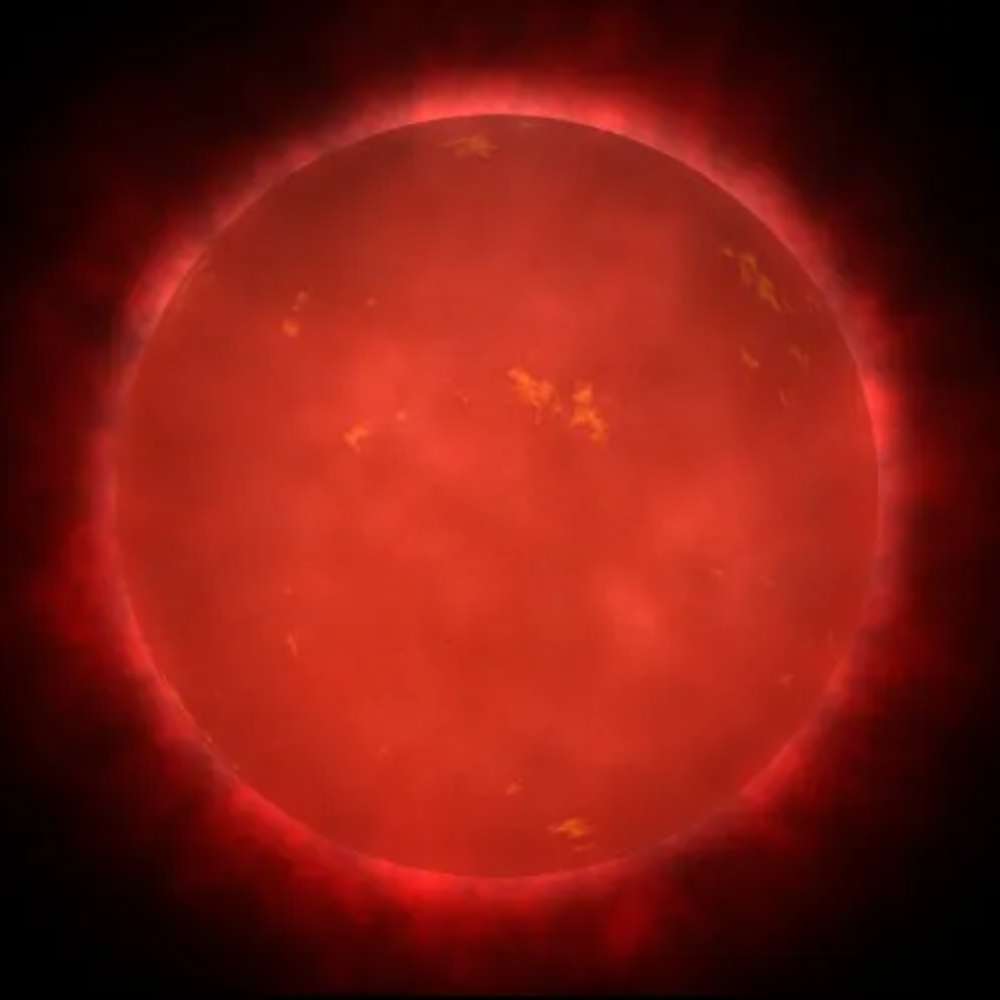
Quick Reader
| Attribute | Details |
|---|---|
| Name | Wolf 359 |
| Catalog Designations | CN Leonis, GJ 406 |
| Star Type | M6 V (Red Dwarf) |
| Constellation | Leo |
| Distance from Earth | ~7.86 light-years (one of the nearest stars) |
| Apparent Magnitude | ~13.5 (invisible to the naked eye) |
| Temperature | ~2,800 K |
| Radius | ~0.16 R☉ |
| Mass | ~0.09 M☉ |
| Luminosity | ~0.001 L☉ (0.1 percent of the Sun) |
| Age | ~100–350 million years (young for a star) |
| Notable Features | Extremely faint, highly active flare star, among the Sun’s closest neighbors |
| Best Viewing Method | Medium-to-large telescopes |
Introduction – A Tiny, Faint, and Fiery Neighbor of the Sun
Wolf 359 is one of the most intriguing stars in our cosmic neighborhood. Located only 7.86 light-years away, it ranks among the top five closest stars to the Sun, alongside Proxima Centauri, Alpha Centauri, Barnard’s Star, and Luhman 16. Despite its proximity, Wolf 359 is completely invisible to the naked eye—a reminder that most stars in the galaxy are small, dim red dwarfs rather than bright suns like Vega or Sirius.
Yet Wolf 359 is anything but quiet. It is a flare star, capable of producing enormous bursts of magnetic activity that dramatically increase its brightness for brief periods. These flares release intense ultraviolet and X-ray radiation, reshaping the star’s immediate environment.
Red dwarfs like Wolf 359 dominate the Milky Way. Studying them helps us understand stellar evolution, habitability, and the future of the galaxy. Wolf 359 stands as a perfect example of the small, long-lived, active stars that make up the majority of our stellar population.
Physical Characteristics of Wolf 359
A Very Cool, Very Small Red Dwarf
Wolf 359 belongs to one of the smallest categories of hydrogen-burning stars:
Temperature: ~2,800 K
Color: Deep red
Radius: ~0.16 times the Sun
Mass: Only ~9 percent of the Sun
It sits close to the lower mass limit required for hydrogen fusion (~0.075 M☉).
Because of its low temperature, most of Wolf 359’s energy is emitted in the infrared, making it much dimmer in visible light.
Luminosity – Among the Faintest Stars Known
Wolf 359 emits only:
0.001 times the Sun’s luminosity
Or one-tenth of one percent of solar brightness
This faint output explains why:
Wolf 359 cannot be seen without a telescope
It was discovered only in the 20th century
Red dwarfs can be extremely numerous without being obvious
If Wolf 359 replaced the Sun, Earth would freeze instantly.
Wolf 359 as a Flare Star
One of Wolf 359’s defining traits is its extreme magnetic activity.
Violent Magnetic Flares
Wolf 359 frequently produces:
Sudden increases in brightness
Intense bursts of ultraviolet radiation
X-ray flares capable of altering its environment
Red dwarfs are fully convective, meaning:
Hot plasma circulates from core to surface
Magnetic field lines twist and tangle
Energy is released violently in flare events
These flares can increase the star’s brightness by several hundred percent for minutes or hours.
Implications for Habitability
Wolf 359’s flares make habitability difficult:
Strong radiation would strip atmospheres of close-orbit planets
Habitability zones are extremely close to the star (~0.03–0.1 AU)
A planet would need a powerful magnetic field to survive
Tidal locking would complicate climate stability
No planets have been confirmed around Wolf 359 so far, and the star’s violent nature may be a contributing factor.
Internal Structure – Fully Convective Physics
Unlike the Sun, which has:
A radiative core
A convective outer layer
Wolf 359 is fully convective.
This means:
Material circulates throughout the entire star
Helium produced by fusion does not accumulate at the core
The star mixes its fuel evenly
Consequences:
Wolf 359 uses hydrogen extremely efficiently
It will live for trillions of years
It will never become a red giant
It will end as a gradually cooling white dwarf after an incomprehensibly long lifespan
Red dwarfs are the ultimate slow-burning stars of the universe.
Chemical Composition and Age
Wolf 359 is:
Metal-poor compared to the Sun
Young (100–350 million years)
Still contracting slightly as it reaches long-term thermal equilibrium
Its low metallicity hints at formation in a different star-forming environment than the Sun.
Wolf 359 in the Constellation Leo
Wolf 359 lies in the constellation Leo, near the lion’s mane. It is not part of the main Leo asterism but sits in a relatively quiet region of the constellation.
Because of its faintness:
Telescopes with at least 8-inch (200 mm) aperture are recommended
Long-exposure astrophotography can reveal the star’s motion over time
Wolf 359 is also one of the fastest-moving stars in the sky, shifting noticeably from decade to decade due to its proximity.
Importance of Wolf 359 in Astronomy
Wolf 359 is significant for several key reasons:
1. A Test Case for Red Dwarf Physics
Red dwarfs are:
The most common stars in the galaxy (75–80 percent)
The longest-lived stars
The hardest to study in visible wavelengths
Wolf 359 offers a rare nearby example.
2. A Laboratory for Stellar Flares
Because of its activity, Wolf 359 helps astronomers:
Study magnetic field generation
Understand atmospheric loss around small stars
Model stellar coronae
3. A Nearby Stellar Neighbor
Wolf 359 is part of the Sun’s immediate stellar neighborhood:
One of the nearest stars
A major contributor to local stellar density
A key member of the solar motion reference frame
Understanding nearby stars is essential for mapping interstellar space.
Internal Physics of Wolf 359 – The Structure of an Ultra-Low-Mass Star
Wolf 359 belongs to the lowest tier of stars that are still capable of hydrogen fusion. Its internal structure is radically different from stars like the Sun.
Fully Convective Interior
Unlike the Sun, which has:
A radiative core
A convective envelope
Wolf 359 is fully convective. This means:
Hot plasma circulates from core to surface
Hydrogen and helium mix uniformly throughout the star
No helium core builds up
Fusion fuel is replenished continuously
Consequences:
Wolf 359 burns hydrogen slowly and uniformly
Its lifespan is measured in trillions of years, far exceeding the current age of the universe
It will never undergo dramatic phases like red giant expansion
It will fade into a white dwarf only at the very end of time
Fully convective stars represent the simplest and most stable fusion engines in the cosmos.
Fusion at the Threshold
At only ~9 percent of the Sun’s mass, Wolf 359 is very close to the lower limit for hydrogen-burning stars:
Minimum mass required: ~0.075 solar masses
Wolf 359: ~0.09 solar masses
This extremely low mass:
Produces weak fusion
Limits surface temperature
Prevents the star from ever becoming bright
It burns so slowly that it will outlive every other star in the solar neighborhood.
Magnetic Activity and Flare Behavior
Despite its dimness, Wolf 359 is highly active magnetically.
Why Red Dwarfs Are Violent
Magnetic fields arise because of:
Full convection
Rapid internal circulation
Rotational effects
Strong dynamo generation
These tangled magnetic fields can erupt explosively.
The Flares
Wolf 359 regularly produces:
UV and X-ray bursts
Optical brightening by several times its normal luminosity
Plasma ejections
Sudden temperature spikes
Flares may last from minutes to hours and release enormous energy relative to the star’s tiny size.
Impact on Space Weather
If Wolf 359 had planets in its habitable zone:
They would orbit extremely close (~0.03–0.1 AU)
Flares would blast them continuously
Atmospheres could be eroded
Habitability would be severely challenged
For this reason, red dwarf habitability is one of the most debated topics in modern exoplanet research.
Wolf 359’s Motion Through Space
Wolf 359’s proximity means its motion is relatively easy to measure.
Proper Motion
Wolf 359 moves rapidly across the sky:
Proper motion: ~4.7 arcseconds per year
One of the highest among nearby stars
It noticeably changes position over a human lifetime.
Radial and Tangential Velocity
Radial velocity: ~19 km/s (moving away from the Sun)
Total space velocity: ~65–70 km/s
This trajectory indicates Wolf 359 is part of the local galactic disk population, unlike halo stars such as Arcturus.
Passing Near the Solar System in the Future
Simulations suggest:
Wolf 359 may pass slightly closer to the Sun in the far future
It will not become a dangerously close star
It contributes to gravitational shaping of the local stellar neighborhood
Nearby red dwarfs help define the Sun’s location within the Milky Way.
Comparison with Other Nearby Red Dwarfs
Wolf 359 is one of several ultra-cool, low-mass neighbors. Comparing them reveals important differences.
Wolf 359 vs Proxima Centauri
| Attribute | Wolf 359 | Proxima Centauri |
|---|---|---|
| Distance | 7.86 ly | 4.24 ly |
| Type | M6 V | M5.5 V |
| Luminosity | 0.1% of Sun | 0.17% of Sun |
| Activity | Strong flares | Very strong flares |
| Planets | None confirmed | Three planets (including Proxima b) |
Proxima is more luminous and more famous, but Wolf 359 is similarly active.
Wolf 359 vs Barnard’s Star
| Attribute | Wolf 359 | Barnard’s Star |
|---|---|---|
| Temperature | 2,800 K | 3,100 K |
| Mass | 0.09 M☉ | 0.14 M☉ |
| Brightness | Extremely faint | Slightly brighter |
| Proper motion | High | Highest known |
Barnard’s Star is older and less active.
Wolf 359 vs TRAPPIST-1
| Attribute | Wolf 359 | TRAPPIST-1 |
|---|---|---|
| Mass | 0.09 M☉ | 0.089 M☉ |
| Luminosity | 0.1% Sun | 0.05% Sun |
| Planets | None known | Seven Earth-sized planets |
| Activity | High | Moderate to high |
TRAPPIST-1 is almost identical in mass but more famous for its multiple planets.
Wolf 359 vs Teegarden’s Star
- Teegarden’s Star is cooler
- Less active
- Hosts potential habitable-zone planets
Wolf 359 represents the more magnetic, violent side of red dwarf behavior.
Wolf 359 and the Search for Exoplanets
Although no planets have been confirmed around Wolf 359, astronomers continue searching.
Why Detection Is Difficult
Faintness makes precision measurements challenging
Flares distort radial velocity data
Small size of the star exaggerates stellar noise
Possible Planetary Zones
The habitable zone (if conditions allowed life) would lie:
At about 0.03–0.05 AU from the star
With orbital periods of a few days
However, flares and radiation pose serious threats to atmosphere retention.
Potential for Earth-Sized Planets
Given its mass:
Wolf 359 could easily host terrestrial planets
But long-term habitability is questionable
Atmospheric erosion is likely
Magnetic shielding would be essential for survival
Future instruments (JWST, ELTs) may detect planets around Wolf 359 through infrared monitoring.
Why Red Dwarfs Like Wolf 359 Dominate the Milky Way
Red dwarfs make up:
About 75–80 percent of all stars
Most of the nearby stellar population
The majority of undiscovered stars
Reasons for their dominance:
Low mass means long lifetimes
Slow fusion extends stellar existence far beyond larger stars
Efficient birth rates in star-forming regions
Wolf 359 is a perfect representative of the galaxy’s most common star type.
Observing Wolf 359 – A Challenge for Amateur Astronomers
Wolf 359 is extremely faint, making it a rewarding but demanding target for telescopic observers.
Naked-Eye Visibility
Wolf 359 is completely invisible to the naked eye.
With a magnitude of ~13.5:
It is more than 10,000 times fainter than the faintest visible stars
Only telescopes can reveal it
Telescope Requirements
To observe Wolf 359, you need:
A medium to large telescope of at least 8 inches (200 mm) aperture
Excellent dark-sky conditions
Patience and detailed star charts
Larger telescopes (10–14 inches) make the star significantly easier to detect.
Star-Hopping Strategy
Wolf 359 is located in the constellation Leo, near:
Regulus
The star 54 Leonis
The upper part of the Lion’s head
Since it does not stand out visually, observers rely on:
Precise coordinate tracking
Comparison with known field stars
Long-exposure astrophotography
Astrophotography of Wolf 359
Capturing Wolf 359 requires:
Long exposures
High-sensitivity cameras
Accurate guiding and plate solving
Astrophotographers can detect its slow movement across the field over months or years, showcasing its proximity.
Wolf 359 in Culture and Science Fiction
Despite being faint and obscure in real astronomy, Wolf 359 is famous in science fiction.
In Star Trek
Wolf 359 is the site of one of the most important battles in the Star Trek universe:
The Battle of Wolf 359
A devastating conflict between the United Federation of Planets and the Borg
Often referenced in stories involving Captain Picard and Commander Sisko
This association made Wolf 359 widely known beyond the astronomy community.
In Other Media
Wolf 359 has appeared in:
Science fiction novels
Video games
Audio dramas (notably the series titled “Wolf 359”)
Its proximity and mysterious faintness make it an ideal setting for speculative storytelling.
Long-Term Evolution and Final Fate
Wolf 359 is one of the most stable and long-lived stars in the galaxy.
Life Expectancy
While the Sun will live ~10 billion years, Wolf 359 will live:
Trillions of years
Possibly longer than the current age of the universe by a factor of 1,000 or more
This makes red dwarfs like Wolf 359 the final survivors of the galaxy when massive stars have long since died.
Future Evolution
Wolf 359 will:
Continue fusing hydrogen extremely slowly
Never expand into a red giant
Gradually brighten over trillions of years
Eventually exhaust its hydrogen evenly
Become a helium white dwarf without ever becoming a giant
This slow, steady path defines the destiny of most stars in the universe.
The Ultimate Timescale
In an unimaginably distant future:
Wolf 359 will cool into a black dwarf
The universe will be cold, dark, and quiet
Red dwarfs will be the last stars shining
Wolf 359 is a cosmic survivor.
Frequently Asked Questions (FAQ)
Why is Wolf 359 so faint?
Because:
It is a very low-mass red dwarf
Its temperature is only ~2,800 K
It emits very little visible light (mostly infrared)
How close is Wolf 359 to Earth?
About 7.86 light-years, making it one of the closest known stars.
Is Wolf 359 dangerous?
No. Despite its flares, the star is too far away to affect Earth.
Does Wolf 359 have planets?
No confirmed planets yet, though searches continue.
Why is Wolf 359 so active?
Because it is:
Fully convective
Magnetically turbulent
Young
Rapidly rotating
These conditions produce frequent flares.
Why does Wolf 359 get used in science fiction?
Its proximity, mystery, and faintness make it ideal for storytelling. The name is also memorable and carries a futuristic feel.
Will Wolf 359 ever be visible to the naked eye?
No. Even if it increased in brightness during a flare, it would never approach visibility thresholds.
Final Scientific Overview
Wolf 359 is one of the Sun’s nearest neighbors, yet one of the faintest stars in our sky. It is an excellent example of the red dwarf majority that dominates the Milky Way. Despite its tiny size and low luminosity, Wolf 359 is:
Highly magnetic
Energetic in flare activity
Extremely long-lived
A key reference for studying red dwarf physics
Its fully convective interior, intense flares, slow evolutionary path, and proximity to Earth make it an invaluable object for astronomers.
Red dwarfs like Wolf 359 will shape the far future of the galaxy long after brighter stars like the Sun have faded. Studying this tiny neighbor reveals the dominant rhythm of stellar evolution throughout cosmic time.