









XMM-Newton
Europe’s Most Powerful X-Ray Eye on the Violent Universe
Quick Reader
| Attribute | Details |
|---|---|
| Mission Name | XMM-Newton |
| Full Form | X-ray Multi-Mirror Mission – Newton |
| Space Agency | ESA (European Space Agency) |
| Mission Type | X-ray space observatory |
| Launch Date | 10 December 1999 |
| Launch Vehicle | Ariane 5 |
| Operating Orbit | Highly elliptical Earth orbit |
| Primary Wavelength | X-ray |
| Main Instruments | EPIC, RGS, OM |
| Mission Status | Operational |
| Design Lifetime | 10 years (greatly exceeded) |
In two sentences
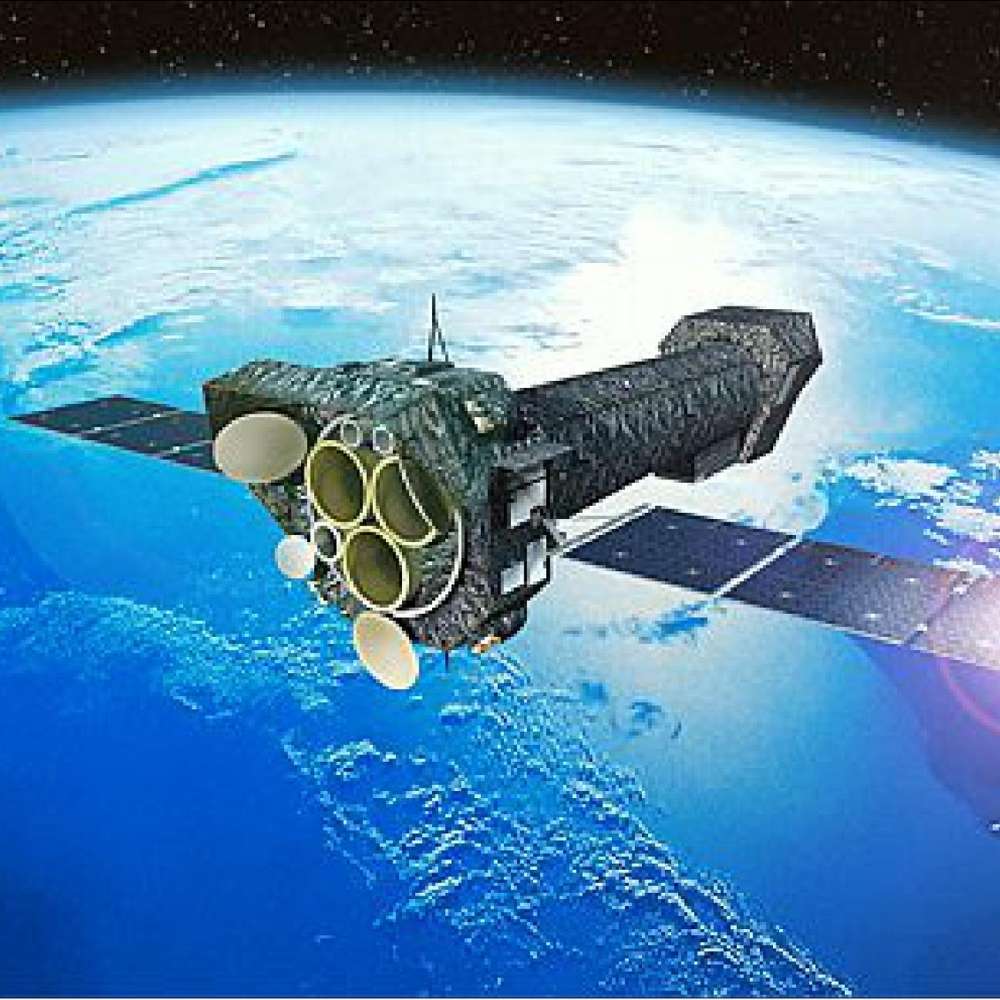
XMM-Newton is ESA’s flagship X-ray observatory, designed to study the most energetic and violent phenomena in the universe. Its unprecedented sensitivity allows astronomers to observe black holes, neutron stars, supernova remnants, and hot galaxy clusters in extraordinary detail.
Key takeaway
If the universe emits extreme energy, XMM-Newton is one of the best tools ever built to detect it.
Best for
High-energy astrophysics, black hole studies, galaxy cluster research, and advanced astronomy readers.
Introduction – Seeing the Universe’s Invisible Violence
The universe looks calm in visible light.
In X-rays, it is anything but.
Exploding stars, matter falling into black holes, neutron stars tearing material from companions—these events release enormous energy that ordinary telescopes cannot see. XMM-Newton was built to reveal this hidden, violent universe by observing X-ray light that never reaches Earth’s surface.
Since its launch, XMM-Newton has transformed our understanding of cosmic extremes.
What Is XMM-Newton?
XMM-Newton is a space-based X-ray telescope that:
Observes high-energy radiation from hot and extreme environments
Uses multiple nested mirrors to collect faint X-ray photons
Combines imaging, spectroscopy, and optical monitoring
Unlike optical telescopes, XMM-Newton does not study stars as they appear—it studies what they are doing at their most energetic moments.
Why X-Ray Astronomy Must Be Done from Space
Earth’s atmosphere absorbs X-rays completely.
This protects life—but blocks observation.
To study X-ray sources, a telescope must operate:
Above the atmosphere
In a stable radiation environment
With long, uninterrupted observing windows
XMM-Newton’s orbit allows it to observe targets for many hours continuously, a critical advantage for studying variable and transient phenomena.
Mission Design – Why “Multi-Mirror” Matters
X-rays cannot be focused like visible light.
They require grazing-incidence mirrors, where photons skim surfaces at shallow angles.
XMM-Newton uses:
Three large mirror modules
58 nested mirrors per module
One of the largest effective collecting areas ever flown for X-ray astronomy
This design allows XMM-Newton to collect far more X-ray photons than earlier missions, making it exceptionally sensitive to faint and distant sources.
Core Scientific Instruments
EPIC – European Photon Imaging Camera
Produces detailed X-ray images
Measures brightness and energy
Ideal for studying supernova remnants, galaxies, and clusters
RGS – Reflection Grating Spectrometer
Provides high-resolution X-ray spectra
Reveals temperature, composition, and motion of hot gas
OM – Optical Monitor
Observes targets in optical and ultraviolet
Enables multi-wavelength comparison
Together, these instruments allow XMM-Newton to study objects across energy ranges simultaneously.
What XMM-Newton Observes Best
XMM-Newton excels at observing:
Black holes and accretion disks
Neutron stars and pulsars
Supernova remnants
Hot gas in galaxy clusters
Active galactic nuclei (AGN)
These objects emit X-rays because their temperatures reach millions of degrees, or because matter is moving at relativistic speeds.
XMM-Newton’s Role in Black Hole Science
One of XMM-Newton’s greatest strengths is studying matter falling into black holes.
It can detect:
X-ray emission from accretion disks
Relativistic broadening of spectral lines
Rapid variability near event horizons
These observations provide indirect evidence of strong gravity and spacetime distortion predicted by general relativity.
Why XMM-Newton Is Still Important Today
Although launched in 1999, XMM-Newton remains scientifically powerful because:
Its sensitivity is still unmatched in key energy ranges
Its instruments remain stable and well-calibrated
Its long operational life provides decades of comparative data
Many modern discoveries rely on archival XMM-Newton observations, making it one of the most valuable data resources in high-energy astronomy.
XMM-Newton in the Context of Space Astronomy
XMM-Newton represents a shift in astronomy:
From static images to energetic processes
From visible light to extreme physics
From single observations to long-term monitoring
It complements optical, infrared, and radio observatories by revealing what happens when matter reaches its physical limits.
XMM-Newton vs Chandra – Two Giants, Two Strengths
XMM-Newton and NASA’s Chandra X-ray Observatory are often compared because they study the same high-energy universe—but they are optimized for different goals.
| Feature | XMM-Newton | Chandra |
|---|---|---|
| Primary Strength | Sensitivity (photon collection) | Angular resolution |
| Mirror Design | Multiple nested mirrors | Fewer, ultra-precise mirrors |
| Best For | Faint, distant sources; spectroscopy | Fine spatial detail |
| Field of View | Large | Smaller |
| Typical Observations | Long, deep exposures | Sharp imaging of compact regions |
Interpretation
Chandra sees sharper.
XMM-Newton sees deeper.
Many of the strongest scientific results come from using both together.
Major Scientific Discoveries Enabled by XMM-Newton
Since launch, XMM-Newton has contributed to thousands of peer-reviewed studies. Its most influential results include:
Detailed mapping of supernova remnants
Measurement of hot gas in galaxy clusters
Long-term monitoring of active galactic nuclei
Discovery and characterization of X-ray flares
Probing extreme environments around neutron stars
These observations revealed how energy moves through the universe on the largest and smallest scales.
Galaxy Clusters – Weighing the Universe
Galaxy clusters are the largest gravitationally bound structures in the universe, and XMM-Newton is one of the best tools to study them.
XMM-Newton observes:
Hot intracluster gas glowing in X-rays
Temperature gradients across clusters
Shock fronts from mergers
From this data, astronomers can infer:
Total cluster mass
Distribution of dark matter (indirectly)
Evolution of large-scale structure
This makes XMM-Newton essential for cosmology, not just astrophysics.
XMM-Newton and Dark Matter Studies
Although XMM-Newton does not detect dark matter directly, it plays a crucial indirect role.
By observing hot gas behavior in clusters, it helps:
Map gravitational potential wells
Test dark matter distribution models
Search for unexplained X-ray emission lines
Several debated dark matter signatures were first noticed—or constrained—using XMM-Newton data.
Active Galactic Nuclei – Watching Black Holes Feed
Active galactic nuclei (AGN) are among XMM-Newton’s most frequent targets.
The telescope can:
Track X-ray variability over hours to days
Measure absorption from surrounding gas
Detect relativistic spectral features
These observations show how supermassive black holes interact with their host galaxies and regulate star formation through energetic feedback.
Neutron Stars and Extreme Physics
XMM-Newton studies neutron stars to probe physics beyond laboratory limits.
It observes:
Thermal emission from neutron star surfaces
Hot spots and magnetic effects
Accretion-powered X-ray bursts
These data constrain:
Neutron star radius
Equation of state of ultra-dense matter
Magnetic field geometry
Few observatories can test fundamental physics this directly.
Long Observations – A Unique Advantage
XMM-Newton’s orbit allows continuous observations lasting many hours, sometimes over a full day.
This is critical for:
Studying variable sources
Detecting faint spectral features
Monitoring gradual changes in emission
Such long, uninterrupted exposures are difficult to achieve with low-Earth orbit observatories.
XMM-Newton in Multi-Wavelength Astronomy
XMM-Newton rarely works alone.
It is often coordinated with:
Optical telescopes
Radio observatories
Gamma-ray missions
Gravitational-wave detectors
This multi-wavelength approach allows astronomers to build a complete physical picture of cosmic events.
Why XMM-Newton Still Dominates Its Niche
Despite newer missions, XMM-Newton remains indispensable because:
Its collecting area is still among the largest
Its spectral capabilities remain unmatched for many targets
Its data archive spans decades
In many cases, XMM-Newton provides the baseline against which newer observations are compared.
The Long-Term Legacy of XMM-Newton
XMM-Newton has far exceeded its original mission goals.
Designed for a nominal 10-year lifetime, it has operated for over two decades, becoming one of the longest-serving and most productive X-ray observatories in history.
Its legacy includes:
One of the largest and most reliable X-ray data archives ever created
Thousands of peer-reviewed scientific papers
Continuous monitoring of cosmic X-ray sources over decades
Establishing Europe as a leader in high-energy astrophysics
In many fields, XMM-Newton data is still the starting reference.
Why XMM-Newton Data Will Remain Valuable for Decades
Even after the mission eventually ends, its scientific value will persist.
This is because:
Long-term datasets are irreplaceable
Variability studies require historical baselines
Many sources evolve on decade-long timescales
Future missions will not replace XMM-Newton’s past—they will build on it.
How Long Can XMM-Newton Continue Operating?
As of now:
The spacecraft remains healthy
Fuel reserves are carefully managed
Instruments remain scientifically productive
ESA continues to extend the mission in multi-year increments.
XMM-Newton is expected to remain operational well into the late 2020s, and possibly beyond, depending on spacecraft health.
XMM-Newton’s Role in the Future of X-Ray Astronomy
XMM-Newton bridges generations of missions.
It connects:
Earlier observatories (ROSAT, ASCA)
Current missions (Chandra, NICER)
Future observatories (Athena)
Athena, ESA’s next-generation X-ray mission, is being designed using lessons learned directly from XMM-Newton’s long operational history.
Why XMM-Newton Still Matters in the Athena Era
Even when Athena launches, XMM-Newton will remain relevant because:
It provides historical comparison
It enables cross-calibration
It supplies legacy targets and context
In astronomy, continuity is as important as resolution.
Frequently Asked Questions (FAQ)
What does XMM-Newton study that optical telescopes cannot?
XMM-Newton observes high-energy X-rays emitted by extremely hot, dense, or violent cosmic environments, such as black holes, neutron stars, and supernova remnants—phenomena invisible in optical light.
Why is XMM-Newton located in a highly elliptical Earth orbit?
This orbit allows long, uninterrupted observations above Earth’s radiation belts, which is essential for studying faint and variable X-ray sources.
Is XMM-Newton still operational today?
Yes.
XMM-Newton remains operational and scientifically active, far beyond its original planned lifetime.
How is XMM-Newton different from Chandra?
Chandra provides sharper images, while XMM-Newton collects more X-ray photons.
XMM-Newton is better suited for deep surveys and spectroscopy of faint objects.
Can XMM-Newton detect black holes directly?
No telescope can see a black hole itself.
XMM-Newton detects X-rays emitted by hot gas spiraling into black holes, allowing astronomers to infer their presence and properties.
Does XMM-Newton help study dark matter?
Indirectly, yes.
By observing hot gas in galaxy clusters, XMM-Newton helps map gravitational potentials dominated by dark matter.
What will eventually replace XMM-Newton?
ESA’s Athena mission is planned as its successor, offering much higher sensitivity and resolution—but it will build upon XMM-Newton’s scientific foundation.
XMM-Newton in the Context of Modern Astronomy
XMM-Newton shows that understanding the universe requires looking beyond visible light.
It connects:
High-energy physics
Gravity and spacetime
Galaxy evolution
Cosmology
By studying the universe at its most energetic, XMM-Newton reveals how cosmic structures live, evolve, and sometimes violently transform.
Related Topics for Universe Map
Chandra X-ray Observatory
Athena Mission
Black Holes
Neutron Stars
Supernova Remnants
Galaxy Clusters
High-Energy Astrophysics
These topics together describe the energetic side of the cosmos.
Final Perspective
XMM-Newton does not show the universe as it looks.
It shows the universe as it acts.
Through its mirrors, astronomers witness matter falling into black holes, stars exploding, and galaxy clusters heating the space between galaxies. Few missions have reshaped our understanding of cosmic violence so completely.
XMM-Newton stands as a reminder that the universe is not only vast and beautiful—but also powerful, extreme, and constantly in motion.