





2011 QF₉₉ (Uranus Trojan)
The First Discovered Trojan Sharing Uranus’s Orbit
Quick Reader
| Attribute | Details |
|---|---|
| Official Designation | (687170) 2011 QF99 |
| Object Type | Transient Uranus Trojan and Centaur |
| Co-orbital Region | Uranus L4 |
| First Observed | 29 August 2011 |
| Discovery Telescope | Canada–France–Hawaii Telescope |
| Observatory | Mauna Kea, Hawaii |
| Semi-major Axis | About 19.1 AU |
| Perihelion | About 15.7 AU |
| Aphelion | About 22.4 AU |
| Orbital Period | About 83 years |
| Orbital Eccentricity | About 0.18 |
| Orbital Inclination | About 10.8° |
| Estimated Diameter | Around 60 km, assuming 5% albedo |
| Measured Albedo | Unknown |
| Rotation Period | Unknown |
| Surface Colour | Not securely measured |
| Confirmed Moon or Rings | None |
| Spacecraft Visits | None |
What Is 2011 QF₉₉?
2011 QF₉₉ is a numbered minor planet occupying a temporary 1:1 mean-motion resonance with Uranus. It is commonly classified as both a Uranus Trojan and a Centaur.
A 1:1 resonance means that the object and Uranus have approximately the same orbital period. It does not mean they follow exactly the same path or remain a fixed distance apart.
Viewed from a reference frame rotating with Uranus, 2011 QF₉₉ follows a looping path around the planet’s leading L₄ region. This type of Trojan movement is known as a tadpole orbit because of its shape in the rotating frame.
The Minor Planet Center now lists the object with the permanent number 687170. It has not received a separate proper name, so it continues to be known by its provisional-style designation, 2011 QF₉₉.
Discovery of 2011 QF₉₉
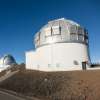
2011 QF₉₉ was found during a survey conducted with the Canada–France–Hawaii Telescope on Mauna Kea in Hawaii. The project searched for trans-Neptunian objects and bodies travelling through the region of the giant planets.
The object was first recorded on 29 August 2011. Additional observations during 2011 and 2012 allowed astronomers to calculate its orbit with increasing accuracy.
At the time of detection, it was approximately 20.3 AU from the Sun and had an apparent r-band magnitude of about 22.6. Its faintness explains why a large telescope and repeated observations were required to identify and track it.
The discovery team included Mike Alexandersen, Brett Gladman, Sarah Greenstreet, J. J. Kavelaars, Jean-Marc Petit and Stephen Gwyn. The object’s identification as a Uranian Trojan was reported in a 2013 study.
The discovery was important because no Uranus Trojan had previously been securely identified. Earlier dynamical work suggested that the Trojan regions of Uranus were largely unstable over the age of the Solar System. 2011 QF₉₉ showed that temporary capture was still possible.
Why Is It Called a Uranus Trojan?
Trojan objects occupy a 1:1 orbital resonance with a planet and librate around one of two principal regions:
- L₄, approximately 60 degrees ahead of the planet
- L₅, approximately 60 degrees behind the planet
2011 QF₉₉ librates around Uranus’s L₄ region, so it travels ahead of Uranus on average.
The object is not stationary at an exact point 60 degrees in front of the planet. Its resonant angle oscillates over time, causing it to move across a broad region around L₄.
Simulations of its motion produce a libration period of roughly 5,900 years. This means that one complete long-term oscillation around the L₄ region takes several thousand years.
The Orbit of 2011 QF99
The orbit of 2011 QF99 closely matches the average orbital distance of Uranus.
The original discovery study calculated a semi-major axis of approximately 19.09 AU, compared with roughly 19.2 AU for Uranus. Updated orbital solutions vary slightly with the observational epoch, so rounded values are more appropriate for a general information page.
| Orbital Property | Approximate Value |
|---|---|
| Semi-major Axis | 19.1 AU |
| Perihelion Distance | 15.7 AU |
| Aphelion Distance | 22.4 AU |
| Orbital Period | 83 years |
| Eccentricity | 0.18 |
| Inclination | 10.8° |
One astronomical unit, or AU, is the average distance between Earth and the Sun.
An eccentricity of approximately 0.18 means the object’s orbit is moderately elongated. It travels significantly closer to and farther from the Sun during each revolution.
Its orbital inclination of about 10.8 degrees means that its path is tilted relative to the main plane of the planets.
Despite sharing Uranus’s average orbital period, 2011 QF99 does not remain close to the planet. The Trojan resonance helps organise its motion so that it avoids ordinary close encounters with Uranus while it remains trapped.
Is Its Trojan Orbit Permanent?
2011 QF₉₉ is not believed to be a primordial Trojan that has remained beside Uranus since the formation of the Solar System.
The discovery team tested its orbit using numerical integrations. The nominal orbit and alternative trajectories allowed by the observational uncertainties remained around the Uranian L₄ region for at least approximately 70,000 years into the simulated future.
Over longer intervals—roughly 100,000 years to one million years—the simulated trajectories left the L₄ Trojan region. Some entered other Uranian co-orbital configurations before returning to scattering Centaur-like motion.
The safest description is therefore:
2011 QF₉₉ is a temporary Uranus Trojan that is expected to remain near L₄ for at least tens of thousands of years, but not for the entire age of the Solar System.
Estimated Size of 2011 QF₉₉
The diameter of 2011 QF₉₉ has not been measured through thermal observations or resolved imaging.
Its absolute magnitude is approximately 9.7. Researchers estimated a diameter close to 60 kilometres by assuming a geometric albedo of 0.05. This albedo value was not measured for the object; it was adopted as a reasonable assumption for a dark outer Solar System body.
The real diameter could be smaller if the surface is more reflective or larger if it is darker. The most accurate wording is therefore:
2011 QF₉₉ may be approximately 60 kilometres across, assuming a geometric albedo of 5%.
It should not be described as definitely 60 kilometres wide.
What Does 2011 QF₉₉ Look Like?
The physical appearance of 2011 QF₉₉ remains unknown.
No reliable published measurement has established its:
- Surface colour
- Spectral type
- Geometric albedo
- Rotation period
- Shape
- Surface composition
- Mass or density
As a result, it should not automatically be portrayed as red, grey, icy or rocky. Its connection with the Centaur population suggests that it may contain primitive outer Solar System material, but this does not identify its actual surface composition.
A scientifically responsible illustration may show it as a small, irregular and dark-looking body, provided the image is clearly presented as an artistic interpretation rather than a direct observation.
Where Did 2011 QF₉₉ Come From?
2011 QF₉₉ was probably a scattering Centaur before it became temporarily trapped in a 1:1 resonance with Uranus.
The discovery team modelled a Centaur population supplied from the trans-Neptunian region. Their simulations showed that passing Centaurs can temporarily enter co-orbital relationships with Uranus and Neptune. This supports the interpretation that 2011 QF₉₉ was not formed in its present Trojan configuration.
Its exact formation location cannot be recovered from its current orbit. Centaur trajectories are chaotic, and small uncertainties become increasingly significant when calculations are extended far into the past.
It is therefore safer to say that 2011 QF₉₉ probably originated in a distant outer Solar System population before gravitational scattering brought it into Uranus’s region.
How Did Uranus Capture It?
Uranus did not capture 2011 QF₉₉ as a moon. The object remains in orbit around the Sun.
Instead, gravitational interactions placed it in a temporary 1:1 mean-motion resonance with Uranus. In this state, its average orbital period is similar to that of the planet, while its relative position oscillates around the leading L₄ region.
Later dynamical research found that the capture and eventual escape of 2011 QF₉₉ are influenced by interactions involving several giant planets. Simulations indicate that brief resonances with Jupiter and Neptune contribute to transitions into and out of the Trojan state, while Saturn also produces an important destabilising influence.
The object’s motion is therefore governed by the combined gravitational architecture of the outer Solar System rather than Uranus alone.
The Future of 2011 QF₉₉
Numerical integrations in the discovery study showed 2011 QF₉₉ remaining near the Uranian L₄ region for more than 70,000 years. It may continue as a broader Uranus co-orbital for approximately one million years before returning to ordinary Centaur-like motion.
These timescales are model results rather than exact departure dates. Long-term predictions become uncertain because small differences in the starting orbit can lead to different outcomes.
Possible future stages include:
- Leaving the L₄ Trojan configuration
- Entering a horseshoe or quasi-satellite orbit
- Returning to a scattering Centaur orbit
- Experiencing further encounters with the giant planets
- Moving inward or outward through the planetary region
- Eventually being ejected from the planetary system
Its present Trojan state is best understood as one temporary chapter in a much longer dynamical journey.
How Common Are Temporary Uranus Co-orbitals?
The discovery of 2011 QF₉₉ suggested that temporary co-orbital objects may be more common than the small number of discoveries implies.
The discovery team’s model estimated that, at a given time, approximately 0.4% of the relevant Centaur population could be temporarily co-orbital with Uranus. The corresponding estimate for Neptune was about 2.8%. The authors noted that these population estimates were accurate only to roughly a factor of two.
Most such objects are extremely faint and move slowly across the sky. They are also difficult to recognise because astronomers need observations collected over a sufficient period to distinguish Trojan motion from an ordinary Centaur orbit.
2011 QF₉₉ may therefore represent a larger, continuously changing population of temporary companions.
Why Was Its Discovery Important?
2011 QF₉₉ was the first object discovered and securely identified as a Uranus Trojan.
Before its identification, Uranus was known to have co-orbital objects, but no confirmed object had been shown to librate around one of its Trojan regions. The discovery demonstrated that the planet can temporarily acquire L₄ or L₅ companions even though much of the Uranian Trojan region is unsuitable for permanent stability.
The object is important because it helps astronomers investigate:
Temporary Resonant Capture
Its orbit shows how a passing Centaur can enter a temporary gravitational relationship with a planet without becoming a satellite.
Centaur Migration
Its probable history helps connect the trans-Neptunian region with the population of unstable bodies moving among the giant planets.
Multi-planet Dynamics
Its evolution demonstrates how Jupiter, Saturn, Uranus and Neptune can collectively influence one small object.
Hidden Co-orbital Populations
Its discovery indicates that additional temporary Uranian companions may remain undetected.
What Remains Unknown?
Astronomers still do not know:
- Its measured diameter and albedo
- Its true shape
- Its rotation period
- Its surface colour
- Its chemical composition
- Whether surface ice is present
- Its mass and density
- Whether it has a small satellite
- Its exact capture date
- Its precise future escape time
No spacecraft has observed 2011 QF₉₉ at close range, so current knowledge is dominated by astrometry and numerical studies of its orbit.
Frequently Asked Questions
What is 2011 QF₉₉?
2011 QF₉₉ is a Centaur temporarily sharing Uranus’s orbital region. It librates around the planet’s leading L₄ region and is classified as a transient Uranus Trojan.
Does it orbit Uranus?
No. It orbits the Sun independently. Its orbital period and average distance are similar to those of Uranus because the two objects are in a 1:1 mean-motion resonance.
How large is 2011 QF₉₉?
It is estimated to be about 60 kilometres across if its geometric albedo is 0.05. Its actual albedo and diameter have not been measured.
How long is its orbital period?
It takes approximately 83–84 Earth years to complete one orbit around the Sun, close to Uranus’s orbital period.
Is it permanently located at L₄?
No. Its position oscillates around the broad L₄ region, and numerical simulations indicate that the Trojan configuration is temporary.
What colour is 2011 QF₉₉?
Its surface colour has not been securely established through published physical observations.
Is it an asteroid or a Centaur?
It is a numbered minor planet dynamically classified as a Centaur. Its current resonant behaviour also makes it a temporary Uranus Trojan.
Does it pose a threat to Earth?
No known present impact threat exists. Its orbit remains in the distant outer Solar System and does not cross Earth’s orbit.
Conclusion
2011 QF₉₉ is one of the most unusual known objects associated with Uranus.
It does not orbit the planet as a moon, nor is it a permanent companion left over from the formation of the Solar System. Instead, it is probably a Centaur that became temporarily trapped in Uranus’s 1:1 orbital resonance.
Its discovery provided the first confirmed example of a Uranus Trojan and showed that transient co-orbital capture is an active process in the modern Solar System.
Although its physical properties remain largely unknown, its orbit provides valuable evidence about how small bodies migrate between the distant trans-Neptunian region and the giant planets. Eventually, gravitational perturbations are expected to remove it from the L₄ region and return it to a more typical Centaur orbit.