





Milky Way Galaxy 3D Map
Map settings
Render on interaction.
Model particles represent stellar populations. They are not individually catalogued stars. Camera rotation changes your viewpoint; it does not advance Galactic time.
Our home galaxy, from its central bar to the Solar System
Find our place in the galaxy
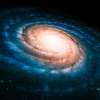
The Milky Way is the galaxy that contains the Sun, Earth and the rest of our Solar System. This explorer connects a three-dimensional model of its overall structure with catalogue-based objects. Begin with the inclined galaxy view, turn it face-on to follow the arms, or view it edge-on to understand the disc.
The bright particles in the whole-galaxy view represent stellar populations. They are illustrative tracers rather than individually identified stars. Measured star-forming regions and the selected nearby-star sample have their own catalogue information. Read the view caption and object card to see which kind of information you are exploring.
Choose a scale to explore
See the galactic structure
Compare the central concentration, elongated bar, disc and surrounding halo from different directions. Component visibility helps reveal how they overlap.
Follow the spiral pattern
Compare arm guides with measured star-forming regions. Select a record to inspect its name, position, parallax and source information.
Meet our stellar neighbours
Switch to a bounded, Sun-centred sample of nearby stars. Search catalogue records and inspect their estimated distances.
Locate Sagittarius A*
Find the central black hole within its wider galactic setting. Its marker is enlarged to remain selectable at this scale.
Explore the surroundings
Compare selected satellite galaxies and globular clusters with the Milky Way. This is a curated set with source information, rather than a complete inventory.
Open the Solar System
Enter a detailed planetary view on this page. Return to the galaxy to see how this small system fits into its much larger home.
Understand the structure
A disc is the broad, flattened part of the galaxy. Its stellar populations have different vertical distributions, while gas and dust help outline star-forming regions. The central bar is elongated; the bulge is the denser central concentration. A more extended stellar halo surrounds the disc. These components overlap rather than forming solid shells. NASA’s overview of Milky Way anatomy ↗
The visual reference for this revision is ESA’s 2025 Gaia-informed artist’s impression: a prominent elongated bar within a broad stellar disc, with less conspicuous spiral structure. Our light and dust are generated as a three-dimensional volume, so the same structure can be examined face-on and edge-on. The colours, fine dust patterns and uncertain arm extensions are illustrative. They are not a direct reconstruction of Gaia’s complete data or an exact copy of the ESA artwork. Visual reference: ESA/Gaia/DPAC, Stefan Payne-Wardenaar ↗
Dust changes what can be seen through the galaxy. The dark lanes and colour treatment here help explain that structure; they do not reproduce a calibrated telescope image. A dark region in the rendering does not establish that a region contains no stars.
What is measured, and what is modelled?
| Map layer | Basis | How to interpret it |
|---|---|---|
| Galaxy light and dust | Illustrative population model | Overall appearance, not a star-by-star census |
| Arm guides | Published spiral-arm fits | Inferred geometry over specified ranges |
| Maser tracers | Radio parallax measurements | Individual star-forming-region records |
| Nearby stars | Selected Gaia catalogue data | Measured astrometry with estimated distances |
| Surrounding objects | Referenced object positions | Selected galaxies and clusters with enlarged markers |
Reid and colleagues used radio observations of molecular masers near young, massive stars to trace Galactic structure. The adopted Sun–centre radius here is 8.15 kiloparsecs, approximately 26,600 light-years. Arm guides describe fitted geometry; sparse coverage and distance uncertainty leave parts of the pattern less securely constrained. Reid et al. (2019) ↗
Nearby-star distances also carry uncertainty. A parallax is an angular measurement, and converting it into a distance requires care, particularly for less precise measurements. The catalogue selection and distance method are documented with the map’s data. The nearby view is a retained sample with observational limits. Guide to Gaia-based distance estimates ↗
Read the view and its scale
The galaxy and nearby-star views use different physical scales. Object markers and particle sizes are enlarged for clarity; the scale bar describes spatial distances at the current focus depth. Opening the Solar System changes scale again, allowing planets and their orbits to be explored clearly. Use Back to Milky Way to restore the galactic context.
The galaxy scene is static. Camera rotation changes your viewpoint, and a guided tour moves between selected views. These controls do not advance the stars through a physical simulation of Galactic history. The Solar System view identifies its own animation and distance settings.
Questions about this explorer
Is this a photograph of the Milky Way from outside?
No. We observe our galaxy from within it. The overall view is a research-informed reconstruction. ESA’s Gaia-based face-on illustration is also explicitly described as an artist’s impression. ESA’s explanation ↗
Can I see every star in the Milky Way?
No. The overview uses representative particles, while catalogue layers contain defined selections. The displayed count belongs to that layer or sample, not to the galaxy’s total stellar population.
Why do the spiral arms have uncertain positions?
Different tracers and distance methods sample different parts of the galaxy. New measurements can revise the reconstruction. A 2026 Chandra/XMM study, for example, found different outer-arm distances along particular sightlines; it does not establish one uniform correction for every arm. Chandra’s research summary ↗
Is the centre a giant visible black ball?
The galaxy-scale marker identifies a location. Sagittarius A* itself is far too small to draw to scale in this overview. The Event Horizon Telescope’s image shows emission around the black hole and a central shadow at an entirely different scale. EHT observation explained by ESO ↗
Sources and further reading
This release retains 199 maser catalogue entries, seven fitted arm segments and a selected sample of 20,000 Gaia DR3 stars within a nominal 200 pc. The surroundings layer includes 11 selected classical satellite galaxies from the January 2021 McConnachie compilation and 157 globular clusters from the historical Harris 2010 edition. These dated selections are not current complete object counts.
The nearby sample uses ESA Gaia data processed by the Gaia Data Processing and Analysis Consortium, with geometric distances from Bailer-Jones and colleagues. Distance medians and uncertainty bounds are retained. Galaxy-wide light and dust are generated specifically for this explorer.
- Reid et al. (2019): Galactic maser parallaxes and spiral structure
- ESA Gaia Archive · Bailer-Jones et al.: stellar distance estimates
- ESA: the Gaia-based Milky Way reconstruction
- NASA Goddard: Milky Way anatomy
- Chandra: updated outer-arm distance measurements
- McConnachie: nearby galaxy compilation, January 2021 update
- Harris: Milky Way globular clusters, 2010 edition