









Nearest Sun-Like Star
Alpha Centauri A: Nearby Sun-Like Star and Planet Candidate
Alpha Centauri A is the closest Sun-like star to Earth, a G2 V star in the nearest stellar system and one of the most important targets in the search for planets around stars like the Sun.
This guide explains its stellar properties, binary orbit with Alpha Centauri B, relationship to Proxima, habitable-zone searches, and the latest cautious evidence for a possible giant planet candidate.
System Preview
Explore Alpha Centauri A in the Nearest Triple System
The preview shows the bright A star, its binary companion, a simplified habitable-zone ring, and Proxima as a distant member. It is built for quick understanding, not physical scale.
Alpha Centauri A Quick Facts
This star is a near-solar twin in the closest stellar system. It is slightly more massive, larger, and more luminous than the Sun, while still sharing the same broad G-type main-sequence classification.
| Attribute | Details |
|---|---|
| Name | Alpha Centauri A, also called Rigil Kentaurus and HD 128620 |
| Star type | G2 V main-sequence star, broadly similar to the Sun |
| Distance | About 1.35 parsecs, or about 4.37 light-years |
| Mass and radius | About 1.1 solar masses and roughly 1.2 solar radii |
| Binary orbit | Orbits Alpha Centauri B in roughly 80 years |
| Planet status | No confirmed planet around the star, but a giant planet candidate has been reported from direct-imaging evidence |
What Is Alpha Centauri A?
Alpha Centauri A is the brighter and more Sun-like member of the close Alpha Centauri AB binary. Together with Alpha Centauri B and the distant red dwarf Proxima Centauri, it belongs to the nearest known star system to the Sun.
It is important because it gives astronomers a nearby version of a solar-type star to measure in extreme detail. Its brightness, proximity, and similarity to the Sun make it a prime target for stellar physics and exoplanet searches.
Alpha Centauri A as a Sun-Like Star
The star shares the Sun's G2 V spectral class, but it is not an exact solar clone. It is somewhat more massive, larger, and brighter, with a temperature close to the Sun's and a slightly different chemical profile.
Those small differences matter. A brighter star places its Earth-like insolation zone farther out than Earth's orbit, and a higher mass means a somewhat faster long-term stellar evolution path.
Alpha Centauri A Distance and Visibility
The system sits about 4.3 light-years away, making it extraordinarily close by galactic standards. From the southern sky, the combined light of A and B appears as one of the brightest points in the night.
It is not visible from much of the Northern Hemisphere. For southern observers, it is a famous guide near the Southern Cross region and a landmark in Centaurus.
Alpha Centauri A and B Binary Orbit
The two bright stars orbit a shared center of mass in about 80 years. Their separation changes from roughly Saturn-like to Neptune-like solar-system distances, so the pair is close as stars go but wide enough for stable inner planetary zones.
NASA summaries describe the A and B stars as close binary companions, while Proxima is a much more distant member. That architecture makes the system a natural laboratory for how planets can form and survive in binary-star environments.
Alpha Centauri A Stellar Properties
Measurements place the star near 1.1 solar masses and around 1.2 solar radii. Its luminosity is commonly given near 1.5 times the Sun's luminosity, which is why a planet receiving Earth-like energy would orbit farther out than Earth does.
Alpha Centauri A Activity and X-rays
Chandra monitoring reported that planets around the two bright Alpha Centauri stars would not be hit by unusually high X-ray radiation compared with the Sun. In that respect, the A star is a more comfortable target than flare-active Proxima.
That does not prove habitability. It only means the radiation environment is not an obvious deal-breaker in the same way it can be around many active red dwarfs.
Alpha Centauri A Habitable Zone
Because the star is more luminous than the Sun, a temperate orbit would sit farther out than Earth's orbit. Research on direct imaging often places the relevant zone around arcsecond-scale separations on the sky, which is unusually favorable because the system is so close.
The binary companion adds dynamical limits, but simulations and observational studies show that stable planetary orbits can exist close to either A or B. The key challenge is detection, not basic orbital possibility.
Alpha Centauri A Planet Candidate
No planet is confirmed around the star as of the current public evidence. However, the NEAR experiment reported a possible source in 2021, and NASA highlighted 2025 Webb observations that provide strong evidence for a gas giant candidate around the A star.
The candidate is not an Earth twin. NASA describes it as possibly about Saturn mass, and if confirmed it would be a gas giant rather than a life-supporting rocky world. The exciting part is proximity: a confirmed planet here would be one of the best exoplanets for direct study.
For SEO and trust, this page should say candidate until follow-up observations confirm orbit, nature, and whether the signal is planetary rather than dust or instrument-related.
Why Alpha Centauri A Planets Are Hard to Detect
The star is close, but it is also bright, moves quickly across the sky, and sits near another bright companion. Those traits create glare, calibration challenges, and background-subtraction problems for direct imaging.
Radial-velocity work is also difficult because very small planetary signals must be separated from stellar activity, binary motion, and instrumental noise. Past claims in the Alpha Centauri system have shown why caution is necessary.
Alpha Centauri A and JWST Evidence
NASA's 2025 Webb report is important because MIRI observations produced the strongest evidence to date for a giant planet around the star. The result is exciting, but still requires confirmation from additional observations and orbit tracking.
This is exactly the kind of update the page should surface early. It gives users a current reason to keep reading while keeping the science careful: strong evidence is not the same as a confirmed planet.
Alpha Centauri A Compared With the Sun
The star is close enough and similar enough that it acts as a nearby solar benchmark. The comparison is not just poetic; it helps calibrate stellar models and frame the question of whether Sun-like stars commonly host planets in stable temperate zones.
| Property | Alpha Centauri A | Sun |
|---|---|---|
| Spectral type | G2 V | G2 V |
| Mass | About 1.1 solar masses | 1 solar mass |
| Radius | About 1.2 solar radii | 1 solar radius |
| Luminosity | About 1.5 solar luminosities | 1 solar luminosity |
Alpha Centauri A, B, and Proxima
The full system contains three stars. A and B form the close bright binary, while Proxima is a distant red dwarf companion and currently the nearest individual star to the Sun.
Proxima has confirmed planets, including Proxima b and d in current NASA Exoplanet Archive listings, while planets around A and B remain more difficult to confirm. That contrast gives the system a useful storytelling shape: the faint star already has known planets, while the Sun-like stars remain the prize targets.
Future Missions to Alpha Centauri A
Future direct-imaging instruments, extremely large telescopes, and mission concepts such as TOLIMAN and Breakthrough Watch keep the system near the top of exoplanet search lists. The reason is simple: distance makes everything easier to study once a planet is found.
An atmosphere around a nearby planet would be more accessible to spectroscopy than a similar planet hundreds of light-years away. That is why the system remains a flagship target for the search for nearby worlds.
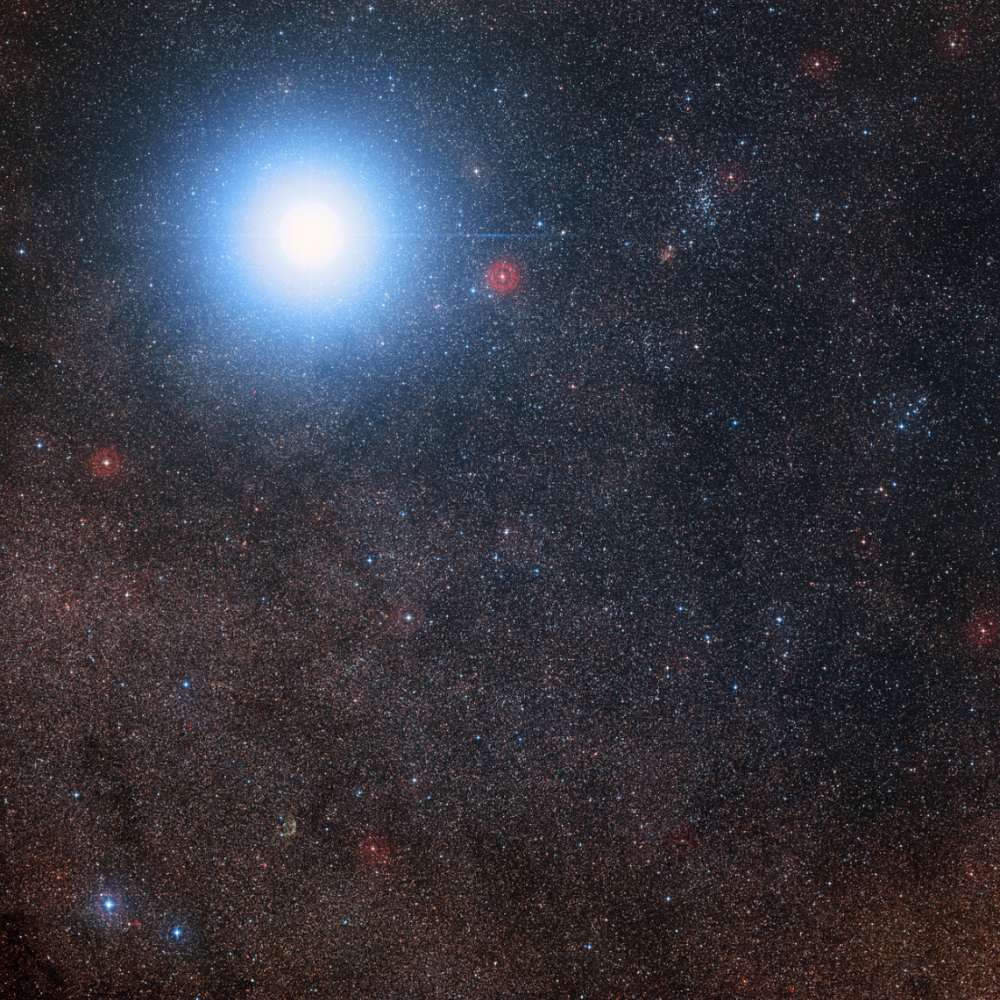
How to Read the Alpha Centauri A Image
The image should be read as a wide-field star view, not as a resolved surface image of the star. Even Hubble shows the system as bright points of light, because stars remain physically tiny at interstellar distances.
The value of the image is context: it shows the brightness and sky environment of the nearest Sun-like star while the article explains what spectroscopy, astrometry, X-rays, and infrared imaging reveal beneath the point of light.
Alpha Centauri A FAQ
Is Alpha Centauri A the closest Sun-like star?
Yes. It is the closest Sun-like star to Earth, while Proxima Centauri is the closest individual star overall.
Does it have a confirmed planet?
No confirmed planet is listed around the star, but direct-imaging observations have produced an important giant planet candidate that needs confirmation.
Is it exactly like the Sun?
No. It has the same broad G2 V class but is slightly more massive, larger, and more luminous than the Sun.
Could it host an Earth-like planet?
Stable temperate orbits are possible, but no Earth-like planet has been confirmed there.
Why is the system hard to observe?
The stars are extremely bright and close together on the sky, which makes faint planet detection technically difficult.