




Kuiper Belt
The Frozen Frontier Beyond Neptune
Quick Reader
| Attribute | Details |
|---|---|
| Name | Kuiper Belt |
| Type | Circumstellar debris disk |
| Location | Beyond Neptune’s orbit |
| Distance from Sun | ~30 AU to ~50 AU |
| Shape | Flattened, disk-like region |
| Composition | Ices (water, methane, ammonia), rock |
| Major Populations | Classical, Resonant, Scattered |
| Notable Objects | Pluto, Haumea, Makemake, Quaoar |
| Discovery Era | Theoretical: 1950s; Observational: 1990s |
| Related Regions | Scattered Disk, Oort Cloud |
| Scientific Importance | Planet formation, Solar System evolution |
Introduction to the Kuiper Belt – Where the Solar System Fades
Beyond the orbit of Neptune lies a vast, cold region filled with icy remnants from the birth of the Solar System. This region, known as the Kuiper Belt, marks the transition from the familiar planetary realm to the deep outer frontier where sunlight weakens and time seems to slow.
The Kuiper Belt is not empty space. It is a structured population of millions of frozen bodies, ranging from small comet-like fragments to large worlds comparable in size to planets. These objects are leftovers from planetary formation—material that never became part of a major planet.
Understanding the Kuiper Belt is essential to understanding how the Solar System formed and why it looks the way it does today.
Historical Origins – From Theory to Discovery
The idea of a distant belt of icy bodies was proposed long before it was observed.
In the mid-20th century:
Astronomers noticed the source of short-period comets could not be explained by known planets
Gerard Kuiper and Kenneth Edgeworth independently suggested a distant reservoir of small icy objects
For decades, the Kuiper Belt remained hypothetical due to the limits of telescope technology.
That changed in 1992, when the first Kuiper Belt object beyond Pluto was discovered. This single observation confirmed the existence of an entire new region of the Solar System.
Where the Kuiper Belt Is Located
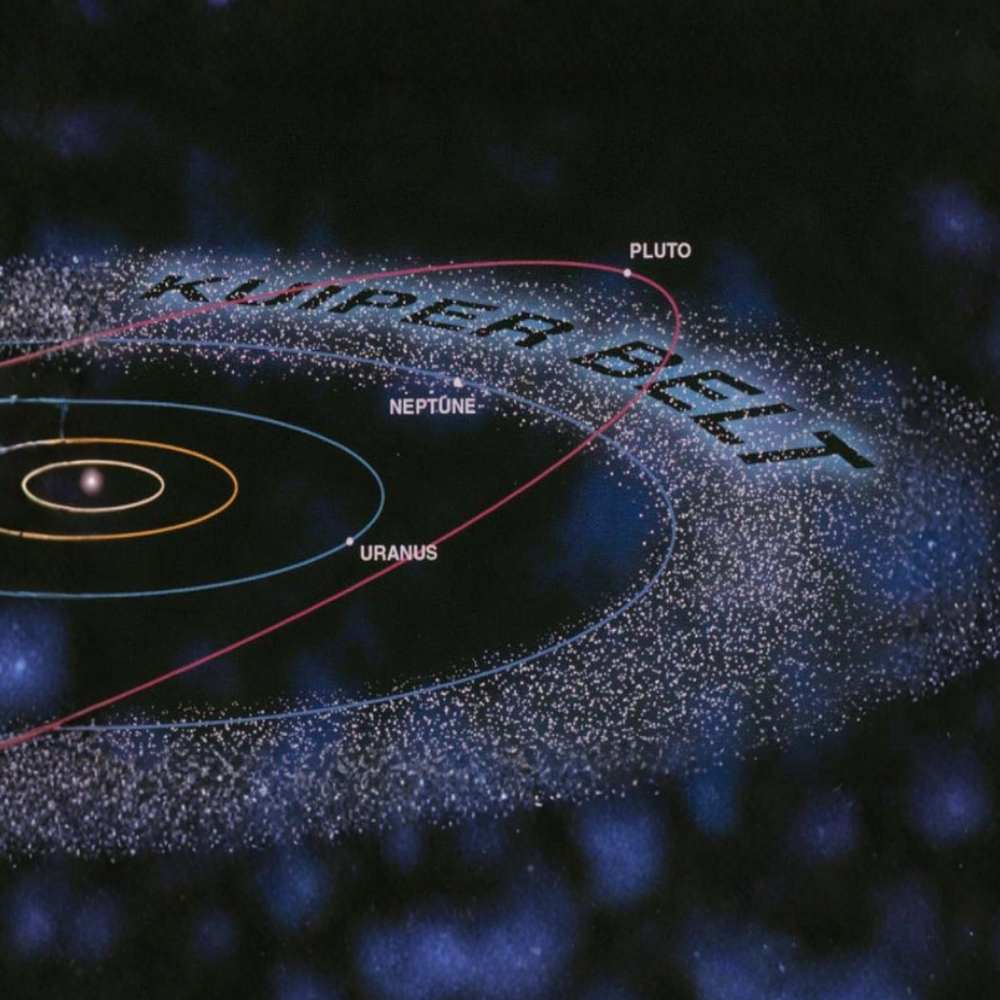
The Kuiper Belt begins just beyond Neptune’s orbit.
Key spatial characteristics:
Inner edge near 30 AU
Outer edge around 50 AU
Relatively flat compared to the spherical Oort Cloud
Its disk-like shape reflects the same rotating plane in which the planets formed.
What the Kuiper Belt Is Made Of
Kuiper Belt objects are composed primarily of primordial material.
Typical composition includes:
Water ice
Methane ice
Ammonia ice
Rocky material
These objects have remained largely unchanged for billions of years, making them natural archives of early Solar System chemistry.
Size and Population of Kuiper Belt Objects
The Kuiper Belt contains:
Millions of objects larger than 1 km
Thousands larger than 100 km
Several large bodies over 1,000 km in diameter
Among these are dwarf planets, including Pluto, Haumea, and Makemake. These bodies are massive enough for gravity to shape them into near-spherical forms.
Pluto and the Kuiper Belt Connection
Pluto was once considered an odd planet. The discovery of the Kuiper Belt revealed its true context.
Pluto is now understood to be:
One of the largest Kuiper Belt objects
Part of a resonant population locked in a 3:2 orbital resonance with Neptune
A representative of a broader class of icy worlds
The Kuiper Belt transformed Pluto from an exception into an example.
Orbital Dynamics – A Structured Region
Kuiper Belt objects do not all orbit the same way.
Their orbits are influenced by:
Neptune’s gravity
Early planetary migration
Resonant interactions
This has created a dynamically organized region rather than a random cloud of debris.
Why the Kuiper Belt Matters
The Kuiper Belt is crucial because it:
Preserves material from the Solar System’s formation
Explains the origin of short-period comets
Provides context for dwarf planets
Serves as a model for debris disks around other stars
Many exoplanetary systems show similar outer belts, making the Kuiper Belt a universal blueprint rather than a local anomaly.
The Main Populations of the Kuiper Belt
The Kuiper Belt is not a single, uniform swarm of objects. Instead, it is divided into several dynamically distinct populations, each shaped by gravity and the early migration of the giant planets.
Understanding these populations helps explain why objects like Pluto, Haumea, and Makemake follow very different orbits despite sharing the same general region.
Classical Kuiper Belt Objects – The Cold Disk
Classical Kuiper Belt Objects (often called Cubewanos) occupy relatively stable, near-circular orbits between about 42 and 48 AU.
Key characteristics:
Low orbital eccentricity
Low inclination relative to the Solar System’s plane
Minimal interaction with Neptune today
These objects are considered the most pristine remnants of the original protoplanetary disk, largely untouched since formation.
They form the structural backbone of the Kuiper Belt.
Resonant Kuiper Belt Objects – Locked with Neptune
Resonant objects orbit the Sun in precise gravitational ratios with Neptune.
The most famous example is Pluto, which follows a 3:2 resonance, completing two orbits for every three orbits of Neptune.
Other resonances include:
2:1
5:2
7:4
Resonant objects:
Are protected from close encounters with Neptune
Were captured during Neptune’s outward migration
Show how planetary motion reshaped the outer Solar System
This resonance trapping explains why Pluto’s orbit remains stable despite crossing Neptune’s orbital distance.
Scattered Disk Objects – The Chaotic Edge
Beyond the main Kuiper Belt lies the scattered disk, a population of objects with highly elongated and inclined orbits.
Scattered disk objects:
Were gravitationally “scattered” outward by Neptune
Can travel far beyond 50 AU
Often approach closer to Neptune at perihelion
Examples include:
Eris
Gonggong
Many extreme trans-Neptunian objects
The scattered disk represents the turbulent aftermath of planetary migration.
Neptune’s Migration and Its Lasting Impact
The current structure of the Kuiper Belt cannot be explained without Neptune’s movement early in Solar System history.
The Migration Scenario
Models suggest that:
Neptune formed closer to the Sun
It migrated outward due to interactions with planetesimals
This migration reshaped the orbits of icy bodies
Consequences of Neptune’s migration:
Capture of resonant objects
Creation of the scattered disk
Depletion of material in the inner Kuiper Belt
The Kuiper Belt is, in many ways, a fossil record of Neptune’s journey.
The Kuiper Belt vs the Scattered Disk
Although related, these two regions are distinct.
| Feature | Kuiper Belt | Scattered Disk |
|---|---|---|
| Typical Distance | 30–50 AU | 50–1,000+ AU |
| Orbital Stability | High | Moderate to low |
| Neptune Interaction | Past-dominated | Ongoing |
| Inclination | Low to moderate | Often high |
| Example Objects | Pluto, Haumea | Eris, Sedna (transition) |
Together, they form a continuous outer architecture rather than isolated zones.
The Kuiper Cliff – A Sudden Drop-Off
One of the Kuiper Belt’s most puzzling features is the Kuiper Cliff — a sharp decline in the number of objects beyond ~50 AU.
Possible explanations include:
Early truncation of the protoplanetary disk
Gravitational clearing by Neptune
Stellar encounters during the Sun’s birth cluster phase
The Kuiper Cliff marks a genuine structural boundary, not just an observational limit.
How Kuiper Belt Objects Become Comets
The Kuiper Belt is the primary source of short-period comets.
Process overview:
Gravitational nudges alter KBO orbits
Objects migrate inward
Solar heating activates cometary behavior
These comets provide direct samples of Kuiper Belt material, delivered to the inner Solar System.
Why the Kuiper Belt Is Not a Planet Graveyard
Unlike the asteroid belt, the Kuiper Belt:
Contains far more mass
Hosts large, spherical worlds
Preserves early Solar System structure
It is not debris from destroyed planets, but unfinished planetary material that never accreted into a single dominant body.
Scientific Importance of Kuiper Belt Dynamics
Studying Kuiper Belt populations allows astronomers to:
Test models of planetary migration
Understand resonance physics
Compare our Solar System to debris disks around other stars
The Kuiper Belt provides context not only for our system, but for planetary systems across the galaxy.
The Kuiper Belt and the Oort Cloud – Two Very Different Reservoirs
Although often mentioned together, the Kuiper Belt and the Oort Cloud are fundamentally different structures.
The Kuiper Belt:
Is disk-shaped
Lies mostly between 30 and 50 AU
Supplies short-period comets
The Oort Cloud:
Is spherical
Extends thousands to tens of thousands of AU
Supplies long-period comets
The Kuiper Belt represents the outer edge of the planetary disk, while the Oort Cloud marks the true gravitational boundary of the Solar System.
Is the Kuiper Belt the End of the Solar System?
In a planetary sense, the Kuiper Belt marks the end of the classical Solar System. Beyond it, objects are no longer shaped primarily by planets but by galactic forces.
However:
The Sun’s gravity extends far beyond the Kuiper Belt
The Solar System’s influence reaches into the Oort Cloud
The Kuiper Belt is a structural boundary, not a gravitational one
It is best understood as the final organized zone formed during planetary construction.
Exploration of the Kuiper Belt
Only one spacecraft has directly explored the Kuiper Belt so far: New Horizons.
After its historic Pluto flyby in 2015, New Horizons continued deeper into the Kuiper Belt and encountered Arrokoth (2014 MU69) in 2019.
This mission revealed that:
Kuiper Belt objects can be contact binaries
Early accretion was gentle, not violent
Many objects formed where they currently orbit
Future missions may explore the Kuiper Belt as a population rather than isolated targets.
What the Kuiper Belt Reveals About Planet Formation
The Kuiper Belt preserves a record of planetary assembly that inner regions lost.
Its structure shows:
Where planet formation stalled
How giant planets reshaped their surroundings
Why some material never formed planets
It demonstrates that planet formation is not guaranteed — it depends on timing, mass, and gravitational competition.
The Kuiper Belt in Other Star Systems
Observations of young stars reveal debris disks remarkably similar to the Kuiper Belt.
These disks:
Appear common around Sun-like stars
Often show gaps and rings shaped by planets
Suggest that Kuiper Belt–like structures are universal
Our Kuiper Belt is not unusual — it is a local example of a common cosmic architecture.
Frequently Asked Questions (FAQ)
What is the Kuiper Belt?
The Kuiper Belt is a disk-shaped region beyond Neptune filled with icy objects left over from the formation of the Solar System. It contains dwarf planets, comet nuclei, and countless smaller bodies.
Is Pluto part of the Kuiper Belt?
Yes. Pluto is one of the largest known Kuiper Belt objects and belongs to the resonant population locked in a 3:2 orbital resonance with Neptune.
How is the Kuiper Belt different from the asteroid belt?
The asteroid belt lies between Mars and Jupiter and is composed mainly of rock and metal. The Kuiper Belt is far larger, colder, and composed mostly of ice-rich bodies.
Where does the Kuiper Belt end?
The Kuiper Belt drops off sharply near 50 AU in a feature known as the Kuiper Cliff. Beyond this lies the scattered disk, not the classical Kuiper Belt.
Does the Kuiper Belt contain planets?
It contains dwarf planets, such as Pluto, Haumea, and Makemake, but no full-sized planets under the current scientific definition.
Why are Kuiper Belt objects so cold?
They receive very little sunlight due to their extreme distance from the Sun, keeping surface temperatures near −220°C or lower.
Do comets come from the Kuiper Belt?
Yes. Most short-period comets originate in the Kuiper Belt, while long-period comets come from the Oort Cloud.
Is the Kuiper Belt still changing?
Yes. Although largely stable, Kuiper Belt objects can still be perturbed by Neptune, collisions, and long-term gravitational effects.
The Kuiper Belt’s Role in the Universe Map
The Kuiper Belt represents the outer blueprint of planetary systems. It links planets to interstellar space and connects the Solar System to debris disks seen around other stars.
In the Universe Map framework, the Kuiper Belt:
Defines the Solar System’s outer structure
Explains dwarf planets and comet origins
Bridges planetary science and galactic context
Final Thoughts
The Kuiper Belt is not a distant curiosity — it is a key to understanding how planetary systems form, evolve, and sometimes fail to complete their construction.
Far beyond Neptune, frozen worlds continue to orbit in silence, preserving a record of the Solar System’s earliest moments. In mapping the Kuiper Belt, we map the unfinished edges of our cosmic home.