



Pluto 3D Map
Map settings
Normal dates: 2026–2050, from JPL geometric vectors. Future positions are predictions. Monthly system data load as needed. Surface images record 2015, with incomplete coverage. Historical flyby: 12–16 July 2015. Model attitude, haze and interior are illustrative.
Pluto: Surface, Moons & New Horizons
Explore Pluto’s nitrogen-ice plains, approach Charon and follow all five known moons around their shared system. See how two worlds keep the same faces toward each other, inspect a possible interior and replay New Horizons’ historic July 2015 flyby.
Two worlds, one shared centre
Pluto and Charon both move around a common centre of mass, called the barycentre. It lies outside Pluto. The pair takes about 6.39 Earth days to turn together, so each keeps the same hemisphere facing the other. Open the Pluto–Charon view to see this motion with physical sizes and distances.
The barycentre marker is a reference point, not another celestial object. The four small moons orbit this system too. They are irregular bodies and are not assigned Charon’s synchronous spin in this map.
Explore Pluto’s surface
The bright heart, dark terrains and rugged boundaries come from New Horizons imagery. Landmark positions use the USGS Gazetteer’s planetocentric latitude and positive-east longitude. Select a region to bring its centre into view.
Burney
A large impact crater in the northern part of the encounter hemisphere.
Hillary Montes
A mountain region along the western edge of Sputnik Planitia, near the contrast between bright ice and darker terrain.
Sputnik Planitia
A vast basin occupied by nitrogen-rich ice. Polygonal terrain and ice flow are recorded in the 2015 encounter images; no current glacier motion is measured by this viewer.
Tenzing Montes
A mountain region at the southern margin of Sputnik Planitia. Water ice can behave as strong bedrock at Pluto’s low temperatures.
Tombaugh Regio
The broad bright region commonly called Pluto’s heart. Its two lobes have different textures; Sputnik Planitia occupies the western lobe.
Virgil Fossae
A named system of troughs and fractures in Pluto’s surface.
Wright Mons
A broad mound with a central depression in terrain interpreted as possible cryovolcanic material. This is an interpretation of observations, not a simulated active eruption.
| Landmark · USGS source | Latitude | Longitude | Named extent |
|---|---|---|---|
| Burney | 45.68° | 133.79°E | 296 km |
| Hillary Montes | 3.26° | 169.58°E | 388 km |
| Sputnik Planitia | 19.51° | 178.69°E | 1,492 km |
| Tenzing Montes | -15.61° | 177.38°E | 283 km |
| Tombaugh Regio | 7.62° | 183.22°E | 2,300 km |
| Virgil Fossae | 5.23° | 122.76°E | 710 km |
| Wright Mons | -21.36° | 173.24°E | 165 km |
What the images can show
The Pluto profile offers a View illustrative full map button. It displays the supplied filled global texture with even lighting, and a return button restores the NASA observed mosaic. Reconstructed areas and the illustrative texture’s resolution must not be mistaken for a complete measured survey. Surface landmarks always return to the observed map.
The NASA Pluto mosaic preserves the source colours. It is not a live image or a calibrated view of what human eyes would see from every location. Sharpness changes because New Horizons saw different longitudes from different distances. Areas without mapped imagery are shown with a neutral hatch; this means missing coverage, not black terrain or a hole.
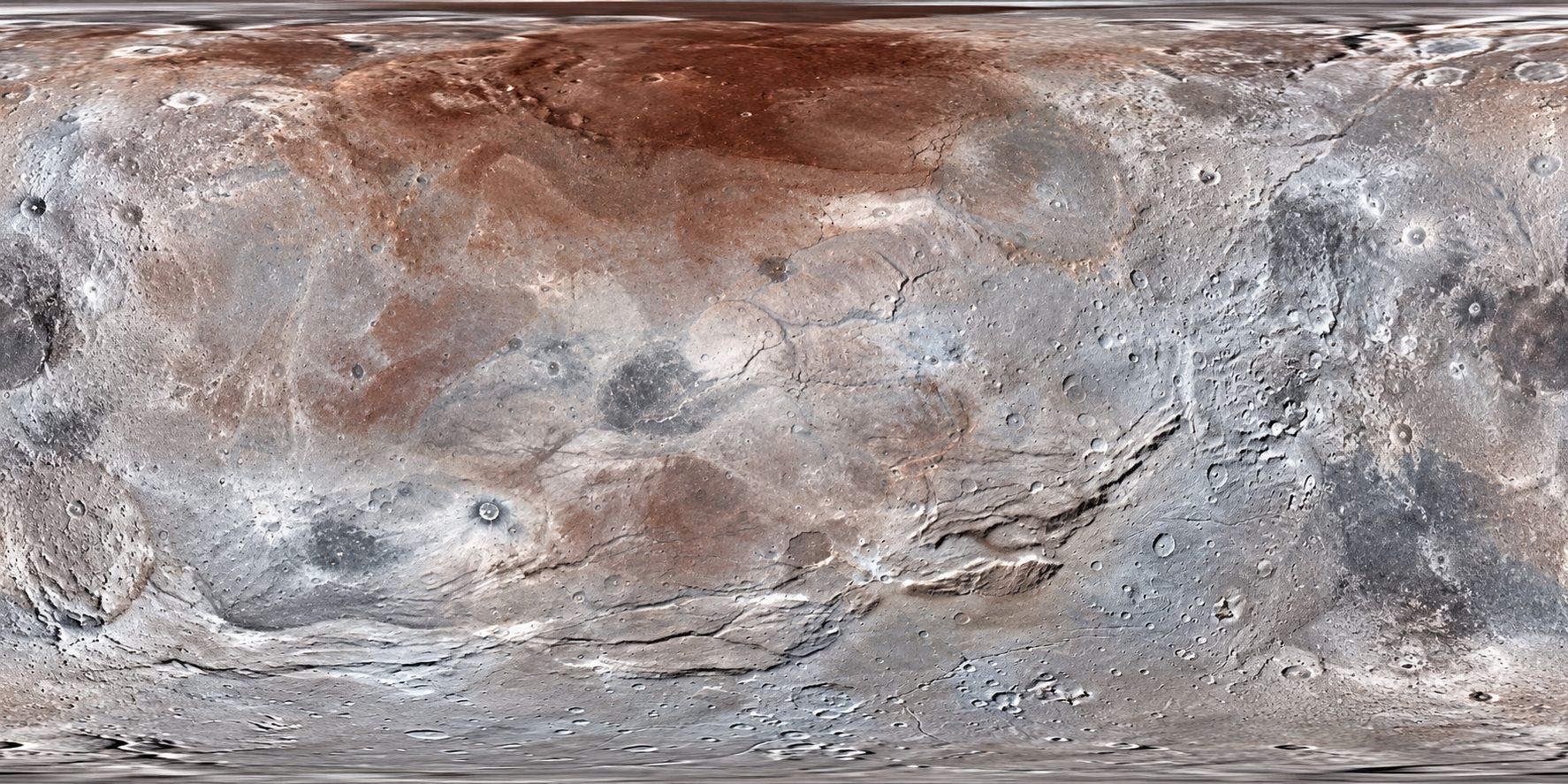
Charon uses the supplied illustrative global colour texture. Its full appearance is not a uniformly resolved, geographically registered survey. Nix and Hydra use published 3D shape fits without invented surface-colour textures. Styx and Kerberos remain enlarged position symbols because no suitably verified downloadable shape file was located. Surface relief, present-day glacier flow and current cloud positions are not simulated.
All five moons
Charon, Styx, Nix, Kerberos and Hydra are all included. Their centre positions come from individually verified JPL satellite targets relative to Pluto’s system barycentre. Physical mode preserves sizes and distances; Readable sizes enlarges Pluto and Charon by 1.5× in system views. Styx and Kerberos remain enlarged symbols. Nix and Hydra load published physical-scale shape meshes on selection, with location markers at system overview.
Charon
Pluto’s largest moon shares a mutually synchronous 6.39-day rotation with Pluto. Both bodies move around a barycentre outside Pluto. The supplied colour texture is illustrative and is not a uniformly resolved, registered survey.
Styx
A small irregular moon orbiting the Pluto–Charon system. The dated location uses the JPL solution. The enlarged marker has no resolved terrain or measured spin; it does not imply tidal locking.
Nix
A small irregular moon of the Pluto–Charon system. Its dated centre follows the JPL solution. The 3D shape is an author-published fit by Simon Porter to New Horizons images, displayed with uniform material and a fixed illustrative orientation. It is not a present-day spin prediction or a registered surface-colour map.
Kerberos
A small irregular moon orbiting the Pluto–Charon system. The dated location uses the JPL solution. The enlarged marker has no resolved terrain or measured spin; it does not imply tidal locking.
Hydra
A small irregular moon of the Pluto–Charon system. Its dated centre follows the JPL solution. The 3D shape is an author-published fit by Simon Porter to New Horizons images, displayed with uniform material and a fixed illustrative orientation. It is not a present-day spin prediction or a registered surface-colour map.
| Moon | Reference radius | Approx. orbit scale | Period · Earth days |
|---|---|---|---|
| Charon | 606.0 km | 19,600 km | 6.387222 |
| Styx | 5.2 km | 43,200 km | 20.160000 |
| Nix | 18.0 km | 49,300 km | 24.850000 |
| Kerberos | 6.0 km | 58,300 km | 32.170000 |
| Hydra | 18.5 km | 65,200 km | 38.200000 |
Orbit scales are reference semimajor axes from published system models; the plotted locations use dated vectors. The orbit traces in the viewer show one sampled circuit around the selected date. They are not permanently closed two-body ellipses.
Nix and Hydra in 3D
These meshes are Simon Porter’s published shape fits to New Horizons observations, used under CC BY 4.0. Nix has the better observational coverage; Hydra’s far side is less constrained. Uniform material reveals the fitted geometry without claiming a measured global colour map. The displayed orientation is illustrative and does not track current spin.
Nix model · Simon Porter · Hydra model · Simon Porter · CC BY 4.0. Adaptation: indexed mesh conversion and kilometre scaling; Nix is uniformly scaled by 0.5 to match the dimensions stated in the author’s chapter. Original shape topology is retained. Styx and Kerberos have more limited imaging; this viewer keeps them as symbols rather than substituting an unverified mesh.
A possible interior
Pluto’s interior has never been directly imaged. The cutaway illustrates an icy shell, a possible ocean, deeper ice and a rock-rich interior. The thicknesses and ordering are schematic: the possible ocean and deep-ice structure depend on the model. These layers should not be read as a measured geological cross-section.
Pluto in the Kuiper Belt
Pluto follows an inclined, eccentric orbit around the Sun, taking roughly 248 Earth years. The Sun & Orbit view places the system beside Neptune’s orbit and a simplified 30–50 AU Kuiper Belt reference band. The band is a broad context guide, not a catalogue of individual objects or the full extent of every distant population.
The Pluto–Charon system is represented by its barycentre in this distant view. Body sizes are enlarged while orbital distances share one linear scale. A dated 248-year path supplies context; normal playback remains within 2026–2050.
Select Sun or Neptune to inspect the supplied global image wrapped onto its 3D globe. The solar appearance is illustrative and Neptune’s cloud pattern is historical; these textures do not show live activity or a registered current orientation.
Replay New Horizons at Pluto
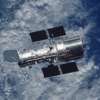
On 14 July 2015, New Horizons flew through the Pluto system. It did not land or enter orbit. Replay 12–16 July using one-minute spacecraft vectors and dated Pluto and Charon positions, then switch to Spacecraft to inspect NASA’s detailed 3D model.
Closest-approach buttons use the nearest one-minute cached samples, not refined event solutions. Distances are centre-to-centre; the profile separately subtracts each reference radius for an approximate altitude. Spacecraft size is enlarged and attitude is illustrative, not SPICE attitude telemetry.
3D model: NASA Visualization Technology Applications and Development (VTAD). Model source and credit ↗
Dates, scale and scientific context
Normal playback covers 1 January 2026 through 31 December 2050, starting at 10 Earth minutes per real second. System data load one month at a time. Future positions follow nominal JPL predictions, with increasing underlying uncertainty possible over time. They are not observations of the future.
Inspection light helps reveal textures on the night side; switch it off to inspect the dated Sun direction. Haze thickness is enlarged for visibility. The map does not simulate mutual eclipses, cast shadows, measured atmospheric density, Pluto terrain relief or the irregular moons’ spin histories. Decorative stars are not a sky catalogue.
Questions about Pluto
Why does Pluto move when Charon goes around it?
Both bodies respond to their shared gravitational system. The reference origin is their system barycentre, which lies outside Pluto’s reference globe. Holding Pluto still would hide this defining feature.
Why is part of the surface blurry or hatched?
The encounter hemisphere has much more detailed images than the far side. Hatching marks pixels without mapped imagery. Neither is a rendering hole; the source coverage is incomplete.
Are the four small moons tidally locked?
They are not given the mutual locking of Pluto and Charon. This map shows their dated positions as symbols, without claiming a measured current orientation.
Did New Horizons land on Pluto?
No. It made a fast flyby in 2015 and continued into the Kuiper Belt. The historical replay is distinct from the normal current-date simulation.
Is the possible ocean confirmed?
No directly imaged ocean is available. Geological and interior models motivate an ocean hypothesis; the cutaway makes that uncertainty explicit.
Data and image sources
- NASA · Pluto facts and five moons
- JPL Horizons · geometric vectors; target identities, query URLs and monthly metadata are retained with the data
- NAIF PCK00011 · nominal Pluto/Charon orientation
- USGS · adopted Pluto landmark names and coordinates
- NASA/JHUAPL/SwRI · Pluto global colour mosaic
- NASA · New Horizons mission
- Charon illustrative texture supplied by Universe Map: original texture