




Eris 3D Map
Map settings
Sun & Orbit: JPL predictions, 2026–2050. Dysnomia and Tidal lock: 2026–2029, limited by the satellite solution. The tidal-lock view compresses centre distances; body sizes retain their ratio. Surface appearance, aligned spin pole and surface prime meridian are illustrative.
DWARF PLANET 136199 · BEYOND NEPTUNE
Eris: Icy Surface, Dysnomia & Synchronous Spin
Explore a distant icy world and the dark companion that helps reveal its properties. Rotate the supplied surface illustration, inspect Dysnomia at a common physical scale, compare dated orbital positions or watch a compact tidal-lock demonstration.
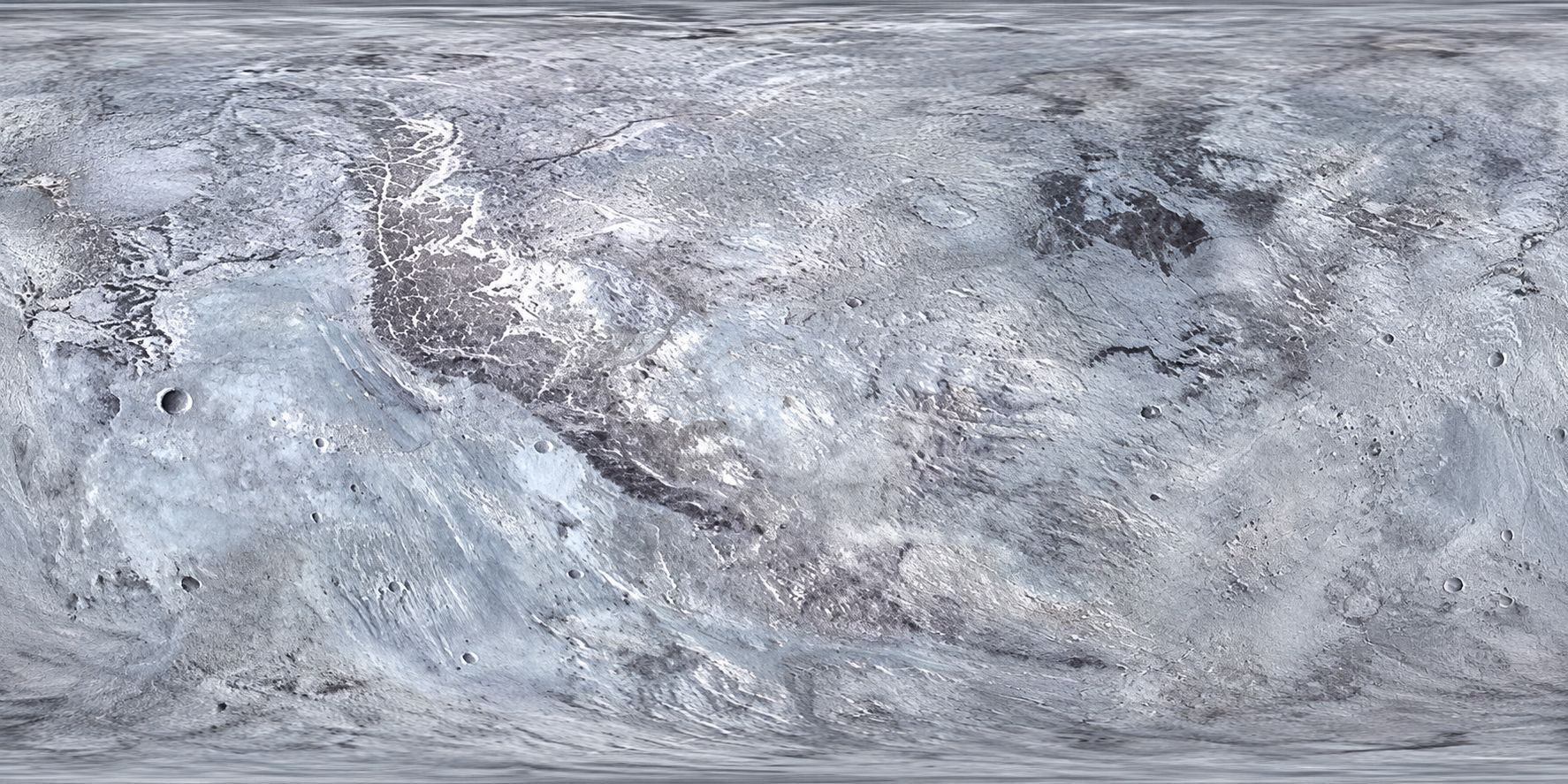
The supplied Eris texture is an illustration. Its apparent cracks, craters and ridges are not an observed terrain atlas. Dated positions, an adopted spin model and unknown surface appearance are identified separately throughout this explorer.
Six ways to explore Eris
A bright world in distant space
Explore Eris using the supplied icy surface illustration and a 1,163 km reference sphere. Its visible terrain is not an observed atlas.
Inspect the supplied surface
Rotate and zoom freely, switch to neutral ice or view the original illustration. No fictional terrain is given observed landmark names.
Meet Dysnomia
Inspect the dark, unresolved moon at a common physical scale with Eris. Dated relative positions use the bundled 2022 solution, limited to 2026–2029.
See the tidal-lock model
A compressed-distance demonstration makes matched spin and orbital motion visible. The reference meridian is illustrative; body-size ratio is preserved.
Follow Eris around the Sun
Compare Eris, Neptune and Pluto on one linear heliocentric scale. The inclined, eccentric Eris path reaches well beyond the Kuiper Belt reference band.
Explore the evidence
Discover how imaging, stellar occultation, photometry and ALMA thermal measurements constrain this distant system.
ONE KNOWN COMPANION
Dysnomia: a dark moon beside bright ice
Updated thermal modelling published by Brown and Butler in 2023 gives Dysnomia a diameter of 615 +60/−50 km. The explorer adopts a 307.5 km reference radius. This differs from the older size listed in the bundled JPL orbit header: the orbit data and visual size are separate inputs.
The physical moon view preserves both size ratio and centre-distance scale. Small hollow markers help locate distant bodies and disappear on close inspection. Select Dysnomia or use the focus menu to approach its plain reference sphere; no invented crater map is applied.
A SLOW, MATCHED RHYTHM
Why Eris does not spin like a one-day world
Independent 2023 photometric studies support rotation of Eris synchronised with Dysnomia’s approximately 15.8-day orbit. This page adopts 15.785899 days as a mean-synchronous spin period. Older public summaries and the JPL physical header still list 25.9 hours; that older number is not used for the globe.
The spin axis is aligned to the nominal moon-orbit pole as a model assumption. Its surface prime meridian is illustrative. A small difference between true orbital angle and uniform mean spin can remain; the model does not force an instantaneous surface feature to point exactly at the moon each frame.
Follow one orbital cycle
In Tidal lock, centre distance is compressed while the body-size ratio is preserved. The gold ring marks an arbitrary reference meridian, not an observed landmark. “Play one cycle · 1 day/s” advances the date by one adopted period and automatically pauses. Its speed is shown in the readout.
Dysnomia is drawn with a mean-synchronous attitude as a model assumption. Its actual pole and resolved surface orientation have not been measured by this explorer.
ILLUSTRATIVE APPEARANCE
Explore the icy surface without invented landmarks
The default image is the supplied Universe Map illustration, wrapped unchanged onto the 1,163 km reference sphere. Smooth drag, wheel and pinch controls work throughout all six views. Switch to neutral ice when you want to inspect the reference shape without artistic terrain.
View the original flat surface illustration
MEASUREMENT & INTERPRETATION
What observations can tell us
A silhouette, not a landscape
A 2010 stellar occultation constrained Eris’s radius to 1,163 ± 6 km. This is used as a reference sphere, with no assertion of surveyed topography or a detailed internal cross-section.
A period from changing brightness
Long-term photometry tests slow rotation despite small brightness variations. The adopted synchronous period describes a spin model; texture phase does not identify a measured prime meridian.
Size without resolved terrain
Thermal flux constrains the moon’s size and reflectivity through a model. These constraints do not supply a detailed texture or remove uncertainty about its shape.
| Feature | Source / constraint | How it is displayed |
|---|---|---|
| Eris surface | No resolved global atlas | Supplied illustration, enabled by default |
| Eris reference radius | 1,163 ± 6 km · occultation | Smooth sphere |
| Eris spin | ≈15.8 d · 2023 photometry | Adopted mean-synchronous model |
| Dysnomia diameter | 615 +60/−50 km · 2023 ALMA model | Plain sphere, radius 307.5 km |
| Dysnomia positions | Bundled JPL 2022 solution | Relative to Eris centre, 2026–2029 |
| Heliocentric positions | Current JPL minor-planet solution | UTC 2026–2050; enlarged context symbols |
A tilted orbit far beyond the main planets
Eris follows a strongly inclined, eccentric orbit. The heliocentric view uses a single linear distance scale, while body symbols are enlarged for visibility. Neptune and Pluto provide context; the faint 30–50 AU Kuiper Belt band is a reference plane rather than a sharp boundary.
The long Eris trajectory is sampled from JPL data through 2500, within the available solution. Approximately one revolution is shown for each body. These path lines are separate from the selectable 2026–2050 date range. Selecting a body opens a close inspection view instead of leaving its enlarged symbol at the overview scale.
Questions about the Eris map
Why does the moon view stop in 2029?
The available JPL satellite solution ends just before 2030. The explorer stays inside that boundary. Switching to Dysnomia or Tidal lock temporarily clamps the date; leaving those views restores the previous normal date, which can extend through 2050.
Is this a live view of Eris and Dysnomia?
No. The dates drive cached geometric orbit predictions. The surface image is an illustration, and the moon is unresolved. This page is not live spacecraft telemetry.
Does Eris really rotate in about 25.9 hours?
That older value remains in some public summaries and metadata. This page follows the newer photometric evidence for a slow spin synchronous with the approximately 15.8-day moon orbit.
Why is there no ring or interior cutaway?
Eris has no known ring, and its interior is poorly constrained. This explorer does not turn an uncertain structure into a detailed measured cross-section or draw an unconfirmed ring as a physical feature.
Why is the reference meridian not always exactly beneath Dysnomia?
The globe rotates uniformly in a mean-synchronous model while JPL positions include varying true orbital motion. The small residual angular difference is not a reversed-control bug or evidence of a measured surface landmark.
Can the map predict an eclipse or occultation?
No precise event timings are provided. Position uncertainties, assumed spin attitude and display scaling make this an educational explorer rather than an event-planning service.
Scientific sources & credits
- NASA · Eris overview — discovery context, one known moon and no known rings. Its older rotation entry is superseded here by the studies below.
- Sicardy et al. (2011) · Eris occultation — adopted reference radius.
- Holler et al. (2021) · Dysnomia orbit — reference 15.785899-day period and orbital scale.
- Szakáts et al. (2023) · tidal locking and Bernstein et al. (2023) · independent synchronous-spin evidence.
- Brown & Butler (2023) · ALMA satellite sizes and masses — revised Dysnomia size.
- NASA/JPL Horizons — geometric UTC vectors, ecliptic J2000. Exact query provenance and solution dates are bundled with the data.
- Surface and context textures: supplied Universe Map assets. Eris’s image is illustrative and copied unchanged. No detailed moon texture or spacecraft model is invented. Three.js and OrbitControls retain their included MIT licence.
Research reviewed 21 October 2026. The current heliocentric solution and older relative satellite solution are distinct. Small numerical interpolation errors do not imply equally small physical orbit uncertainties.