






Our galactic neighbourhood
The Local Group
Our galaxy is part of a bigger story.
The Local Group is the galaxy group that contains our Milky Way, Andromeda and Triangulum, together with many smaller galaxies. Explore some of its members, compare their distances, and see how our galactic neighborhood fits into the larger universe.
- Our home galaxy
- Milky WayThe Solar System is inside it
- Two dominant members
- Milky Way + M31Andromeda is also called M31
- Another major spiral
- Triangulum / M33The third-largest member
- Distance to Andromeda
- ≈2.5 million lyAn approximate distance from Earth
- Most members
- Dwarf galaxiesFaint systems make the census difficult
- Type of structure
- Galaxy groupDifferent from the Virgo Cluster
What is the Local Group?
The Local Group, also described as the Local Galactic Group, is our nearby family of galaxies, linked by gravity. It contains large spiral galaxies, smaller irregular galaxies and many faint dwarfs. The Milky Way and Andromeda are its two dominant galaxies; Triangulum is another major spiral.
A galaxy is an enormous system of stars, gas, dust and dark matter. A galaxy group brings multiple galaxies together. It is not a star cluster inside the Milky Way, and the points on a Local Group map usually represent entire galaxies rather than individual stars.
Which galaxies belong to the Local Group?
Start with the Milky Way, Andromeda and Triangulum, then compare smaller companions and more isolated dwarfs. The explorer below is a selection of nine familiar members, not a complete catalogue. Distances are approximate and measured from Earth, rather than from the group's centre.
Use the filters to separate large spirals from the Milky Way's companions, Andromeda's companions and other dwarfs. These are reading categories, not a prediction of each object's future orbit. In particular, Triangulum's relationship with Andromeda is more complicated than a simple fixed satellite label.
Explore nine selected galaxies
Showing 9 of 9 selected examples
Andromeda Galaxy · M31
- Galaxy type
- Spiral
- Approximate distance from Earth
- ≈2.5 million light-years
The other dominant galaxy of the Local Group, with its own satellite population.
Read all nine records
| Galaxy | Type | Distance from Earth | Relationship |
|---|---|---|---|
| Milky Way | Spiral | We live inside it | Our home galaxy; one of the Local Group’s two dominant galaxies. |
| Andromeda Galaxy · M31 | Spiral | ≈2.5 million light-years | The other dominant galaxy of the Local Group, with its own satellite population. |
| Triangulum Galaxy · M33 | Spiral | ≈3 million light-years | A major Local Group spiral. Its relationship with Andromeda is more complex than a fixed satellite label. |
| Large Magellanic Cloud | Irregular dwarf | ≈160,000 light-years | A nearby companion of the Milky Way. |
| Small Magellanic Cloud | Irregular dwarf | ≈200,000 light-years | A Milky Way companion associated with the Magellanic system. |
| Messier 32 · M32 | Compact elliptical | ≈2.5 million light-years | A compact companion of Andromeda; a separate galaxy, not part of its stellar disk. |
| Messier 110 · M110 | Dwarf elliptical | ≈2.7 million light-years | An Andromeda companion also catalogued as NGC 205. |
| NGC 6822 · Barnard’s Galaxy | Irregular dwarf | ≈1.6 million light-years | A dwarf galaxy in the wider Local Group, outside the main companion lists shown here. |
| IC 1613 | Irregular dwarf | ≈2.3 million light-years | Another dwarf in the wider Local Group, away from the two main satellite concentrations. |
From a map symbol to an observed galaxy
How many galaxies are in the Local Group?
A 2025 research compilation identified 134 galaxies within one megaparsec of the Local Group barycentre, including the Milky Way and Andromeda systems and peripheral members. This is a dated, defined sample rather than a permanent total: discoveries and membership decisions can change the count.
Counts differ when surveys include different boundaries or uncertain candidates. That is why a useful census needs both a date and selection rules. Our nine-object explorer is a small comparison guide, not an estimate of the group's full population.
What are satellite and dwarf galaxies?
“Dwarf” describes a small galaxy; “satellite” describes its relationship to a larger host. A dwarf can be a satellite or a more isolated group member. The Large and Small Magellanic Clouds are prominent companions of the Milky Way, while M32 and M110 are companions of Andromeda.
Smaller members also help measure the universe. IC 1613 contains variable stars used as distance indicators, and its low dust content makes them easier to study. NGC 6822 provides another nearby example of an irregular dwarf whose stars and gas can be examined in detail.
How to read a Local Group map
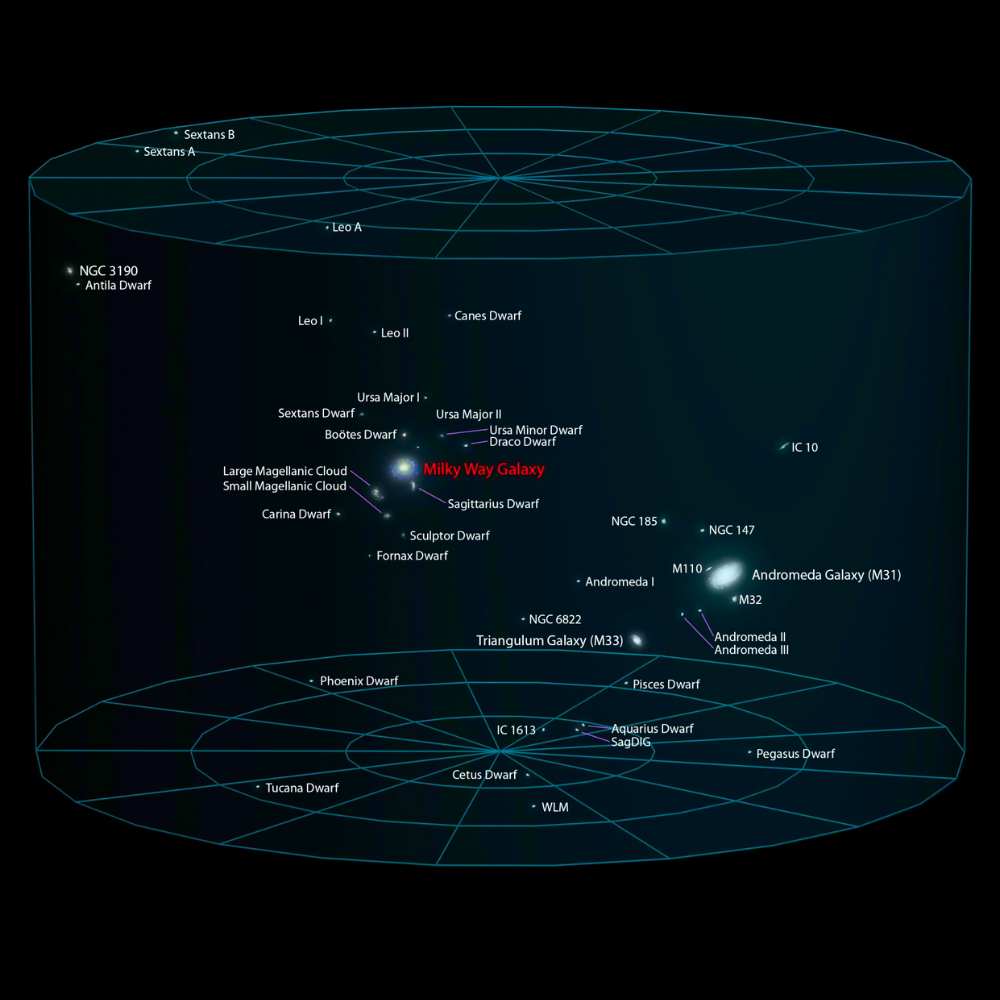
First find the Milky Way, then Andromeda and Triangulum. Next look for the concentrations of smaller companions around the two largest galaxies. More isolated dwarfs help show that the group is not just two neat circles of satellites.
A sky chart shows directions from our viewpoint. A spatial map adds distance. When exploring a 3D view, rotate it to test apparent alignments: objects that overlap on your screen may be separated in depth. Check its scale notes before comparing the drawn sizes of galaxies with the gaps between them.
Rotate the Local Group in 3DHow large is the Local Group?
Public descriptions commonly place the Local Group on a scale of roughly ten million light-years across. This is a broad description of the neighborhood, not the diameter of a hard-edged sphere. The boundary and membership depend on how researchers define the group.
Andromeda's roughly 2.5-million-light-year distance provides a useful reference. A light-year is a distance: the length light travels in one year. The light arriving from Andromeda therefore began its journey roughly 2.5 million years ago. Nearby galaxies are still extraordinarily distant on human scales.
How do astronomers measure these distances?
Distances to nearby galaxies come from observations of their stars, not from how large their symbols look on a map. For Cepheid variables, the time between brightness peaks helps estimate their intrinsic brightness. Comparing that with their apparent brightness, with corrections such as dust extinction, gives a distance estimate. RR Lyrae stars provide another calibrated variable-star route.
Another method uses the tip of the red giant branch: a characteristic brightness limit for certain aging red giants. Comparing that calibrated luminosity with the brightness seen in another galaxy provides a distance estimate. Different methods offer independent checks, and each carries measurement and calibration uncertainties.
What holds the group together?
Gravity governs the group's motions, but the visible stars and gas do not tell the whole mass story. Astronomers infer additional matter from effects such as stellar and galaxy motions. Dark-matter halos are central to models of the Milky Way, Andromeda and their surrounding systems.
A bright galaxy symbol does not show its entire mass distribution. Inferred mass depends on the region being measured, the motions used and the model assumptions. A brightness ranking therefore cannot establish exactly which galaxy has the greatest total mass.
Will the Milky Way and Andromeda merge?
A merger remains possible, but a guaranteed collision in four billion years is too certain. Sawala and colleagues reported in 2025 that their models gave roughly a 50% chance of no Milky Way–Andromeda merger within ten billion years.
A 2026 study by Wu and colleagues, using different corrected proper-motion measurements, found about a 90% chance of merging within ten billion years in its preferred model, with a median time near 6.5 billion years. The authors still found the outcome sensitive to measurement uncertainties. These are conditional research predictions, not a fixed appointment; Triangulum and the Large Magellanic Cloud also influence the calculation.
Is the Local Group inside the Virgo Cluster?
No. The Local Group and the Virgo Cluster are different structures. Our galaxy belongs to the Local Group, outside the much larger Virgo Cluster. The similar names “Virgo Cluster” and “Virgo Supercluster” can cause confusion.
The wider neighborhood is often discussed in the traditional Virgo or Local Supercluster context. Laniakea is a still broader region defined using galaxy flows. Such supercluster descriptions should not be treated as one gravitationally bound object with a single physical edge.
From home to the galaxy neighbourhood
Earth belongs to the Solar System
The Sun and its planets form one system inside the Milky Way galaxy.
The Milky Way is one galaxy
Our galaxy is a member of the Local Group. Its stars are not separate galaxies.
The Local Group is a galaxy group
It includes the Milky Way, Andromeda, Triangulum and many dwarf galaxies. It is not the Virgo Cluster.
Broader names use different definitions
The Local Group lies outside the Virgo Cluster. Virgo Supercluster and Laniakea describe larger-scale surroundings; Laniakea is defined using galaxy-motion flows, not as one gravitationally bound galaxy group.
Questions about the Local Group
Is the Milky Way in the Local Group?
Yes. The Milky Way is one of the group's two dominant galaxies, alongside Andromeda.
Is Andromeda the nearest galaxy?
It is the nearest large spiral galaxy to the Milky Way. Smaller galaxies, including the Magellanic Clouds, are much closer to us.
Is the Local Group the same as a star cluster?
No. A star cluster contains stars within a galaxy; the Local Group contains multiple galaxies.
Are all Local Group dwarfs satellites of the Milky Way?
No. Andromeda has companions of its own, and the group also contains dwarfs outside the two main satellite systems.
Can a map show every member with certainty?
A map reflects its catalogue, date and selection rules. Different boundaries and the treatment of faint or uncertain objects can produce different membership lists.
Is a Milky Way–Andromeda collision certain?
No fixed date is established. Published studies in 2025 and 2026 found different merger probabilities under different measurements and assumptions. Both highlight the importance of uncertain galaxy motions.
Sources, image credits & map notes
- NASA: Galaxies — NASA
- Makarov et al. (2025): The frozen outskirts — Astronomy & Astrophysics
- NASA Hubble: Messier 31 — NASA
- NASA Hubble: Messier 33 — NASA
- NASA: The Galaxy Next Door — NASA
- NASA: WISE's View of a Wispy Cloud — NASA
- NASA Hubble: Messier 32 — NASA
- NASA Hubble: Messier 110 — NASA
- ESA: Euclid's view of NGC 6822 — ESA
- ESO: The Milky Way's Clean and Tidy Galactic Neighbour — ESO
- Wempe et al. (2026): The mass distribution in and around the Local Group — Nature Astronomy
- Sawala et al. (2025): No certainty of a Milky Way–Andromeda collision — Nature Astronomy
- Wu et al. (2026): The Fate of the Milky Way–Andromeda System — The Astrophysical Journal Letters
- Tully et al. (2014): The Laniakea supercluster of galaxies — Nature
- NASA: Large Scale Structures — NASA
- Las Cumbres Observatory: Distribution of Galaxies — Las Cumbres Observatory
- NASA Hubble: Measuring galaxy distances with red giant stars — NASA
Image credits
- Local Group and neighbouring galaxies: corrected schematic: Andrew Z. Colvin, CC BY-SA 3.0; author-corrected diagram, JPEG rendition. Original source. CC BY-SA 3.0 licence. This JPEG rendition is shared under the same licence. Author-corrected 2016 diagram, converted to JPEG without changing its labels or composition. It includes neighbouring outliers and is not a complete membership census.
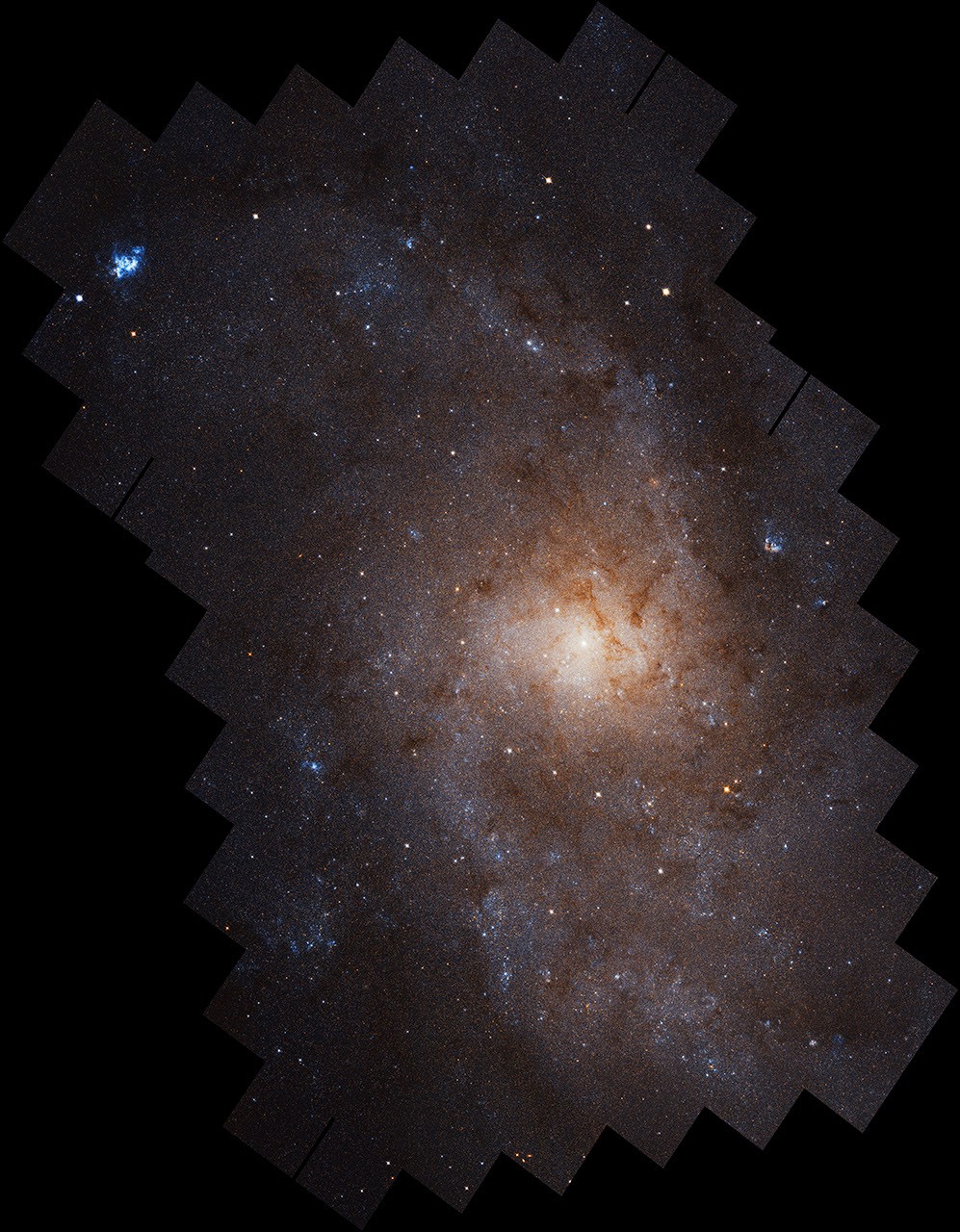
- Hubble observation mosaic of the Triangulum Galaxy: NASA, ESA, and M. Durbin, J. Dalcanton, and B.F. Williams (University of Washington). Original source. Published Hubble colour-composite observation, preserved without cropping or enhancement. The mosaic covers part of M33; its stepped footprint is not the galaxy’s boundary.

How the interactives work
The member explorer presents nine selected examples with rounded distances from Earth. Its filters organise the examples; they do not calculate galaxy positions or orbits. The cosmic-address symbols explain membership and wider context without implying a common physical scale. The 3D map is a separate experience; consult its own scale and data notes when interpreting positions.
See our galactic neighbourhood from another angle.
Open the Local Group map, change your viewpoint and explore the space between the galaxies.