



Actaea
The Dark Moon of Salacia in the Kuiper Belt
Quick Reader
| Attribute | Details |
|---|---|
| Name | Actaea |
| Formal Designation | (120347) Salacia I Actaea |
| Provisional Designation | S/2006 (120347) 1 |
| Object Type | Natural satellite of a trans-Neptunian object |
| Parent Object | (120347) Salacia |
| Location | Kuiper Belt |
| Average Distance of the System from the Sun | About 42 AU |
| Estimated Diameter | 290 ± 21 km |
| Orbital Distance from Salacia | Approximately 5,600 km from centre to centre |
| Orbital Period | 5.49389 days |
| Orbital Shape | Nearly circular |
| Rotation | Probably synchronous with its orbit |
| Surface | Very dark, with optical colours similar to Salacia |
| Composition | Likely a mixture of ice, rocky material, and dark organic-rich compounds |
| Discovery Date | 21 July 2006 |
| Discovery Method | Hubble Space Telescope imaging |
| Discoverers | Keith S. Noll, Harold F. Levison, Denise C. Stephens, and William M. Grundy |
| Official Naming Date | 18 February 2011 |
| Name Origin | Actaea, one of the Nereids or sea nymphs in Greek mythology |
| Observability | Detectable only with powerful professional observatories |
Introduction – A Large Moon Hidden Beyond Neptune
Actaea is the only known natural satellite of (120347) Salacia, a large trans-Neptunian object orbiting within the Kuiper Belt. The pair travels around the Sun at an average distance of approximately 42 astronomical units, placing it slightly farther from the Sun than Pluto’s average orbit.
Although Actaea is usually described as a moon, it is remarkably large compared with Salacia. Its estimated diameter is approximately 290 kilometres, while Salacia is thought to measure about 866 kilometres across. Actaea is therefore roughly one-third the diameter of its parent object, making the Salacia–Actaea system an unusually balanced pairing compared with most planet-and-moon systems.
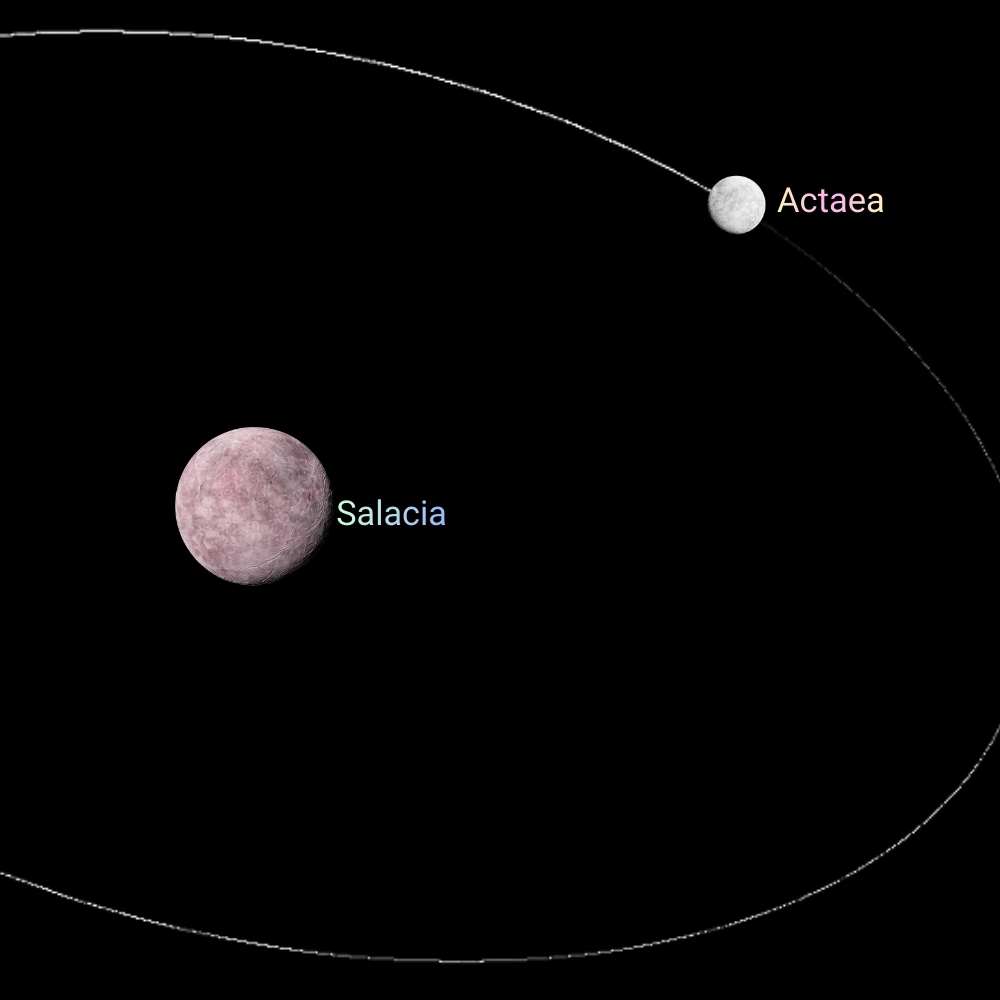
The moon completes one orbit around Salacia every 5.49389 days at a centre-to-centre distance of approximately 5,600 kilometres. Its orbit is almost circular, and recent research provides strong evidence that Salacia and Actaea have become tidally synchronized, meaning that each body may continuously face the same side toward the other.
Despite its scientific importance, Actaea remains extremely difficult to observe. It is too distant and faint for ordinary telescopes, and even major observatories usually record it as a point of light rather than a resolved world with visible surface features.
The Discovery of Actaea
Actaea was discovered in images obtained with the Hubble Space Telescope on 21 July 2006. The discovery team consisted of Keith S. Noll, Harold F. Levison, Denise C. Stephens, and William M. Grundy.
The moon was initially assigned the provisional designation:
S/2006 (120347) 1
This designation indicated that it was the first satellite discovered around minor planet number 120347 during 2006.
Before the discovery of Actaea, astronomers could estimate Salacia’s brightness and approximate size, but they could not determine the system’s mass accurately. Once the moon’s orbit was measured, researchers were able to apply Kepler’s laws and calculate the combined mass of Salacia and Actaea.
This transformed Salacia from a distant point of light into a system whose density, internal composition, and evolutionary history could be investigated more precisely.
The moon received its official name, Actaea, on 18 February 2011. In Greek mythology, Actaea was one of the Nereids, a group of sea nymphs associated with the ancient sea god Nereus. The ocean-related name complements Salacia, the Roman goddess of salt water and the sea.
How Large Is Actaea?
Actaea’s diameter is estimated to be approximately:
290 ± 21 kilometres
This makes it larger than many small moons found around the giant planets, although it remains much smaller than major trans-Neptunian satellites such as Charon.
Its size has not been measured by directly photographing a resolved solid disk. Instead, astronomers combined several forms of evidence, including:
- Thermal radiation from the Salacia–Actaea system
- The brightness difference between the two objects
- Their similar optical colours
- Assumptions about their relative surface reflectivity
Because Actaea and Salacia display similar visible colours, researchers often assume that their surfaces reflect sunlight at approximately similar rates. Under this assumption, the difference in brightness can be used to estimate their relative diameters.
However, the measurement still contains uncertainty. A darker Actaea would need to be larger to produce the observed brightness, while a more reflective surface would imply a smaller diameter.
The currently used estimate of 290 ± 21 kilometres is therefore a scientifically modelled value rather than a direct measurement of its physical edge.
Actaea’s Orbit Around Salacia
Actaea follows a compact orbit around Salacia, with an orbital semimajor axis of roughly 5,600 kilometres. This measurement represents the distance between the centres of the two bodies, not the distance between their surfaces.
The moon completes one full revolution in approximately:
5.49389 days
Its orbit has extremely low eccentricity, meaning it is nearly circular rather than strongly elongated.
This circular shape is important because it suggests that tidal forces have gradually altered the system. When a moon begins with an eccentric orbit, repeated gravitational stretching can dissipate orbital energy as internal heat. Over long periods, this process tends to make the orbit more circular.
The compact orbit also makes Salacia–Actaea one of the tightest known binary systems among trans-Neptunian objects when its separation is compared with the size of Salacia’s gravitational sphere of influence.
Because the orbit is accurately measurable, it provides astronomers with one of the most reliable ways to determine the total system mass. Recent orbital modelling gives a combined mass of approximately:
4.861 × 10²⁰ kilograms
This value applies to the entire Salacia–Actaea system. The individual mass of Actaea has not been measured independently with the same precision.
A Likely Doubly Synchronous System
Recent observations provide significant evidence that Salacia and Actaea are in a fully synchronous configuration.
In a synchronously rotating moon, the rotational period matches the orbital period. This causes the same hemisphere of the moon to face its parent continuously, just as the Moon always presents nearly the same face toward Earth.
The Salacia–Actaea system may go one step further. The available evidence suggests that Salacia’s own rotation may also match Actaea’s 5.49-day orbital period.
If this interpretation is correct:
- Actaea always shows the same hemisphere to Salacia.
- Salacia always shows the same hemisphere to Actaea.
- The two bodies appear almost fixed in each other’s skies.
- Their rotation and orbit have reached a tidal equilibrium.
This condition is called double synchronous rotation or mutual tidal locking.
A study based on approximately 16 years of photometric observations found a brightness cycle almost identical to Actaea’s orbital period. The researchers concluded that the signal most likely comes from surface variations on Salacia rotating in synchrony with the moon’s orbit.
Their tidal modelling suggests that this synchronized state could have developed within approximately 1.1 billion years after the moon formed or was captured. However, because neither surface can yet be mapped in detail, the result is described as strong evidence rather than an absolutely direct observation of their rotation.
The Dark Surface of Actaea
Actaea appears to have a dark surface that reflects only a small fraction of the sunlight reaching it. Its visible colour is similar to that of Salacia, suggesting that the two bodies may have related surface materials or may have experienced similar space-weathering processes.
Possible surface materials include:
- Water ice
- Dark carbon-rich compounds
- Irradiated organic material
- Silicate or rocky grains
- Other frozen volatile compounds
However, Actaea’s composition cannot yet be described with certainty.
Recent JWST observations detected strong water-ice absorption and a carbon dioxide ice feature in the combined spectrum of Salacia and Actaea. The two objects were blended together at the instrument’s spatial resolution, meaning the measurements could not determine how much of each spectral feature came from Actaea and how much came from Salacia.
It is therefore reasonable to describe Actaea as probably ice-rich, but it would be inaccurate to claim that JWST has independently confirmed a specific water-ice or carbon-dioxide distribution across Actaea’s surface.
Why Actaea Is Important to Kuiper Belt Science
Actaea is scientifically valuable because a moon provides information that cannot easily be obtained from an isolated Kuiper Belt object.
By studying its orbit, astronomers can determine:
- The total mass of the Salacia–Actaea system
- The average density of the two bodies
- Possible proportions of rock, ice, and organic material
- The effects of tidal evolution
- Clues to the system’s formation
- The internal response of Salacia to long-term gravitational stress
The system’s estimated density is low enough to indicate a substantial fraction of ice and other low-density material, but high enough that the bodies may not be extremely porous collections of loose fragments.
Actaea also helps astronomers compare different satellite systems beyond Neptune, including:
- Pluto and Charon
- Orcus and Vanth
- Varda and Ilmarë
- Eris and Dysnomia
- Haumea and its moons
Each of these systems preserves evidence of collisions, captures, orbital migration, and tidal evolution during the early history of the outer Solar System.
A Small World with a Large Scientific Role
Actaea may appear to be only a faint companion orbiting a larger Kuiper Belt body, but its scientific importance is far greater than its size suggests.
Without Actaea, astronomers would have much less information about Salacia’s mass, density, composition, and internal structure. The moon’s nearly circular orbit and probable synchronous rotation also preserve evidence of billions of years of tidal interaction.
Together, Salacia and Actaea form a compact, dark, and distant system that provides a valuable window into how moons formed and evolved in the cold outer regions of the Solar System.
How Did Actaea Form?
Actaea’s exact origin remains unknown. No spacecraft has visited the Salacia system, and astronomers cannot yet reconstruct its early history from surface geology. Instead, they study the moon’s size, orbit, colour, and tidal relationship with Salacia to evaluate several possible formation scenarios.
The leading possibilities include:
- Formation after a major collision
- Capture of an independently formed Kuiper Belt object
- Formation through the gravitational collapse of a shared cloud of material
None of these explanations has been proved specifically for Actaea. However, its compact, nearly circular orbit and apparent surface similarity to Salacia provide useful clues.
Formation Through a Giant Collision
One possible explanation is that Actaea formed during a collision between Salacia and another large body early in the Solar System’s history.
In this scenario, an impact would have launched icy and rocky material into orbit around Salacia. Some of that debris could then have gathered under its own gravity to form Actaea.
A collision could help explain:
- Why Actaea orbits relatively close to Salacia
- Why the two objects have similar optical colours
- Why the moon’s orbit may have begun close to its present primary
- Why the system contains a relatively large moon compared with Salacia
Computer models show that collisions between large trans-Neptunian objects can create satellites in two main ways. A surviving fragment of the impactor may remain gravitationally bound, or material ejected into orbit may form a debris disk from which a new moon develops. Such impact-based processes have been investigated for several large Kuiper Belt satellite systems.
However, similar colours do not prove that Actaea formed from Salacia’s material. Two bodies originating in the same region of the early Solar System could naturally have similar surfaces even if one was captured later.
Could Actaea Have Been Captured?
Another possibility is that Actaea originally formed as an independent Kuiper Belt object and was later captured by Salacia.
Direct capture is difficult because two isolated objects passing each other normally exchange no lasting energy. Without a way to lose orbital energy, the smaller body would simply continue through space.
Capture may nevertheless have occurred through:
- Interaction with a third object
- Collision with surrounding debris
- Gravitational encounters inside a young multiple-body system
- Gas or particle drag during the earliest stages of Solar System formation
The ancient Kuiper Belt was probably much more crowded than it is today. Frequent encounters between planetesimals could therefore have made capture more likely.
If Actaea was captured into an eccentric or inclined orbit, tidal forces could later have reduced the eccentricity and expanded or altered the orbit. Its present nearly circular path does not reveal whether the moon began as captured material or as collision-produced debris.
The similar visible colours of Salacia and Actaea may favour a related origin, but they do not eliminate capture as a possibility. Hubble observations found that the two components have almost identical optical colours, suggesting broadly similar surface materials or similar histories of space weathering.
Formation from a Collapsing Cloud
A third possibility involves the gravitational collapse of a cloud of pebbles, dust, and ice in the young outer Solar System.
Instead of forming as a single body, a rotating cloud could collapse into two or more objects orbiting a shared centre of mass. This type of process is often considered when explaining binary systems in the Kuiper Belt.
Gravitational collapse is especially useful for explaining wide binaries containing similarly sized objects. Salacia and Actaea, however, form a much tighter and less equal pairing. Actaea is large for a moon, but Salacia remains clearly dominant in size.
This does not make gravitational collapse impossible. Later collisions, tidal interactions, and orbital migration could have changed an initially wider system. Nevertheless, the present configuration alone does not provide enough evidence to select this model over collision or capture.
The Meaning of Actaea’s Nearly Circular Orbit
Actaea follows a nearly circular orbit with a period of approximately 5.494 days. A circular orbit is an important sign of long-term tidal evolution.
Tidal forces arise because gravity acts more strongly on the near side of an object than on its far side. This difference slightly stretches both bodies and creates tidal bulges.
When the rotation and orbital motion are not synchronized, these bulges do not point perfectly toward the companion. Their displacement produces gravitational torques that gradually change:
- Rotational speed
- Orbital separation
- Orbital eccentricity
- Internal temperature
Over long periods, tidal interactions tend to remove eccentricity and push the system toward a stable configuration.
Actaea’s orbit is now extremely close to circular, indicating that tides have had enough time to reshape the system since its formation.
How the Orbit May Have Expanded
Recent tidal modelling suggests that Actaea probably began closer to Salacia than it is today.
Early in the system’s history, Salacia may have rotated much faster than Actaea orbited. Its tidal bulge would then have pulled slightly ahead of the moon, transferring rotational angular momentum from Salacia into Actaea’s orbit.
As a result:
- Salacia’s rotation gradually slowed.
- Actaea moved farther away.
- The orbital period became longer.
- The orbit became more circular.
- Both bodies approached synchronous rotation.
This process is similar in principle to the gradual outward movement of Earth’s Moon, although the Salacia–Actaea system has evolved much further toward complete synchronization.
A study based on approximately 16 years of photometric observations found that Salacia’s likely rotation period is consistent with Actaea’s orbital period. The researchers concluded that the system has probably reached a doubly synchronous state and that synchronization may have occurred within roughly 1.1 billion years of Actaea’s formation or capture.
What Double Synchronous Rotation Would Look Like
In a doubly synchronous system, each body keeps the same hemisphere pointed toward the other.
An observer standing on the Salacia-facing side of Actaea would see Salacia remain almost fixed in the sky. It would not rise and set in the ordinary sense.
Likewise, Actaea would remain in nearly the same position above one hemisphere of Salacia.
The opposite hemisphere of each object would never see the companion.
This arrangement represents the final equilibrium of tidal evolution. Once rotation and orbit become synchronized, the tidal bulges no longer move significantly relative to the line connecting the two bodies, and the transfer of angular momentum becomes much weaker.
Salacia–Actaea appears to be only the third trans-Neptunian binary system observationally supported as doubly synchronous, after Pluto–Charon and Eris–Dysnomia.
What Actaea Reveals About Salacia’s Interior
Tidal evolution depends strongly on the internal structure of the bodies involved.
A completely rigid object responds differently to tidal stress than one containing warmer, softer, or partially differentiated material. The time required to reach synchronization therefore provides indirect information about Salacia’s interior.
The relatively rapid tidal evolution inferred for the system suggests that Salacia has been capable of dissipating mechanical energy inside its body.
Possible interior structures include:
- A mixture of water ice, rock, and organic compounds
- A compacted but incompletely differentiated interior
- An ice-rich mantle surrounding denser material
- Regions that were warmer and more deformable early in Solar System history
However, tidal models rely on uncertain values such as Actaea’s individual mass, density, and Salacia’s internal rigidity. They cannot yet produce a unique internal model.
Density and the Ice-to-Rock Balance
The orbit of Actaea allows astronomers to calculate the combined mass of the two bodies. Thermal measurements and brightness modelling are then used to estimate their sizes.
Recent orbital work gives the system a mass of approximately:
4.86 × 10²⁰ kilograms
When this mass is combined with commonly used diameter estimates of approximately 866 kilometres for Salacia and 290 kilometres for Actaea, the resulting average system density is around 1.4 grams per cubic centimetre.
This is denser than nearly pure water ice but substantially less dense than solid rock.
The system therefore probably contains a mixture of:
- Water ice
- Rocky minerals
- Carbon-rich organic material
- Internal voids or remaining porosity
This density is an average for the whole binary. It does not prove that Actaea and Salacia have identical compositions or densities.
Actaea may be more ice-rich and less dense than Salacia, as is often expected for smaller satellites. Its individual mass has not yet been measured precisely enough to confirm this. The latest orbital analysis therefore explores a range of possible Actaea densities rather than assigning it one exact value.
A New Complication in Composition Models
A 2025 thermal-orbital study investigated the Salacia–Actaea system under earlier assumptions about its rotational state. The model found that a relatively low rock fraction—approximately 20–30 percent—could reproduce the assumed spin-orbit evolution, with an organic fraction potentially comparable to the rock fraction.
However, the later evidence that Salacia and Actaea are fully synchronized changes an important input to those calculations.
The researchers reporting synchronous rotation specifically noted that previous composition constraints should now be reconsidered. Therefore, the proposed 20–30 percent rock fraction should be treated as a model-dependent result rather than an established measurement of Actaea’s composition.
What JWST Detected in the Salacia–Actaea System
JWST’s Near-Infrared Spectrograph observed the Salacia–Actaea system across wavelengths from approximately 0.7 to 5.1 micrometres.
The combined spectrum showed:
- Strong water-ice absorption features
- A carbon dioxide ice absorption band
- A dark surface mixed with non-ice material
- Spectral properties broadly consistent with other water-ice-rich Kuiper Belt objects
These observations provide much stronger evidence for exposed water ice in the system than earlier near-infrared studies had revealed.
However, Actaea and Salacia were blended together in the JWST data. The telescope recorded their combined light rather than separate spectra.
It is therefore accurate to say that water ice and carbon dioxide ice were detected in the Salacia–Actaea system. It is not yet possible to state how those materials are distributed between the surface of Salacia and the surface of Actaea.
Could Actaea Contain More Surface Ice Than Salacia?
It is scientifically plausible that Actaea could have an ice-rich surface.
Smaller moons may expose relatively fresh ice if they formed from collisionally ejected outer layers of a larger body. They may also retain different proportions of rock and ice than their primaries.
Actaea’s similar optical colour to Salacia suggests that their surfaces are not radically different in visible light. However, visible colour alone cannot determine:
- Water-ice abundance
- Carbon dioxide concentration
- Ice grain size
- Surface porosity
- Depth of organic coatings
Only spatially resolved spectroscopy can answer these questions.
Future observations that separate Actaea’s light from Salacia’s would determine whether the ice signatures detected by JWST are dominated by the moon, the primary, or both.
Comparing Actaea with Other Trans-Neptunian Moons
| Moon | Parent Object | Relative Character | Tidal State |
|---|---|---|---|
| Actaea | Salacia | Large, dark satellite in a compact orbit | Strong evidence for double synchronous rotation |
| Charon | Pluto | Exceptionally large relative to Pluto | Doubly synchronous |
| Dysnomia | Eris | Dark satellite of a much larger dwarf planet | Evidence supports synchronous system evolution |
| Vanth | Orcus | Large moon with uncertain formation history | Possible advanced tidal evolution |
| Ilmarë | Varda | Smaller companion in a compact binary | Tidal state not yet firmly established |
Actaea is smaller relative to Salacia than Charon is relative to Pluto, but it remains large enough to exert a substantial long-term tidal influence.
Its compact orbit and probable double synchronization make it particularly useful for comparing how differently sized Kuiper Belt systems reach similar tidal end states.
Why the Formation Question Remains Unanswered
Several observations must improve before Actaea’s origin can be determined more confidently.
Astronomers still need:
- An independent measurement of Actaea’s mass
- A more direct diameter measurement
- Separate infrared spectra of both bodies
- Better constraints on each object’s albedo
- Precise measurements of orbital orientation
- Detailed thermal models of Salacia’s interior
At present, a collision-related origin is plausible, capture remains possible, and formation through gravitational collapse cannot be completely excluded.
The strongest conclusion is not how Actaea formed, but what happened afterward: billions of years of tidal interaction transformed the system into a compact, nearly circular, and probably doubly synchronous binary.
How Astronomers Observe Actaea
Actaea is located more than six billion kilometres from the Sun and is far too small and faint to appear as anything more than a point of light in present-day astronomical images.
Most observations of the Salacia–Actaea system rely on three main techniques:
- High-resolution imaging
- Long-term photometric monitoring
- Stellar occultations and thermal measurements
Each technique reveals a different part of the system’s physical nature.
High-Resolution Imaging with Hubble
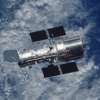
Actaea was discovered in images taken by the Hubble Space Telescope in July 2006. Hubble’s high spatial resolution allowed astronomers to distinguish the faint moon from the brighter light of Salacia.
Repeated Hubble observations subsequently enabled researchers to track Actaea at different positions around its parent. By measuring these changing positions, astronomers could determine:
- Its orbital period
- Its orbital distance
- Its orbital orientation
- The combined mass of Salacia and Actaea
- The extremely low eccentricity of the orbit
Archival Hubble observations have remained important even after more powerful observatories became available. Recent researchers used resolved Hubble photometry to determine which member of the system is primarily responsible for the brightness variations seen in unresolved ground-based observations. The evidence indicates that the measured light curve is mostly associated with surface variations on Salacia rather than Actaea.
Observations with Large Ground-Based Telescopes
Large observatories equipped with adaptive optics can also separate Actaea from Salacia under favourable conditions.
Adaptive optics measures the distortion caused by Earth’s atmosphere and rapidly corrects the telescope’s optics. This produces sharper images and allows astronomers to distinguish objects separated by only a tiny angle in the sky.
Observations of Salacia and Actaea with facilities such as the Keck Observatory have helped researchers:
- Confirm the moon’s orbit
- Measure the brightness difference between the two bodies
- Compare their visible and near-infrared colours
- Improve estimates of their relative sizes
- Refine the total mass of the system
Earlier Hubble and Spitzer studies found that Salacia and Actaea have broadly similar optical colours. This similarity may indicate related surface materials, although it does not prove that the moon formed directly from Salacia.
Why Actaea’s Surface Cannot Yet Be Mapped
Even the best available images do not reveal mountains, craters, plains, or other surface features on Actaea.
The problem is not simply that the moon is faint. Its physical diameter is only a few hundred kilometres, while its distance from Earth is billions of kilometres. At that range, the entire object occupies an extremely small angle in the sky.
Current images can show:
- Actaea’s position relative to Salacia
- Its relative brightness
- Changes in brightness over time
- Its orbital motion
They cannot yet show:
- Individual craters
- Surface colour regions
- Ice deposits
- Geological structures
- The shape of the body with high precision
Descriptions of Actaea as a dark, icy, cratered, or irregular world are therefore scientific expectations rather than features directly photographed on its surface.
What Brightness Measurements Can Reveal
Although Actaea cannot be mapped directly, astronomers can monitor how the total brightness of the system changes over time.
A rotating body with an uneven surface may appear brighter when a more reflective region faces Earth and darker when a less reflective region rotates into view. An elongated object can also produce a repeating light curve because its visible cross-sectional area changes during rotation.
Approximately 16 years of photometric monitoring revealed a repeating brightness cycle closely matching Actaea’s 5.49-day orbital period. When these data were combined with resolved Hubble measurements, the researchers found significant evidence that Salacia’s rotation is synchronized with Actaea’s orbit.
The measured peak-to-peak variation was approximately 0.09 magnitude. The study interpreted this signal as evidence of longitudinal differences across Salacia’s surface, although the exact nature of those differences remains unknown.
Why JWST Could Not Separate Actaea from Salacia
The James Webb Space Telescope has obtained the most detailed infrared spectrum yet recorded for the Salacia–Actaea system.
JWST’s Near-Infrared Spectrograph observed the pair across wavelengths from approximately 0.7 to 5.1 micrometres. The resulting spectrum revealed prominent water-ice absorption bands and a carbon dioxide ice feature.
However, Actaea was fully blended with Salacia at the spatial resolution of the observation. JWST therefore measured the combined reflected light of both bodies rather than producing separate spectra for the moon and its parent.
The observations confirm that exposed water ice and carbon dioxide ice are present somewhere within the system. They do not yet reveal:
- Whether both bodies contain the same amount of ice
- Whether Actaea is more ice-rich than Salacia
- Which object produces most of the carbon dioxide feature
- Whether their ice grains have similar sizes
- How the materials are distributed across either surface
Obtaining separate infrared spectra of Salacia and Actaea would be one of the most valuable future advances in the study of this system.
Stellar Occultations – Using a Distant Star as a Probe
A stellar occultation occurs when a Solar System body passes directly in front of a distant star.
As the object blocks the star’s light, observers record the exact time when the star disappears and reappears. Observations from several locations can trace different paths across the shadow, allowing researchers to reconstruct the object’s size and shape.
For Actaea, a successful multi-chord occultation could provide:
- A more direct diameter measurement
- Evidence of whether the body is spherical or elongated
- Limits on a possible atmosphere
- Improved orbital positioning
- A more accurate estimate of its surface reflectivity
- A better density estimate when combined with mass constraints
A particularly valuable double-occultation opportunity involving both Salacia and Actaea was identified for August 2024, and Hubble astrometry was requested to refine the predicted shadow paths. A published final scientific analysis of that campaign was not identified in the sources reviewed here, so no result from the event should yet be claimed.
Could Actaea Have an Atmosphere?
No atmosphere has been detected around Actaea.
Given its estimated diameter and likely low mass, its gravity is probably too weak to retain a substantial atmosphere over billions of years. Lightweight gases would tend to escape into space, especially after impacts or temporary heating.
It remains theoretically possible that Actaea could occasionally develop an extremely thin and temporary exosphere produced by:
- Surface ice sublimation
- Micrometeorite impacts
- Charged-particle interactions
- Release of trapped gases
There is currently no observational evidence confirming such an exosphere. A high-quality stellar occultation would be one of the most effective ways to search for it.
Is Actaea Geologically Active?
There is no direct evidence of present-day geological activity on Actaea.
Its small size suggests that it probably lost most of its original internal heat long ago. However, the moon may have experienced greater internal heating earlier in its history when its orbit was more eccentric and tidal forces were stronger.
Possible ancient processes include:
- Tidal deformation
- Internal cracking
- Movement of water ice
- Impact-driven resurfacing
- Temporary melting within the interior
These possibilities remain theoretical. No cryovolcano, fracture system, young terrain, or geological deposit has been directly observed on Actaea.
The water-ice and carbon dioxide features detected by JWST apply to the blended system and cannot currently be used as proof of geological activity specifically on the moon.
Comparing Actaea with Other Trans-Neptunian Moons
Actaea belongs to a diverse group of satellites orbiting large objects beyond Neptune.
| Moon | Parent Object | Scientific Importance |
|---|---|---|
| Actaea | Salacia | Large moon in a compact, nearly circular, probably doubly synchronous system |
| Charon | Pluto | Exceptionally large moon whose mass strongly affects the system’s shared barycentre |
| Dysnomia | Eris | Satellite associated with another system showing synchronous tidal evolution |
| Vanth | Orcus | Large moon whose origin may involve collision, capture, or primordial binary formation |
| Ilmarë | Varda | Compact companion useful for determining Varda’s mass and density |
| Weywot | Quaoar | Smaller moon on a more eccentric orbit, contrasting with Actaea’s circular path |
Actaea is not as dominant relative to Salacia as Charon is relative to Pluto. Nevertheless, it is large enough and close enough to have significantly altered Salacia’s rotation through tidal interaction.
The systems of Salacia–Actaea, Orcus–Vanth, and Varda–Ilmarë share several orbital characteristics, including compact mutual orbits compared with their Hill spheres. These similarities may point toward related formation histories or similar tidal evolution after formation.
Actaea and Charon – Important Differences
Actaea is sometimes compared with Charon because both moons have had major tidal effects on their parent bodies.
However, the two systems are not equally balanced.
Charon is exceptionally large relative to Pluto, and the centre of mass of the Pluto–Charon system lies outside Pluto. Actaea is much smaller relative to Salacia, so the system’s barycentre is expected to remain within Salacia.
The similarities are nevertheless important:
- Both systems have nearly circular mutual orbits.
- Both show strong tidal evolution.
- Both appear to have synchronized rotation.
- Each moon allows the total system mass to be calculated.
- Both preserve information about formation in the early Kuiper Belt.
Salacia–Actaea therefore represents a smaller-scale example of the kind of tidal equilibrium most famously observed in the Pluto–Charon system.
The Long-Term Future of Actaea
If Salacia and Actaea are fully synchronized, the system has already approached the final stable stage of ordinary tidal evolution.
Under this interpretation:
- Actaea is not expected to spiral rapidly inward.
- It is not currently moving outward at a significant rate.
- Salacia’s rotation is no longer transferring substantial angular momentum into the orbit.
- The nearly circular orbit should remain stable for extremely long periods.
This conclusion assumes that the system is not significantly disturbed by a collision or an unusually close encounter with another object.
Because Actaea’s orbit is extremely compact compared with Salacia’s gravitational region of control, ordinary external perturbations are unlikely to remove it easily. This is an inference from the measured compact orbit and probable tidal equilibrium rather than a direct prediction of every possible future encounter.
Could a Spacecraft Visit Actaea?
No spacecraft has visited Salacia or Actaea, and all current knowledge comes from remote observations.
A future mission to the system could investigate:
- Actaea’s true shape and dimensions
- Surface geology and crater distribution
- Water-ice and carbon dioxide distribution
- Surface composition and colour
- Mass and density of each body separately
- Internal structure
- Possible rings or additional satellites
- The exact rotational state of both objects
A flyby could obtain valuable information, but an orbiter would provide the most complete scientific return. Reaching the system would be technically challenging because of its enormous distance from the Sun and the long travel time required.
No detailed surface description should therefore be treated as confirmed until Actaea is spatially resolved by significantly more powerful observations or visited by a spacecraft.
Frequently Asked Questions
Is Actaea a dwarf planet?
No. Actaea is a natural satellite because it orbits Salacia rather than orbiting the Sun independently.
Salacia itself is often described as a dwarf-planet candidate because it may be sufficiently massive to have a rounded shape. However, it is not one of the five dwarf planets formally recognized by the International Astronomical Union: Ceres, Pluto, Haumea, Makemake, and Eris.
Is Actaea larger than Pluto’s moon Charon?
No. Charon is substantially larger.
Actaea is nevertheless a sizeable trans-Neptunian satellite and is unusually important because of its strong tidal relationship with Salacia.
Has Actaea been photographed?
Yes, but only as a faint point of light separated from Salacia.
No photograph currently reveals its surface geography.
Does Actaea contain water ice?
Water ice has been detected in the combined infrared spectrum of Salacia and Actaea.
Because the two objects were blended in the JWST observations, water ice has not yet been independently measured on Actaea alone.
Does Actaea always show the same side to Salacia?
It is strongly expected to do so.
Recent research also provides significant evidence that Salacia shows the same hemisphere toward Actaea, making the pair a doubly synchronous system. The conclusion is well supported by photometric and orbital evidence but has not been confirmed through direct surface imaging.
Could Actaea support life?
There is no evidence that Actaea supports life.
Its extremely cold environment, small size, weak gravity, and lack of a confirmed atmosphere make surface habitability highly unlikely. Speculative ancient subsurface heating cannot currently be tested with available observations.
Could Actaea have smaller moons?
No additional moon has been confirmed around Actaea or elsewhere in the Salacia system.
Very small companions would be difficult to detect, so deeper high-resolution observations could still search for them.
Why is Actaea scientifically important?
Its orbit allows astronomers to calculate the system’s mass. Its tidal relationship with Salacia also provides clues about the internal properties, composition, and history of both bodies.
Without Actaea, far less would be known about Salacia.
Remaining Scientific Questions
Several major questions remain unanswered:
- What is Actaea’s exact diameter?
- What is its individual mass and density?
- Is its surface composition identical to Salacia’s?
- Which body dominates the water-ice and carbon dioxide signatures?
- Did Actaea form through collision, capture, or gravitational collapse?
- Is the moon spherical or irregular?
- Does it contain ancient impact basins?
- Did tidal heating ever modify its interior?
- Are the two objects perfectly synchronized?
- Does the system contain additional small satellites or debris?
Answering these questions will require a combination of resolved spectroscopy, occultation measurements, improved thermal modelling, and possibly future spacecraft exploration.
Final Thoughts
Actaea is a small and distant world, but it plays a central role in understanding one of the Kuiper Belt’s most intriguing binary systems.
Its orbit has allowed astronomers to measure the mass of the Salacia–Actaea system. Its nearly circular path records billions of years of tidal evolution. Its probable synchronous rotation suggests that both bodies have reached a state of mutual gravitational equilibrium.
At the same time, Actaea remains largely unexplored. Its true shape, internal structure, surface geology, exact composition, and formation history are still unknown.
Recent Hubble photometry, long-term ground-based monitoring, and JWST spectroscopy have transformed scientific understanding of the system. Yet these observations have also demonstrated how much remains hidden: even JWST could not obtain a spectrum of Actaea separately from Salacia.
Actaea therefore represents both progress and mystery. It is a dark Kuiper Belt moon whose presence reveals the mass, density, and tidal history of its parent, while its own surface remains beyond the resolving power of modern astronomy.
Future observations may eventually separate the two bodies spectroscopically, measure Actaea through a stellar occultation, and reveal whether its surface is dominated by ancient ice, dark organic compounds, impact debris, or a mixture of all three.
Until then, Actaea remains a faint but scientifically powerful companion—an essential key to understanding Salacia and the formation of satellite systems in the distant outer Solar System.