








Amycus
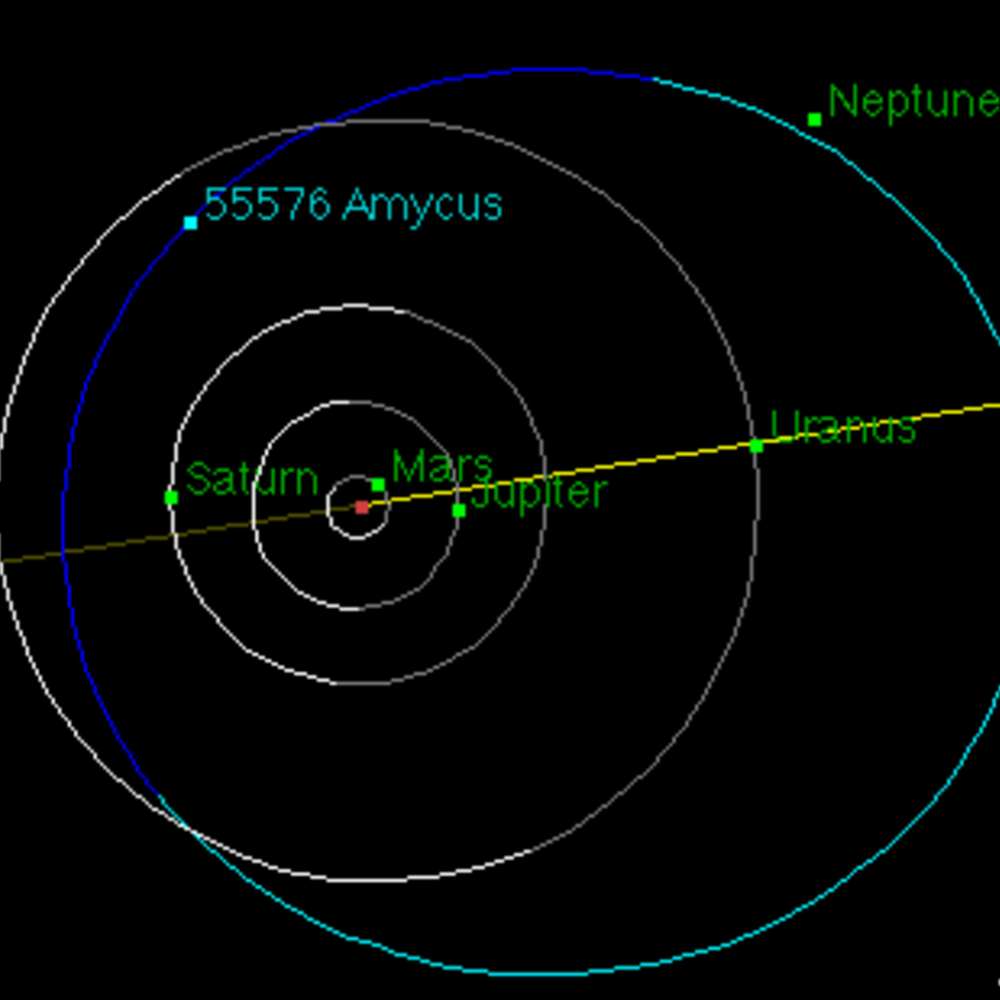
Amycus is a distant Centaur following an elongated and dynamically unstable orbit in the outer Solar System. It travels from inside Uranus’s average orbital distance to beyond the average orbit of Neptune, taking approximately 125 years to complete one journey around the Sun.
Thermal observations indicate that Amycus is roughly 104 kilometres in diameter. It has a reddish surface, a moderate-to-low reflectivity and tentative evidence of surface water ice. No spacecraft has visited it, so its physical appearance remains known only through remote observations.
Quick Reader
| Attribute | Details |
|---|---|
| Official Name | (55576) Amycus |
| Provisional Designation | 2002 GB10 |
| Object Type | Centaur |
| Discovery Date | 8 April 2002 |
| Discovery Programme | Near-Earth Asteroid Tracking |
| Discovery Site | Palomar Observatory, California |
| Perihelion | About 15.2 AU |
| Aphelion | About 34.8 AU |
| Semi-Major Axis | About 25.0 AU |
| Orbital Period | About 125 years |
| Orbital Eccentricity | About 0.39 |
| Orbital Inclination | About 13.3° |
| Estimated Diameter | About 104 km |
| Geometric Albedo | About 0.083 |
| Reported Rotation Period | About 9.76 hours |
| Lightcurve Amplitude | About 0.16 magnitude |
| Surface Classification | RR, or very red |
| Surface Water Ice | Tentatively detected |
| Confirmed Moon or Rings | None |
| Spacecraft Visits | None |
What Is Amycus?
Amycus, officially designated (55576) Amycus, is a Centaur—a member of a population of small bodies moving through the region of the giant planets.
The classification describes its orbit rather than proving that it has one particular composition. Centaurs may contain mixtures of ice, rocky grains, carbon-rich material and complex organic compounds. Some display cometary activity, while others appear inactive.
NASA’s JPL Small-Body Database classifies Amycus as a Centaur. Its orbit extends from approximately 15.2 to 34.8 astronomical units from the Sun. One astronomical unit, or AU, is the average distance between Earth and the Sun.
Because Uranus orbits at an average distance of about 19.2 AU and Neptune at about 30.1 AU, Amycus moves from inside Uranus’s orbital distance to beyond Neptune’s. This large change in distance is produced by its noticeably eccentric orbit.
Discovery of Amycus
Amycus was discovered on 8 April 2002 by the Near-Earth Asteroid Tracking programme, commonly known as NEAT, during observations at Palomar Observatory in California.
It initially received the provisional designation 2002 GB₁₀. After astronomers collected enough observations to establish a reliable orbit, it received the permanent minor-planet number 55576.
NEAT was designed primarily to search for objects that might approach Earth, but its wide-field observations also detected many objects located much farther away. Amycus itself is not a near-Earth object and does not presently approach Earth’s orbit.
How Amycus Received Its Name
Amycus was named after a male Centaur from Greek mythology.
According to the official naming explanation preserved by JPL, the mythological Amycus was among the first Centaurs to take part in the battle between the Centaurs and the Lapiths. The astronomical name follows the tradition of naming members of this orbital population after Centaurs and related figures from classical mythology.
The name should not be confused with another mythological Amycus, the king of the Bebrycians. The minor planet’s namesake is specifically the Centaur associated with the conflict at the wedding of Pirithous.
The Orbit of Amycus
Amycus follows a broad, elongated orbit around the Sun.
At perihelion—its nearest point to the Sun—it is approximately 15.2 AU away. At aphelion—its farthest point—it reaches roughly 34.8 AU. Its average orbital distance, represented by the semi-major axis, is about 25 AU.
It completes one revolution in approximately 125 Earth years.
| Orbital Property | Approximate Value |
|---|---|
| Perihelion Distance | 15.2 AU |
| Aphelion Distance | 34.8 AU |
| Semi-Major Axis | 25.0 AU |
| Orbital Period | 125 years |
| Eccentricity | 0.39 |
| Inclination | 13.3° |
An eccentricity near 0.39 means that its orbit is significantly elongated rather than nearly circular. Its inclination of about 13.3 degrees places its path at a noticeable angle to the main plane in which the planets orbit.
Amycus is also located close to the 3:4 mean-motion resonance with Uranus. However, being near a resonance does not necessarily mean that the object is securely protected by it. Dynamical studies describe its orbit as unstable over sufficiently long timescales.
Its exact future path cannot be predicted indefinitely. Repeated gravitational interactions with the outer planets can gradually change a Centaur’s eccentricity, inclination and distance from the Sun.
How Large Is Amycus?
The best-supported thermal analysis in the Herschel Centaur study estimated Amycus to have an effective diameter of approximately 104 ± 8 kilometres.
The same analysis found a visible geometric albedo of approximately 0.083, with an uncertainty of about 0.015–0.016. This means the surface reflects roughly 8% of incident visible light under the standard geometry used for albedo measurements.
Earlier Spitzer-based work produced a smaller diameter of about 76 kilometres and a higher albedo near 0.18. Another infrared estimate listed by JPL is approximately 101 kilometres but carries a much larger uncertainty. These values differ because thermal estimates depend on the available wavelengths, measured heat emission and assumptions within the thermal model.
For a general science page, the most defensible description is:
Amycus is estimated to be about 104 kilometres in diameter, although older measurements produced different values.
The term “effective diameter” does not prove that Amycus is a perfect sphere. It describes the diameter of a spherical body that would produce a similar thermal signal.
Rotation and Possible Shape
Photometric observations found a reported rotational period of approximately 9.76 hours, with a brightness variation of about 0.16 magnitude.
A lightcurve measures how an object’s brightness changes over time. These variations may be caused by:
- An irregular shape
- Differences in surface reflectivity
- A combination of shape and surface markings
Some lightcurve summaries also list a possible double-peaked period of 19.52 hours. A double-peaked interpretation may apply when an elongated body presents two similar broad sides during one complete rotation. Current evidence is insufficient to map the exact shape directly, so 9.76 hours should be presented as the reported photometric rotation period rather than an unquestionable final value.
Amycus is too distant to appear as a resolved world in ordinary telescope images. Its true shape, pole orientation and surface features remain unknown.
The Surface Colour of Amycus
Amycus belongs to the very red end of the Centaur colour range. In astronomical observations, “red” means that its surface reflects proportionally more light at longer visible wavelengths than at shorter wavelengths.
This does not mean that Amycus would appear bright red to an observer nearby. Because it reflects only a small portion of the sunlight reaching it, the surface would probably look dark reddish-brown.
Visible spectroscopy shows a steep red spectral slope. Amycus is commonly placed in the RR taxonomic class, which contains some of the reddest small bodies in the outer Solar System. Different observing runs have produced slightly different spectral slopes, but the differences are small enough that they may result from measurement conditions rather than major surface changes.
What Is Amycus Made Of?
The exact composition of Amycus remains uncertain.
Near-infrared observations have produced tentative evidence of water ice. The word “tentative” is important because the available spectral data do not establish the strength, distribution or physical state of the ice with complete confidence. Scientific catalogues of outer Solar System surfaces have therefore marked water ice on Amycus as possible rather than securely confirmed.
Its surface may contain a mixture of:
- Water ice
- Dark carbon-rich material
- Complex radiation-processed compounds
- Dust and mineral grains
The reddish colour may be associated with complex organic-rich material produced or altered by long exposure to ultraviolet radiation and energetic particles. However, colour alone cannot identify one specific chemical compound.
Amycus has spent a long time in the cold outer Solar System, where radiation can gradually darken and chemically alter exposed surface materials. Impacts may occasionally uncover fresher material from below the weathered surface.
Has Amycus Shown Cometary Activity?
No confirmed coma or sustained dust activity has been reported for Amycus.
Researchers have also searched for carbon-monoxide emission from several distant Centaurs. A 2002 radio observation of Amycus produced only an upper limit rather than a confirmed detection of CO gas. This means that the observation did not reveal measurable CO outgassing at the achieved sensitivity, but it cannot prove that Amycus contains no volatile material.
Amycus is therefore best described as an apparently inactive Centaur.
Some Centaurs release gas and dust even at large distances from the Sun, while many others remain inactive. The exact processes responsible for distant Centaur activity are still under investigation and may involve highly volatile compounds, internal heating or changes in the structure of water-rich ice.
Because the perihelion of Amycus is approximately 15.2 AU, it never approaches the Sun closely enough for ordinary surface water ice to behave like it does on comets near Earth. Any future activity would probably require more volatile substances or a major change in its orbit.
Where Did Amycus Originate?
Amycus probably originated in a population beyond Neptune and was later scattered into the region of the giant planets.
Centaurs are generally regarded as a transitional population connecting trans-Neptunian objects with bodies that may eventually evolve toward comet-like orbits. Gravitational interactions can move objects inward from distant source regions and place them temporarily on paths crossing or approaching the orbits of giant planets.
The exact birthplace of Amycus cannot be reconstructed. Centaur orbits are chaotic, meaning that small uncertainties grow rapidly when their trajectories are calculated far into the past or future.
It is therefore safer to say that Amycus was probably scattered inward from the trans-Neptunian region rather than claiming that it formed in one precisely known location.
The Future of Amycus
Amycus follows an unstable orbit near the 3:4 mean-motion resonance with Uranus. Its proximity to the resonance does not appear to provide permanent protection from gravitational disruption.
Over long periods, interactions with Uranus, Neptune and possibly other giant planets may change its orbit. Possible population-level outcomes for Centaurs include:
- Transfer into another Centaur orbit
- Movement toward the inner giant-planet region
- Evolution toward a comet-like orbit
- Scattering back toward the trans-Neptunian region
- Ejection from the planetary system
- Collision with the Sun or a planet
These possibilities describe the general evolution of Centaurs, not a certain prediction for Amycus. Studies show that active and inactive Centaurs can experience several different dynamical end states, depending on their encounters with the planets.
Amycus is not an Earth-crossing object. Its closest point to the Sun remains about 15 times farther from the Sun than Earth’s orbit, so it poses no known present impact threat.
Why Amycus Is Important
Amycus provides scientists with a useful example of a large, red and apparently inactive Centaur.
A Link Between Distant Populations
Its orbit helps researchers investigate how objects move between the trans-Neptunian region and the domain of the giant planets.
A Very Red Centaur Surface
The strong red colour of Amycus contributes to studies of the wide range of surface colours found among Centaurs. These colour differences may reflect composition, radiation exposure, impact history and previous thermal processing.
Possible Surface Ice
Tentative evidence of water ice makes Amycus valuable for comparing icy material on Centaurs with that found on Kuiper Belt objects and comet nuclei.
An Inactive Comparison Object
Amycus can be compared with active Centaurs such as Chiron, Echeclus and 29P/Schwassmann–Wachmann 1. Such comparisons may help astronomers understand why some Centaurs develop comae or outbursts while others do not.
What Remains Unknown?
Astronomers still do not know:
- The exact three-dimensional shape of Amycus
- Whether its full rotation period is 9.76 or 19.52 hours
- Its spin-axis direction
- Its mass and density
- Its internal structure
- The exact composition of its red surface
- How much water ice may be present
- Whether it has ever displayed weak activity
- Whether it possesses a small moon or rings
- Its exact formation location
- Its eventual orbital fate
No spacecraft has visited Amycus, and existing telescopes see it as an unresolved point of light.
Frequently Asked Questions
How large is Amycus?
The best-supported thermal estimate gives an effective diameter of approximately 104 kilometres, with an uncertainty of about eight kilometres.
How long is a year on Amycus?
Amycus takes approximately 125 Earth years to complete one orbit around the Sun.
How quickly does Amycus rotate?
Photometric observations produced a period of approximately 9.76 hours. A double-peaked interpretation could indicate a complete rotation of about 19.52 hours, so the exact spin period is not fully settled.
What colour is Amycus?
Amycus has a very red reflected-light spectrum. It would probably appear dark reddish-brown rather than bright red.
Is there water ice on Amycus?
Some spectral observations provide tentative evidence of water ice, but its presence and abundance have not been established with complete certainty.
Is Amycus an active comet?
No confirmed coma or sustained activity has been reported. It is currently described as an apparently inactive Centaur.
Does Amycus have a moon or rings?
No moon or ring system has been confirmed.
Has a spacecraft visited Amycus?
No spacecraft has visited Amycus.
Conclusion
Amycus is a large, very red Centaur moving through the distant region occupied by Uranus and Neptune.
Its approximately 125-year orbit, estimated 104-kilometre diameter and unusual surface colour make it an important target for outer Solar System research. Observations suggest a dark, radiation-processed surface with possible water ice, although its exact composition remains unknown.
Amycus currently shows no confirmed cometary activity. Its unstable orbit, however, indicates that its present path is probably temporary on astronomical timescales.
By studying Amycus, astronomers can better understand how primitive objects migrate inward from beyond Neptune, how Centaur surfaces evolve and why only some members of this transitional population develop visible comet-like activity.