






Southern Sky Structure
Caelum Supercluster: SCl 59 and the Hidden Southern Web
The Caelum Supercluster is a catalogued galaxy supercluster, also known as SCl 59, seen toward the faint southern constellation Caelum and studied through redshift maps of galaxy clusters.
It is not a familiar naked-eye object. Its importance comes from scale, uncertainty, and context: the structure helps show how astronomers turn scattered galaxy-cluster redshifts into a three-dimensional map of the cosmic web.
Map Preview
Trace the Caelum Supercluster Through Cluster Nodes
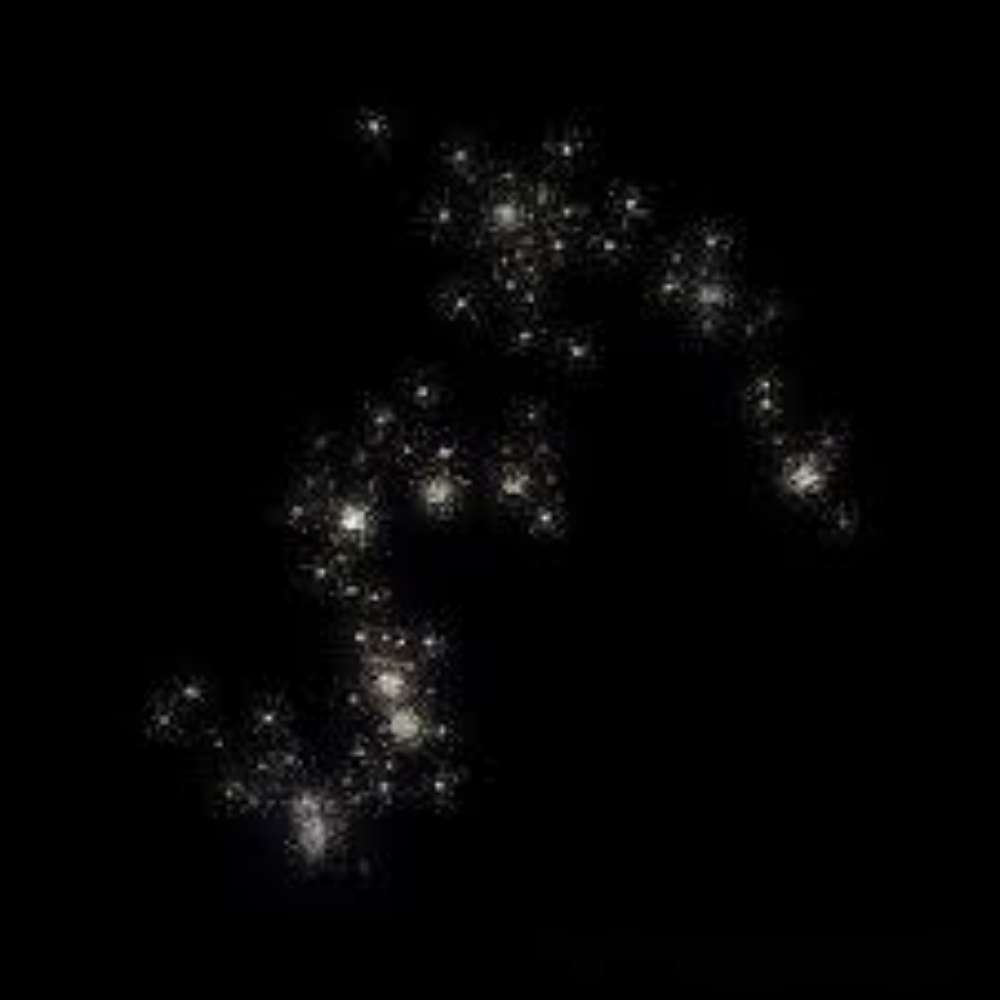
The preview represents a loose chain of galaxy-cluster concentrations connected by simplified filaments. It is designed to communicate the idea of a supercluster without pretending that the layout is a direct telescope image.
Caelum Supercluster Quick Facts
This is a distant large-scale structure entry in supercluster catalogues, not a single galaxy cluster. The values below should be read as catalogue-scale estimates because supercluster boundaries depend on the redshift sample and linking method used.
| Attribute | Details |
|---|---|
| Name | Caelum Supercluster, also identified as SCl 59 |
| Object class | Supercluster of galaxies and galaxy clusters |
| Sky direction | Toward Caelum, a faint southern constellation |
| Approximate center | Right ascension 04h 43m, declination about -33 degrees 30 minutes |
| Redshift | Commonly listed near z 0.126 in summary catalogues |
| Reported extent | About 280 Mpc, or about 910 million light-years, in commonly repeated catalogue summaries |
What Is the Caelum Supercluster?
The Caelum Supercluster is best understood as a large overdensity traced by galaxy clusters. It is not one gravitationally relaxed object like a single cluster, and it is not something that has a sharp visible edge in the sky.
Astronomers identify structures like this by measuring galaxy and cluster redshifts, converting those redshifts into distance estimates, and looking for linked concentrations that rise above the surrounding field.
Caelum Supercluster Location in the Southern Sky
Caelum is a small southern constellation introduced by Nicolas-Louis de Lacaille. The constellation itself is faint, but the direction matters because southern redshift surveys have historically been essential for filling gaps in large-scale maps.
The supercluster entry is usually placed near right ascension 04h 43m and declination around -33.5 degrees. That position is a sky direction toward a distant structure, not a nearby object inside the constellation's stars.
Caelum Supercluster Distance and Redshift
The structure is commonly associated with a redshift around z 0.126. At that redshift, cosmological distance depends on which distance definition is being used, so articles should avoid mixing light-travel distance, luminosity distance, and comoving distance as if they were the same value.
Public summaries often describe the near side as roughly 1.4 billion light-years away and list a larger comoving distance near two billion light-years. The cleanest way to present it is to state the redshift first, then explain that distance estimates are cosmology-dependent.
Caelum Supercluster Size and Reported Extent
The often cited size is about 280 Mpc, or roughly 910 million light-years. That makes it enormous by everyday standards, but the number should be treated as a catalogue-scale extent across linked components rather than the diameter of a single bound body.
Superclusters are usually irregular networks of clusters, groups, sheets, and filaments. Their measured size can change when astronomers use a different galaxy sample, redshift limit, or linking length.
Caelum Supercluster Evidence From Redshift Catalogues
The foundation for this type of work comes from catalogues of Abell and ACO galaxy clusters, plus spectroscopic surveys that measure how far galaxies and clusters lie along the line of sight.
The 2014 catalogue work by Chow-Martinez, Andernach, Caretta, and Trejo-Alonso presented all-sky and southern supercluster catalogues out to redshift 0.15. Their method used a tunable friends-of-friends approach so that linking length could respond to survey completeness.
Caelum Supercluster as SCl 59
The SCl naming comes from supercluster catalogue work rather than from a visual discovery image. In that sense, SCl 59 is a map label: it tells readers that this object belongs to a structured catalogue of large-scale galaxy-cluster associations.
This distinction is useful for search visitors. Someone looking for the object may see dramatic claims, but the more accurate view is that SCl 59 is a catalogued large-scale overdensity whose exact physical interpretation depends on the data and method.
Caelum Supercluster Structure and Filaments
Like other superclusters, the structure is expected to be filamentary rather than spherical. Dense cluster nodes sit inside a looser network of galaxies, while emptier regions separate one concentration from another.
This is why the page should show a network-style visual rather than a planet-like sphere. The scientific idea is not a single solid object, but a web pattern formed by gravity, dark matter, galaxy clusters, and cosmic expansion.
Caelum Supercluster Compared With Better-Known Structures
Virgo and Laniakea are closer and more famous because they contain our local cosmic neighborhood. Shapley and Horologium-Reticulum are better studied because they are rich, prominent southern structures with extensive observational history.
Caelum is different. It is often introduced through scale lists, but its stronger educational value is showing how catalogue entries can be real and still uncertain in detail.
| Structure | Why It Matters | How to Compare |
|---|---|---|
| Laniakea | Defines the local flow basin containing the Milky Way | Closer and dynamically mapped through galaxy motions |
| Horologium-Reticulum | Rich southern supercluster complex | More prominent in observational literature |
| Caelum | Distant SCl catalogue structure toward a faint constellation | Useful for learning catalogue-based cosmic web mapping |
Is the Caelum Supercluster Gravitationally Bound?
Most superclusters are not fully virialized. The crossing times are often longer than the age of the universe, so their clusters preserve a memory of large-scale formation rather than behaving like a settled cluster.
For this object, the safest wording is that parts may represent a real overdense network, while the whole catalogue extent is not necessarily a single future-collapsing object. Dark energy and cosmic expansion matter on these scales.
Galaxies Inside the Caelum Supercluster Region
The visible galaxies trace only part of the mass. Most of the gravitational framework is dark matter, while the hot gas and galaxy populations inside clusters reveal how dense environments shape galaxy evolution.
Cluster cores tend to favor older elliptical and lenticular galaxies, while outskirts and filaments can preserve more spiral galaxies and ongoing star formation. That environmental contrast is one reason superclusters matter beyond simple size rankings.
Caelum Supercluster Surveys and Southern-Sky Mapping
Southern surveys such as 6dFGS helped make the southern sky far more useful for large-scale structure studies. The final 6dF release reported more than 136,000 spectra and more than 125,000 galaxies in its catalogue, giving astronomers a much stronger redshift base.
The 2dF Galaxy Redshift Survey also transformed large-scale structure work by measuring redshifts for roughly 220,000 galaxies. Together with cluster compilations and later surveys, these data sets explain how faint southern structures become mapable.
Why Caelum Supercluster Facts Need Care
Some online summaries call it one of the largest superclusters and repeat very large mass and galaxy-count estimates. Those statements should be handled carefully unless the page cites the exact catalogue definition behind them.
The better article strategy is to separate stable facts from interpretive claims: name, SCl identification, sky direction, redshift, catalogue context, and reported extent are central; claims about rank, total galaxy count, or future binding should be phrased as reported or uncertain.
How to Read the Caelum Supercluster Image
The image is a visual map concept, not a direct photograph of a 910-million-light-year structure. Individual galaxies and clusters are too distant and spread across too much volume to appear as one resolved object in a telescope frame.
Use the image as an orientation tool: it shows a dark southern-sky setting and suggests clustered concentrations, while the article explains the redshift evidence that gives the structure depth.
Caelum Supercluster FAQ
Is the Caelum Supercluster real?
It is listed as a supercluster in astronomical database and catalogue contexts, but its detailed size and interpretation depend on the redshift sample and linking method used.
What does SCl 59 mean?
SCl 59 is a supercluster catalogue identifier. It is a structured catalogue label, not the name of a single galaxy cluster.
How far away is it?
It is commonly associated with redshift near z 0.126, corresponding to a distance on the order of billions of light-years depending on distance definition.
Can it be seen with a telescope?
No amateur telescope will show the full structure. Individual member galaxies or clusters require deep surveys and redshift measurements to connect them into a supercluster map.
Is it larger than Laniakea?
Some summaries list a larger reported extent, but Laniakea is defined through galaxy flow mapping while Caelum is usually discussed as a catalogue supercluster, so the comparison is not one-to-one.