




Cosmic Web Landmark
CfA2 Great Wall: Coma Wall and Cosmic Web Structure
CfA2 Great Wall is the historic galaxy sheet also called the Coma Wall, a redshift-mapped structure that revealed how galaxies gather into vast walls around cosmic voids.
This guide explains what the wall is, how the CfA redshift surveys exposed it, why the Coma and Abell 1367 clusters anchor its densest regions, and how modern maps place it inside the larger cosmic web.
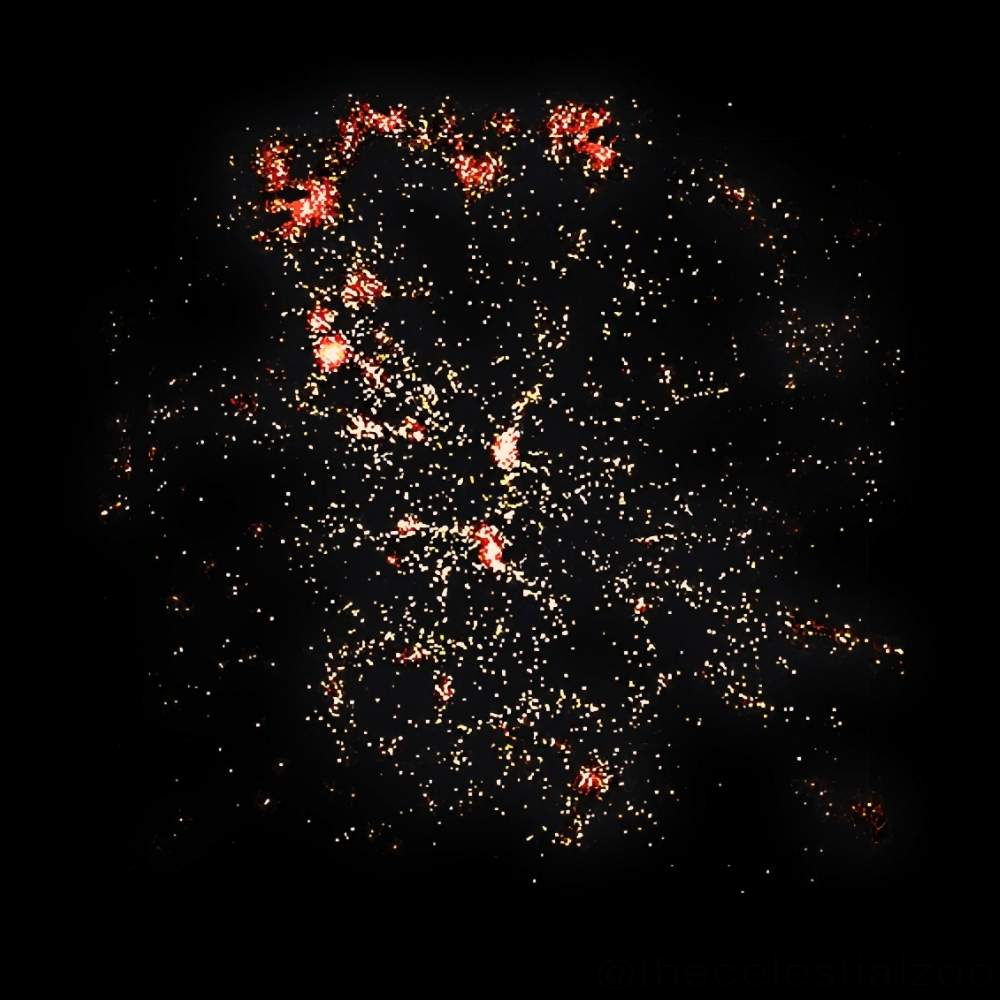
Map Preview
Explore the CfA2 Great Wall as a Galaxy Sheet
The preview treats the wall as astronomers first understood it: not a solid barrier, but a broad surface of galaxies and clusters. Bright knots represent dense cluster regions, while glowing ridges suggest filaments and sheets separating low-density voids.
CfA2 Great Wall Quick Facts
The structure is best understood as a nearby wall or sheet of galaxies highlighted by the Center for Astrophysics redshift surveys. Its best-known dense region passes through the Coma Cluster and Abell 1367, with galaxies spread across a much larger redshift-space pattern.
| Attribute | Details |
|---|---|
| Name | CfA2 Great Wall, often called the Coma Wall or Great Wall |
| Structure type | Large galaxy wall or sheet in the nearby large-scale universe |
| Key clusters | Coma Cluster, Abell 1367, and related groups and filaments |
| Discovery context | Revealed by CfA redshift survey slices in the 1980s and published as a major large-scale structure result in 1989 |
| Approximate scale | Hundreds of millions of light-years across, with values depending on cosmology and boundary definition |
| Scientific value | Evidence that galaxies trace sheets, filaments, clusters, and void boundaries rather than a random distribution |
What Is the CfA2 Great Wall?
The CfA2 Great Wall is a large concentration of galaxies mapped in redshift space. It is not a physical wall with an edge or surface like a solid object. It is a broad cosmic sheet where galaxies and clusters are more densely arranged than in the surrounding void regions.
The common name Coma Wall comes from the importance of the Coma region in the structure. The fuller name connects the discovery to the Center for Astrophysics redshift survey extension that made the pattern visible.
CfA2 Great Wall Discovery by Redshift Survey
The CfA redshift surveys measured galaxy velocities and used redshift as a distance indicator for large-scale mapping. When galaxies were plotted in wedge-shaped slices, the distribution did not look smooth. It showed sharp structures, empty regions, and long surfaces of galaxies.
Margaret Geller and John Huchra's 1989 work made the Great Wall famous as one of the first dramatic examples of large-scale structure in the nearby universe. Earlier CfA slices had already suggested a bubble-like pattern, and the expanded survey clarified how strong the wall-and-void geometry could be.
CfA2 Great Wall Structure and Scale
The wall stretches across a large angle of the sky and contains multiple concentrations rather than one single cluster. Papers describe it as passing through the Coma and Abell 1367 regions and extending toward other galaxy concentrations in the northern survey volume.
Published scale estimates depend on the chosen Hubble constant, survey boundary, and whether the structure is measured as a wall, sheet, or connected complex. A careful page should say hundreds of millions of light-years rather than imply a perfectly fixed size.
CfA2 Great Wall and the Coma Cluster
The Coma Cluster, also known as Abell 1656, is one of the densest and most studied parts of the wall. It contains a rich concentration of galaxies and hot intracluster gas, making it a major benchmark for cluster physics.
In maps, Coma appears as a bright node rather than the entire structure. That distinction matters for accuracy: the wall is the larger galaxy sheet, while the cluster is one major gravitational hub inside it.
CfA2 Great Wall and Abell 1367
Abell 1367, often called the Leo Cluster, is another important concentration along the wall. It is dynamically active and contains more star-forming galaxies than the more mature Coma Cluster.
The contrast between Coma and Abell 1367 helps users understand that a cosmic wall is not uniform. Some regions are mature cluster cores, while others are still accreting galaxies and groups through filaments.
CfA2 Great Wall in the Cosmic Web
The CfA2 Great Wall became important because it showed that galaxies organize into a web of walls, filaments, clusters, and voids. Modern simulations explain this pattern through gravitational growth from small early-universe density fluctuations.
Voids expand relative to denser regions, matter gathers along surfaces and filaments, and clusters grow where multiple streams intersect. The Coma Wall is a nearby, historically important example of that general cosmic web architecture.
CfA2 Great Wall and Redshift-Space Caution
Redshift surveys are powerful, but their maps must be read carefully. Galaxy velocities include cosmic expansion plus local gravitational motions. In dense clusters, this can stretch structures along the line of sight, creating effects often called fingers of God.
That does not erase the wall. It means the shape seen in a redshift map is a measured representation that needs interpretation. The best explanation combines redshift data, cluster catalogs, density analysis, and comparisons with simulations.
CfA2 Great Wall Compared With Sloan Great Wall
The Sloan Great Wall is larger and was mapped later using the Sloan Digital Sky Survey. The CfA2 Great Wall remains historically central because it arrived earlier and changed how astronomers thought about galaxy distribution.
| Feature | CfA2 Great Wall | Sloan Great Wall |
|---|---|---|
| Survey era | 1980s CfA redshift mapping | 2000s SDSS mapping |
| Main importance | Historic proof of wall-and-void galaxy structure | Larger and more detailed later wall complex |
| Reader takeaway | The discovery that made cosmic web structure vivid | A deeper survey example of the same large-scale pattern |
Why the CfA2 Great Wall Matters
The wall matters because it connected visual mapping to physical cosmology. It showed that galaxy clustering exists on scales far beyond single clusters and that voids are not empty accidents but major components of the cosmic pattern.
It also gave cosmologists a benchmark for testing cold dark matter simulations. A successful model must produce galaxies that gather into filaments, sheets, and clusters without violating the large-scale uniformity of the universe.
How to Read the CfA2 Great Wall Image
The image should be read as a galaxy-distribution visualization, not a telescope photograph of a solid wall. Bright concentrations represent dense regions such as clusters and groups, while scattered points and glowing strands suggest surrounding filaments.
The black regions are just as important as the bright ones. They help communicate the wall-and-void pattern that redshift surveys revealed: matter collects around large underdense spaces rather than filling the universe evenly.
CfA2 Great Wall FAQ
Is the Coma Wall the same as the CfA2 Great Wall?
In many educational contexts, yes. Coma Wall is a common name tied to the Coma region, while CfA2 Great Wall connects the structure to the CfA redshift survey discovery.
Is it a real wall in space?
No. It is a large sheet-like distribution of galaxies, groups, and clusters, separated from other dense regions by lower-density voids.
Who discovered it?
Margaret Geller and John Huchra made the Great Wall famous through CfA redshift survey work published in 1989, building on earlier CfA slice mapping.
Why does the URL say Coma Wall instead of CfA2 Great Wall?
Coma Wall is a shorter user-facing name. The page can still target CfA2 Great Wall by using the full term naturally in the title, first paragraph, headings, schema, and content.
Is it bigger than the Sloan Great Wall?
No. Sloan Great Wall is generally described as larger, but the CfA2 structure is earlier and historically more important for revealing the wall-and-void pattern.