




Local Universe Underdensity
KBC Void
The KBC Void is a proposed large underdensity around the local universe, where galaxy counts appear lower than the cosmic average across hundreds of megaparsecs.
It is not an empty hole in space. It is a possible large-scale density dip around our cosmic neighborhood, important because it may slightly bias local measurements of cosmic expansion and sharpen the debate around the Hubble tension.
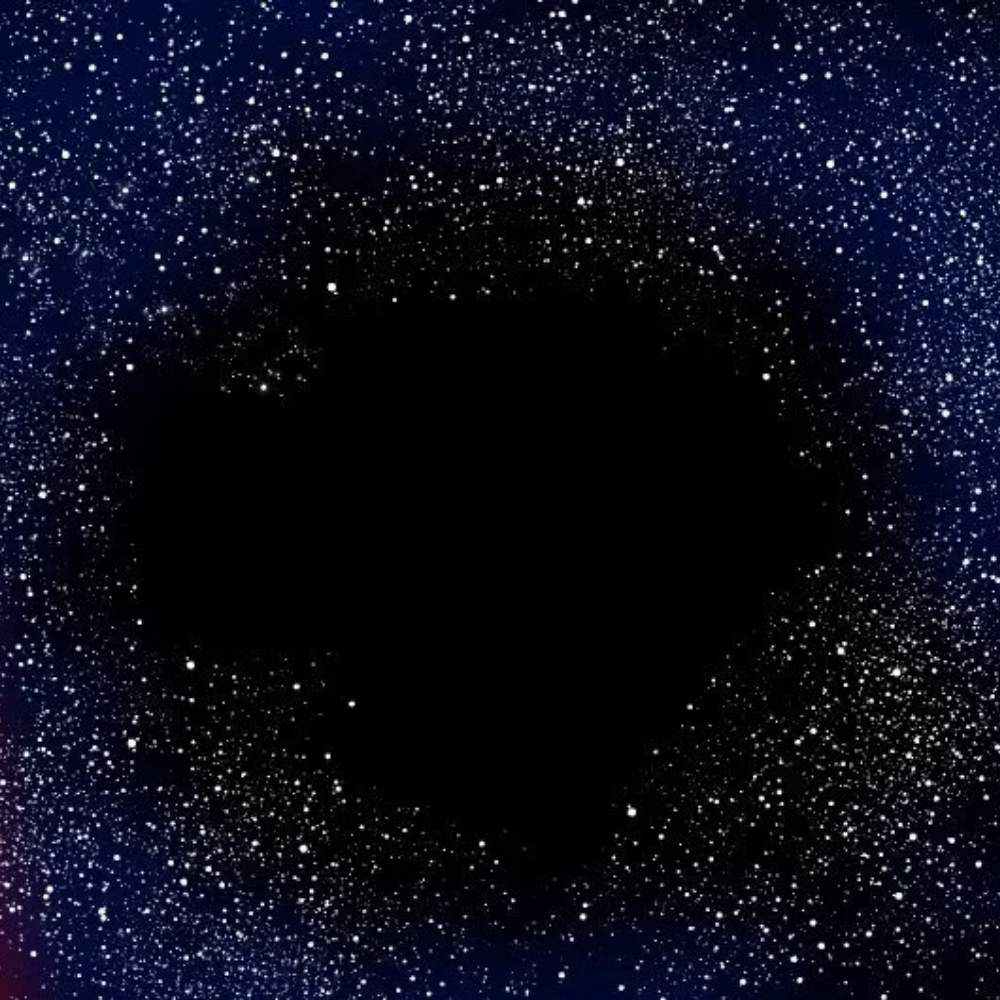
Interactive Density Preview
See the KBC Void as a density dip
This lightweight preview shows the idea behind a local underdensity: a darker low-density center surrounded by brighter galaxy-rich structures. It is an educational visual, not a measured sky survey map.
KBC Void Quick Facts
The KBC Void is also called the Keenan-Barger-Cowie void, local hole, or local supervoid. Its central idea is simple: the nearby universe may contain fewer galaxies and less luminous matter than regions farther away.
| Name | KBC Void, named after Ryan Keenan, Amy Barger, and Lennox Cowie |
|---|---|
| Object type | Large-scale local underdensity in the galaxy distribution |
| Core scale | Often discussed on scales of about 200-300 Mpc around the Local Group |
| Evidence type | Near-infrared galaxy counts and K-band luminosity density measurements |
| Key result | Keenan, Barger, and Cowie found a lower local luminosity density, with the density rising at larger redshift. |
| Cosmology relevance | It may influence local expansion measurements, but whether it solves the Hubble tension remains debated. |
What Is the KBC Void?
The KBC Void is a proposed large underdensity in the local universe. In plain language, it means our region may sit inside a vast zone where the average number of galaxies is lower than the average farther out.
This does not mean the region is empty. The Milky Way, the Local Group, the Virgo Cluster, and many surrounding galaxies still exist inside or near the region. A cosmic void is a relative term: it describes a lower density compared with the cosmic mean, not absolute nothingness.
How the KBC Void Was Found
The modern KBC Void result comes from measuring galaxy luminosity density as a function of redshift. Keenan, Barger, and Cowie used near-infrared data because K-band light is a useful tracer of stellar mass.
Their 2013 study examined the redshift range from about 0.01 to 0.2 and found that the nearby region was underdense compared with larger distances. In their measurements, luminosity density rose beyond the local volume, suggesting that the local universe may not be a fair sample of the cosmic mean.
The safe scientific takeaway: evidence for a local underdensity is real enough to study seriously, but its exact depth, shape, and cosmological importance depend on how surveys, redshifts, galaxy evolution, and cosmic flows are modeled.
KBC Void Size and Scale
The most common scale attached to the KBC Void is roughly 300 Mpc around the Local Group, or about one billion light-years in radial scale. Some popular descriptions talk about a billion-light-year class local underdensity, but exact wording matters because cosmological distance measures are not all the same.
For readers, the key idea is not a sharp edge. The KBC Void is better imagined as a broad density gradient: the nearby universe appears less dense, while galaxy counts and luminosity density rise toward more typical values at larger distances.
| Inner region | Lower galaxy luminosity density near the Local Group. |
|---|---|
| Transition region | Density rises with redshift as surveys look beyond the local underdensity. |
| Outer comparison | Farther measurements approach a more stable background luminosity density. |
KBC Void Evidence
The strongest evidence comes from galaxy counts and luminosity density. If galaxies trace the underlying mass distribution well enough, a lower luminosity density suggests a lower matter density in the local universe.
Several later studies discuss the local hole or KBC Void using optical, infrared, X-ray, and radio observations. The debate is not whether local structure exists; it is how deep the underdensity is, how far it extends, and how much it affects cosmological measurements.
Does the KBC Void Explain the Hubble Tension?
The KBC Void is often discussed because of the Hubble tension: the mismatch between local measurements of the universe's expansion rate and early-universe estimates from the cosmic microwave background.
If we live in a large underdensity, galaxies inside or near that region may flow outward faster than they would in a perfectly homogeneous universe. That can make the local expansion rate look higher than the global background rate.
But this is not settled. Some analyses argue the KBC Void could contribute significantly to the tension, while others test whether the effect is large enough using supernovae, baryon acoustic oscillations, or direct distance tracers.
Why the KBC Void Is Controversial
The KBC Void sits in a sensitive place in cosmology. Standard Lambda-CDM assumes the universe becomes statistically homogeneous on large enough scales. A very deep and very extended local underdensity can look uncomfortable for that picture.
However, cosmologists also expect some cosmic variance. The hard question is whether the KBC Void is a rare but allowed fluctuation, a survey interpretation issue, or evidence that structure formation is stronger than expected.
- Survey systematics: dust, selection effects, and galaxy evolution can affect number counts.
- Redshift-space distortion: outflows from a void can make the apparent density contrast look different from the real-space contrast.
- Model dependence: the answer changes depending on the assumed cosmology and flow model.
KBC Void and Our Local Universe
The Milky Way is part of the Local Group, which lies within the larger Laniakea flow region. The KBC Void idea places this familiar neighborhood inside a much broader low-density environment.
That makes the KBC Void a powerful reminder: where we observe from matters. Even if the universe is homogeneous on the largest scales, our local patch can still be unusually dense, unusually empty, or dynamically affected by nearby structures.
KBC Void Compared With Other Voids
The KBC Void is different from famous visual voids like the Bootes Void because it is centered around the local universe rather than being a distant patch on the sky. Its importance is less about emptiness you can point to and more about how local structure may bias measurements.
| KBC Void | Local underdensity around the Local Group, important for Hubble-flow debates. |
|---|---|
| Bootes Void | A famous distant void with very few galaxies compared with surrounding structures. |
| Local Void | A nearer underdense region adjacent to the Local Group, smaller than the KBC-scale claim. |
| Dipole Repeller | An underdense region associated with galaxy flow away from that direction. |
How Future Surveys Can Test the KBC Void
The future of the KBC Void question depends on better maps. Large spectroscopic and imaging surveys can measure galaxy density, peculiar velocities, weak lensing, and baryon acoustic oscillations across the local-to-global transition.
Why the KBC Void Matters
The KBC Void matters because it forces a careful question: are our local measurements truly local versions of the global universe, or are they partly shaped by the cosmic neighborhood we happen to occupy?
Even if it does not fully solve the Hubble tension, the KBC Void remains an important test case for cosmic variance, large-scale structure, galaxy survey calibration, and the assumption that the universe looks statistically average from our location.
KBC Void FAQ
What is the KBC Void?
The KBC Void is a proposed large local underdensity around the Local Group, named after Keenan, Barger, and Cowie.
Are we inside the KBC Void?
Many discussions of the KBC Void place the Local Group inside or near the center of the underdense region, but the exact geometry remains debated.
Is the KBC Void completely empty?
No. It contains galaxies, gas, and dark matter. It is called a void because its density appears lower than the cosmic average.
How large is the KBC Void?
It is commonly discussed as a roughly 300 Mpc scale local underdensity, corresponding to a billion-light-year class structure depending on how the scale is described.
Does the KBC Void solve the Hubble tension?
It may contribute to local expansion differences, but whether it can fully explain the Hubble tension is still debated.
Why is the KBC Void important?
It tests whether our local cosmic environment can bias measurements of expansion, matter density, and large-scale structure.
Selected References
- Keenan, Barger, and Cowie 2013: Evidence for a 300 Megaparsec Scale Under-density
- Keenan, Barger, and Cowie 2016: Local Large-Scale Structure and Homogeneity
- Haslbauer, Banik, and Kroupa 2020: KBC Void and Hubble Tension
- Testing the local void hypothesis with BAO measurements
- Testing the local supervoid solution with direct distance tracers