






Cosmic Neighborhood
Local Group
The Local Group is the gravitational family of galaxies that contains the Milky Way, Andromeda, Triangulum, and more than 50 known or candidate dwarf galaxies spread across roughly ten million light-years.
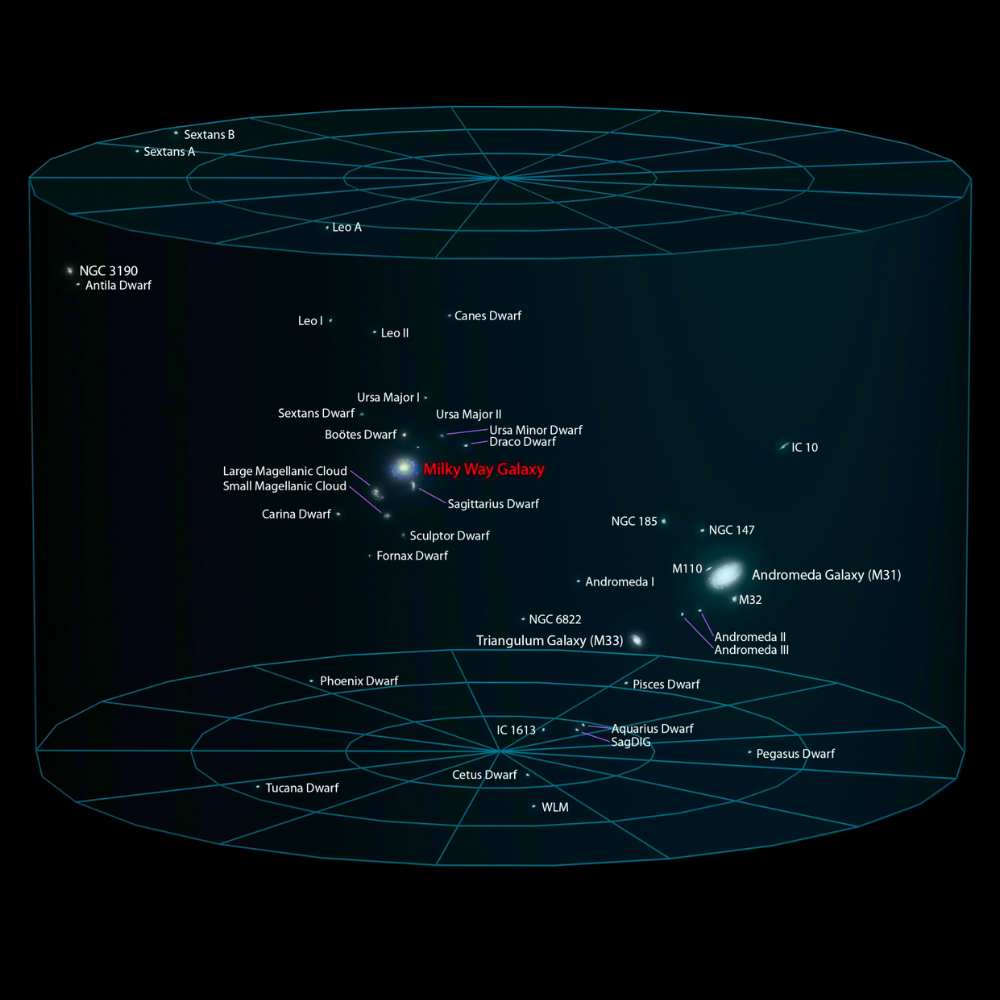
Explore the Local Group in 3D
The dedicated 3D view helps connect the article to a spatial map of the Milky Way, Andromeda, Triangulum, satellite galaxies, and the wider scale of the local galaxy neighborhood.
Local Group Quick Facts
The Local Group is not a cluster like Virgo or Coma. It is a smaller gravitationally bound group where a few large galaxies dominate the mass while many dwarf galaxies orbit within their extended dark matter halos.
| Attribute | Details |
|---|---|
| Name | Local Group |
| Dominant galaxies | Milky Way and Andromeda Galaxy, also known as M31 |
| Third-largest member | Triangulum Galaxy, also known as M33 |
| Member count | More than 50 known and candidate galaxies, mostly dwarfs |
| Approximate span | Nearly 10 million light-years across in common public descriptions |
| Larger environment | Near the Virgo Cluster region and within the broader Laniakea Supercluster context |
What Is the Local Group?
The Local Group is our closest galaxy-scale environment. It includes the Milky Way, Andromeda, Triangulum, the Magellanic Clouds, and many faint dwarf galaxies that are difficult to detect because they contain relatively few stars.
This neighborhood matters because it is close enough for astronomers to resolve individual stars, trace stellar streams, measure galaxy motions, and compare large spiral galaxies with the smaller dwarfs that surround them.
Local Group Main Galaxies
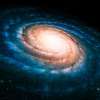
Three galaxies define the visible backbone of the Local Group: the Milky Way, Andromeda, and Triangulum. Together they set the scale for most maps of the region.
Local Group Dwarf Galaxies
Most Local Group members are dwarf galaxies. Some, like the Large and Small Magellanic Clouds, are bright companions of the Milky Way. Others are faint dwarf spheroidal systems that reveal themselves through careful star counts and motion measurements.
Dwarf galaxies are important because they preserve clues about galaxy formation, dark matter, chemical enrichment, and how larger galaxies grow by accreting smaller systems over cosmic time.
Local Group Satellite Systems
The Milky Way and Andromeda each have satellite systems. Around the Milky Way, the Magellanic Clouds, Sagittarius Dwarf, Draco, Ursa Minor, Fornax, Sculptor, and other systems help trace the shape and mass of the galactic halo.
Andromeda has its own rich satellite population, including M32 and NGC 205, along with many fainter dwarf companions. These satellites are not just small background objects. Their orbits, tidal tails, and star formation histories reveal how large galaxies assemble over billions of years.
Some satellites appear to lie in flattened arrangements, sometimes called planes of satellites. Their exact significance is debated, but they remain important tests for galaxy formation models and dark matter simulations.
Local Group Structure and Scale
The Local Group is often described as having two dominant centers: one around the Milky Way and one around Andromeda. This gives the region a broad twin-core structure rather than a neat sphere.
Many satellites orbit within the halos of the Milky Way or Andromeda, while more isolated dwarfs such as NGC 6822 and IC 1613 help trace the wider boundary between the group and the surrounding local flow.
How to Read a Local Group Map
A Local Group map should not be read like a flat star chart. The galaxies occupy three-dimensional space, and the most useful view depends on whether you want distance, gravitational grouping, or visual scale.
Start with the three large landmarks: the Milky Way, Andromeda, and Triangulum. Then look for dwarf galaxies clustered around the Milky Way and Andromeda halos. Finally, compare the isolated dwarfs near the outer boundary, because they show where the Local Group begins to blend into the surrounding cosmic environment.
Local Group Dark Matter
Visible stars do not provide enough mass to explain the motions of galaxies and satellites in the Local Group. Dark matter halos around the Milky Way, Andromeda, and smaller systems are central to understanding how the group remains gravitationally bound.
Satellite motions, stellar streams, and halo structures let astronomers test models of dark matter on scales that are closer and more detailed than distant galaxy clusters.
Local Group Future Merger
The Milky Way and Andromeda are moving toward each other. NASA Hubble-based studies describe a major encounter beginning in about four billion years, followed by a long merger process that reshapes both galaxies.
The stars themselves are so widely spaced that direct stellar collisions are unlikely. The larger effect is gravitational: the galaxies' disks, halos, gas, and satellite systems will be stirred into a new merged system over billions of years.
Local Group in the Larger Universe
The Local Group sits near the outskirts of the Virgo Cluster region and within the larger Laniakea Supercluster context. This placement connects our small galaxy group to the cosmic web of clusters, filaments, and voids.
That larger context explains why the Local Group is not isolated in a simple way. Nearby structures influence galaxy motions, local flows, and the way our cosmic neighborhood fits into the expanding universe.
Local Group Compared With Nearby Groups
The Local Group is less massive than rich galaxy clusters, but it is one of the best laboratories for studying galaxy evolution because its members are close enough for detailed observation.
| Group | Main galaxies | Why it matters |
|---|---|---|
| Local Group | Milky Way, Andromeda, Triangulum | Closest detailed test bed for satellites, dark matter, and galaxy mergers |
| M81 Group | M81, M82, NGC 3077 | Nearby interacting group with strong tidal features and active star formation |
| Sculptor Group | NGC 253, NGC 300 | Loose nearby group useful for comparing lower-density environments |
| Centaurus A Group | Centaurus A, M83 region | Nearby group environment with a prominent elliptical galaxy and active galactic nucleus |
Local Group FAQ
What is the Local Group?
The Local Group is the galaxy group that contains the Milky Way, Andromeda, Triangulum, and many smaller dwarf galaxies.
How many galaxies are in the Local Group?
Public NASA descriptions often say the Local Group contains more than 50 galaxies. The count changes as faint dwarf candidates are discovered and confirmed.
Which galaxies dominate the Local Group?
The Milky Way and Andromeda dominate the Local Group by mass and brightness, with Triangulum as the third-largest major member.
Will the Milky Way and Andromeda collide?
Yes. Hubble-based studies indicate the two galaxies will begin a major encounter in about four billion years and merge over a longer timescale.
Is the Local Group part of a larger structure?
Yes. It sits in the broader local cosmic environment near the Virgo Cluster region and within the Laniakea Supercluster context.