




Local Void
The Local Void is a nearby underdense region beside the Local Group, shaping how the Milky Way and neighboring galaxies move through the local universe.
It is not visible as a dark circular object in the sky. Astronomers infer it from what is missing: fewer galaxies, sparse redshift maps, and peculiar velocity patterns that show matter flowing away from the emptier region.
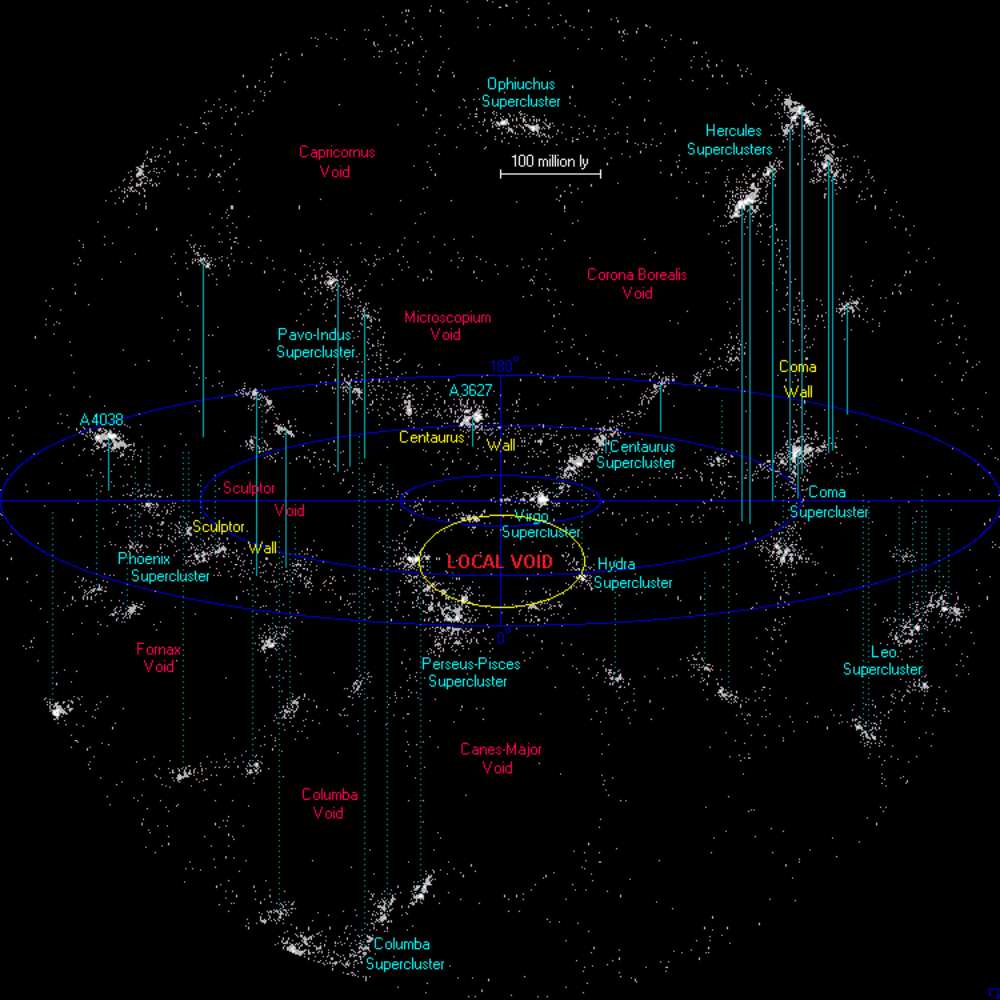
See the Local Void as a Nearby Cosmic Repeller
This lightweight preview shows the central idea: an underdense region does not pull like a rich cluster. Matter around it tends to move outward toward denser walls, while nearby attractors such as Virgo help shape the full local velocity field.
Local Void Quick Facts
The Local Void is one of the most important nearby voids because it begins close to the Local Group and helps explain part of the galaxy motion measured in our cosmic neighborhood.
| Attribute | Details |
|---|---|
| Name | Local Void |
| Type | Nearby cosmic void, or underdense region in the galaxy distribution |
| Location | Adjacent to the Local Group and partly behind the Milky Way's Zone of Avoidance |
| Approximate scale | Often discussed as tens to more than one hundred million light-years across, depending on boundary definition |
| Discovery context | Recognized through nearby galaxy mapping and velocity studies associated with Tully and Fisher |
| Scientific value | Useful for understanding local galaxy flows, void expansion, and the balance between attractors and repellers |
What Is the Local Void?
This nearby void is a region where galaxies are much less common than in the surrounding cosmic web. It sits beside the Local Group, the small galaxy family that contains the Milky Way, Andromeda, Triangulum, and many dwarf galaxies.
A void is not a perfect vacuum. It can contain thin gas, faint dwarf galaxies, and dark matter. The defining feature is relative emptiness: compared with galaxy-rich walls and clusters, the void has far fewer visible galaxies per unit volume.
Local Void Location Beside the Milky Way
The void begins near the edge of the Local Group rather than billions of light-years away. That makes it part of our immediate large-scale environment, even though it cannot be seen as a single object through a telescope.
Part of the region is difficult to map because it overlaps the Zone of Avoidance, where foreground stars, dust, and gas in the Milky Way block optical surveys. Radio hydrogen surveys and infrared mapping help fill in that hidden portion.
This is why maps of the region can look different. The boundary depends on survey depth, sky coverage, galaxy selection, and whether the map is built from positions, velocities, or both.
How the Local Void Was Discovered
The underdensity became clear through nearby galaxy catalogs, redshift measurements, and peculiar velocity studies. Tully and Fisher's work on the local universe helped reveal that some directions near us contain many fewer galaxies than expected.
Modern projects such as Cosmicflows improved the story by adding redshift-independent distances. These measurements are important because nearby galaxy redshifts can be strongly affected by local gravity, not just by the smooth expansion of the universe.
Instead of treating the void as a blank patch, modern maps treat it as a dynamical feature. Its lack of matter changes the gravitational balance around the Local Group.
Local Void and Milky Way Motion
The Milky Way is not simply drifting with cosmic expansion. It has a peculiar velocity, meaning motion relative to the smooth Hubble flow. Nearby galaxy clusters, superclusters, and voids all contribute to that motion.
Dense regions such as the Virgo Cluster and the Great Attractor direction pull matter toward them. Underdense regions work differently: because they contain less mass than average, galaxies around them tend to move away relative to the void center.
This is often described as void repulsion or evacuation. The nearby underdensity is therefore part of the explanation for why the Local Group moves the way it does, alongside attraction from denser regions.
Local Void Structure and Boundaries
The void is not a perfect sphere. Nearby voids are irregular, lumpy, and connected to surrounding filaments. The edges are traced by galaxy groups and walls, while the interior has far fewer luminous galaxies.
Local Void Neighboring Structures
This underdense region sits near familiar structures in the local cosmic web. The Local Group lies on one side, while richer directions include the Virgo region, nearby galaxy groups, and longer filaments that connect the local universe to larger mass concentrations.
| Neighbor | Best description | Why it matters |
|---|---|---|
| Local Group | Milky Way, Andromeda, Triangulum, and dwarf galaxies | Our direct position near the void boundary |
| Virgo region | Nearest rich cluster environment | Major nearby attractor in local flow maps |
| Sculptor and nearby groups | Loose galaxy groups and filaments | Help outline the surrounding cosmic web |
| Zone of Avoidance | Milky Way foreground that hides background galaxies | Makes some void boundaries harder to measure |
Galaxies Inside the Nearby Void
The region is not completely empty, but galaxies inside or near it are rare. Some isolated dwarf and irregular galaxies are important because they let astronomers study galaxy formation with fewer environmental disturbances.
Void galaxies often evolve differently from cluster galaxies. They may have fewer close encounters, less ram-pressure stripping, and a quieter merger history. That isolation can preserve gas-rich, low-mass systems that are difficult to find in ordinary optical surveys.
Radio observations of neutral hydrogen are especially useful because gas-rich dwarfs can be faint in visible light while still detectable at 21-centimeter wavelengths.
How Astronomers Map the Local Void
A good map combines several kinds of evidence. Redshift surveys show where galaxies are missing or concentrated. Distance indicators such as the tip of the red giant branch help separate real distance from peculiar velocity. Radio surveys can reveal hidden hydrogen-rich galaxies.
The challenge is that nearby distances are messy. A galaxy's redshift can be shifted by local gravity, so redshift alone is not always enough. That is why Cosmicflows-style distance mapping is valuable for the local universe.
The result is a more physical picture: a nearby underdensity beside denser regions, with galaxy velocities showing the effect of both attraction and evacuation.
Void Expansion and Dark Energy
Voids are useful for cosmology because low-density regions expand differently from dense regions. In the standard Lambda CDM model, gravity slows growth in matter-rich regions while dark energy becomes important on large scales.
The Local Void is too small to solve major cosmological tensions by itself. But it is a nearby laboratory for testing how structure growth, peculiar velocities, and underdensities behave in the real universe.
Careful wording matters here. The void does not prove an alternative cosmology on its own. It helps refine the local map used when comparing nearby measurements with the wider cosmic expansion.
Compared With Other Voids
This region is smaller than famous giant voids such as the Boötes Void, but it is closer and dynamically important for us. That makes it more directly relevant to the motion of the Milky Way and nearby galaxies.
| Void | Best comparison | Why readers care |
|---|---|---|
| Local Void | Nearby underdensity beside the Local Group | Influences local galaxy motion |
| Boötes Void | Much larger and farther known void | Famous example of extreme galaxy sparsity |
| KBC Void | Proposed large local underdensity | Connected to debates about local expansion measurements |
| Cosmic web voids | Common low-density regions between filaments | Show that emptiness is a normal part of large-scale structure |
How to Read the Map
The image should be read as an educational map, not as a direct photograph. The dark region represents low galaxy density, while surrounding labels and bright structures show the galaxy-rich boundaries that help define the void.
The key is relative density. If a map shows the Local Group near the edge, the important idea is that we live beside a cosmic emptier region rather than at the center of a dense cluster.
Why the Local Void Matters
The Local Void matters because it turns absence into evidence. It helps explain nearby galaxy flows, tests how underdense regions evolve, and gives readers a more complete map of the Milky Way's cosmic neighborhood.
For Universe Map, it also connects several pages naturally: Local Group, Virgo Supercluster, Laniakea, KBC Void, Boötes Void, and the cosmic web. A visitor can move from the galaxies closest to us into the larger invisible architecture that shapes their motion.
Local Void FAQ
What is the Local Void?
It is a nearby cosmic underdensity beside the Local Group, with far fewer galaxies than surrounding walls and clusters.
Can we see it directly?
No. It is inferred from galaxy distribution, redshift surveys, radio observations, and measured galaxy motions.
Does the Local Void push the Milky Way?
In a cosmological sense, yes. The underdense region contributes to motion away from the void, while dense regions also attract the Local Group.
Is the Local Void completely empty?
No. It may contain faint galaxies, gas, and dark matter, but its galaxy density is much lower than average.
Why is it hard to map?
It is nearby, irregular, sparse, and partly hidden behind the Milky Way's Zone of Avoidance.