




Makemake 3D Map
Map settings
Sun & Orbit: JPL predictions, 2026–2050. MK2: a circular demonstration using a preliminary published radius and period; phase and plane are illustrative, with no UTC position prediction. Surface, spin pole and prime meridian are illustrative.
KUIPER BELT · DWARF PLANET 136472
Makemake: Surface, Moon & Orbit
Explore Makemake’s icy appearance, an adopted rotation model, its faint companion MK2 and its journey around the Sun. Rotate the globe, inspect the moon, or choose a date to compare Makemake with Neptune and Pluto.
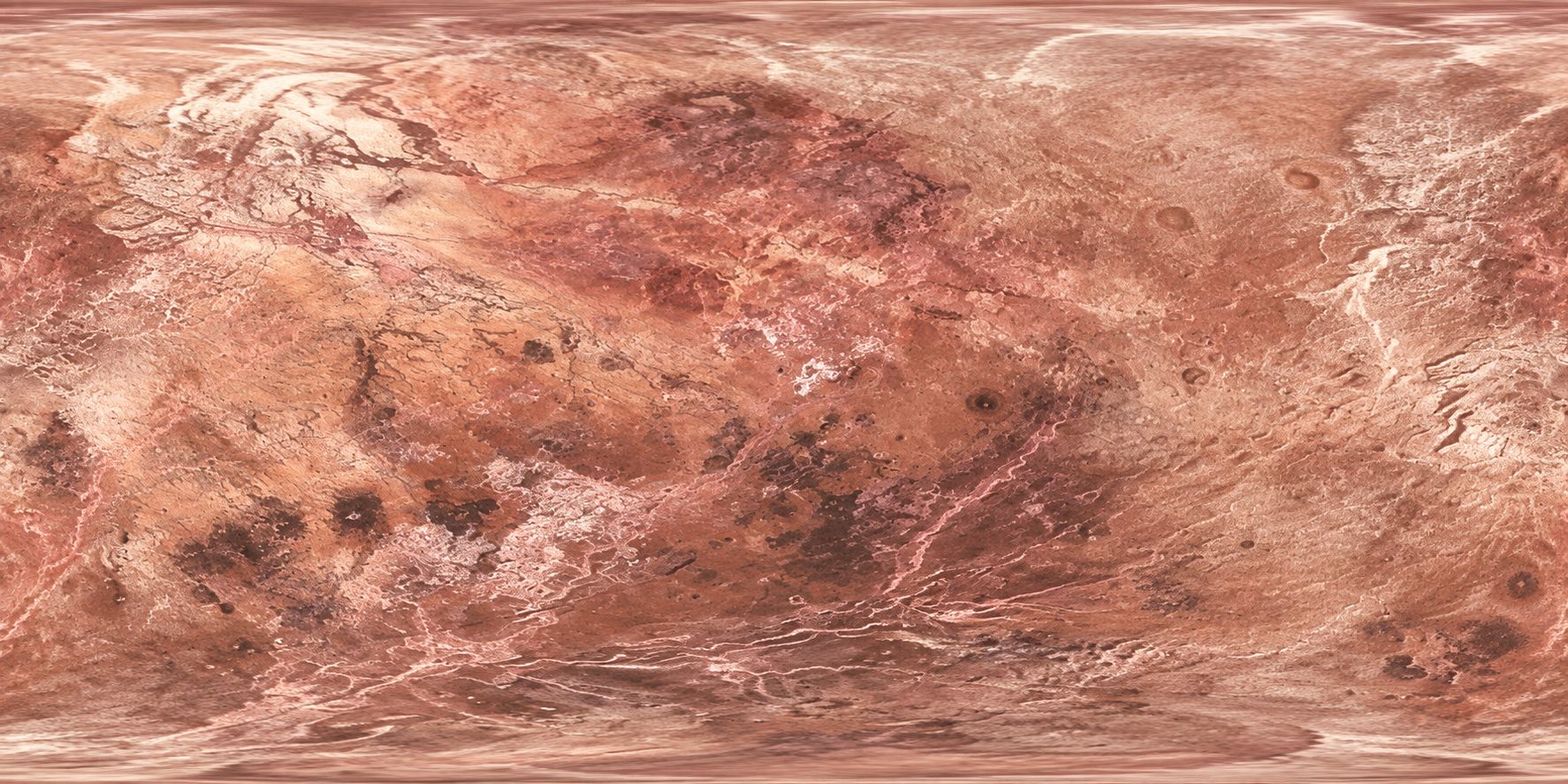
The default surface uses Universe Map’s supplied illustration. Its apparent craters, ridges and colours are artistic details, not an observed global terrain atlas. Dated JPL positions, a preliminary moon-orbit demonstration and illustrative appearance are identified separately in the explorer.
Six ways to explore
An icy world beyond Neptune
Explore a 715 km reference sphere using your supplied surface illustration. Its terrain and spin orientation are not measured maps.
Explore the reddish surface
Rotate and zoom the supplied texture, or switch to neutral ice. No invented craters are labelled as observed landmarks.
Meet MK2
Compare a small dark moon with Makemake. The circular demonstration uses a published radius and period, with an arbitrary phase and plane.
Follow one full rotation
Watch a 22.8266-hour reference spin. The rotation period has alternative interpretations; pole and prime meridian are illustrative.
Travel through the Kuiper Belt
Explore dated heliocentric positions through 2050, alongside Neptune and Pluto. Distances share one scale; body symbols are enlarged.
What observations reveal
Explore occultation, Hubble moon discovery and JWST spectroscopy. Separate evidence from the visual assumptions used in this map.
A FAINT COMPANION
MK2: small, dark and still mysterious
S/2015 (136472) 1, nicknamed MK2, was detected in Hubble observations taken in April 2015. Its approximate 80 km radius depends on assumptions about reflectivity; a detailed surface shape is not resolved.
A preliminary circular fit published in revised form in 2026 gives a radius of 22,250 ± 780 km and a period of 18.023 ± 0.017 days. The explorer uses these two values for a demonstration. Its phase and orbital plane are illustrative, so it cannot predict an eclipse or tell you where MK2 is now.
SPIN, SHAPE & APPEARANCE
A familiar day on a distant world
The default spin model uses 22.8266 hours. Photometry also permits a shorter, single-peaked interpretation near 11.4133 hours; the longer period is an adopted interpretation, not a uniquely established attitude solution. The display pole and prime meridian are illustrative.
One full rotation advances exactly one adopted spin period and then pauses. At the default speed, ten simulated minutes pass each real second, so a rotation takes about 137 seconds. Very high speeds can produce visual aliasing on a screen.
Explore without hiding the terrain
The surface view has no invented landmark pins. Smooth orbit controls let you rotate freely and zoom toward the illustration. Use neutral ice to examine the reference sphere without the supplied texture.
View the original flat illustration
OBSERVATIONS & OPEN QUESTIONS
What we know, and what remains uncertain
Size from disappearing starlight
Occultations constrain the projected silhouette and atmosphere at a particular epoch. They do not provide a complete topographic map or uniquely fix the three-dimensional figure.
Ices and methane gas
JWST detected methane fluorescence alongside hydrocarbon ices. Whether the gas forms a bound atmosphere or an expanding coma remains unresolved. A confirmed vent location is not available.
Keep hypotheses separate
Unlike Haumea, Makemake has no confirmed ring in this explorer. Proposed explanations for thermal excess do not establish a ring. Its interior and magnetosphere also remain poorly constrained.
| Feature | Evidence / model | What the explorer shows |
|---|---|---|
| Surface | Ice composition from spectra | Supplied artistic texture; no mapped landmarks |
| Body size | Occultation constraints | Reference sphere, radius ≈715 km |
| Rotation | Adopted 22.8266 h interpretation | Illustrative pole and phase |
| MK2 | Hubble detection; preliminary circular fit | Physical scale, schematic orbit phase and plane |
| Sun & Orbit | JPL geometric vectors, ecliptic J2000 | UTC dates 2026–2050; enlarged body symbols |
| Methane gas | JWST spectral detection | Research notes; no invented global shell or vent |
Makemake in the Solar System
The orbital view uses a single linear distance scale. Its faint 30–50 AU band provides a Kuiper Belt reference plane, while the body symbols are enlarged for visibility. Makemake’s inclined orbit rises away from that plane. The path lines show approximately one revolution of each bundled JPL trajectory; they are not the duration of the date selector.
Questions about the map
Is this a live photograph of Makemake?
No. The globe uses an illustrative texture. Sun & Orbit uses cached JPL predictions for the selected UTC date. Neither is a live spacecraft camera feed.
Why is MK2’s date control disabled?
The available preliminary radius and period do not supply a complete dated, unambiguous inertial orbit. The demonstration has its own elapsed-day counter, so an arbitrary phase is never labelled as today’s position.
Does MK2 always face Makemake?
Its rotation and locking state are unknown. No synchronous spin is imposed. The fixed attitude of the unresolved sphere is a display choice.
Why are there no interior layers or landers?
Makemake’s interior is poorly constrained, and no spacecraft has visited it. A detailed measured cross-section or landing location would imply evidence that is not available.
Does Makemake have an atmosphere?
JWST methane gas detection updates the older picture of a purely inactive frozen world. The gas geometry remains uncertain; the page distinguishes detection from a confirmed global atmosphere.
Scientific sources & image credits
- NASA · Makemake overview — public size, discovery, surface and satellite context.
- Ortiz et al. (2012) · stellar occultation and Brown (2013) · size and projected shape.
- Hromakina et al. (2019) · photometric rotation interpretations.
- NASA/Hubble · discovery of MK2.
- Bamberger · preliminary MK2 orbit, revision 28 February 2026.
- Protopapa et al. (2025) · JWST hydrocarbon ices and methane gas.
- NASA/JPL Horizons — geometric heliocentric positions; exact query provenance is bundled with the data.
- Makemake, Sun, Neptune and Pluto images: supplied Universe Map assets. Makemake imagery is illustrative, not an observed atlas. No resolved MK2 texture is used.
Research reviewed 21 October 2026. Numerical interpolation accuracy does not represent physical orbit certainty. Moon fit uncertainties must not be interpreted as precision live tracking.