











Proxima Centauri System Map
Proxima Centauri
The closest star to the Sun and the nearest known planetary system beyond our own.
Proxima Centauri is a small red dwarf in the Alpha Centauri system, about 4.24 light-years from Earth. It is faint, magnetically active, and orbited by confirmed planets including Proxima Centauri b, the nearest known exoplanet in a star's habitable-zone region.
Interactive 3D Experience
Explore the Proxima Centauri system in 3D
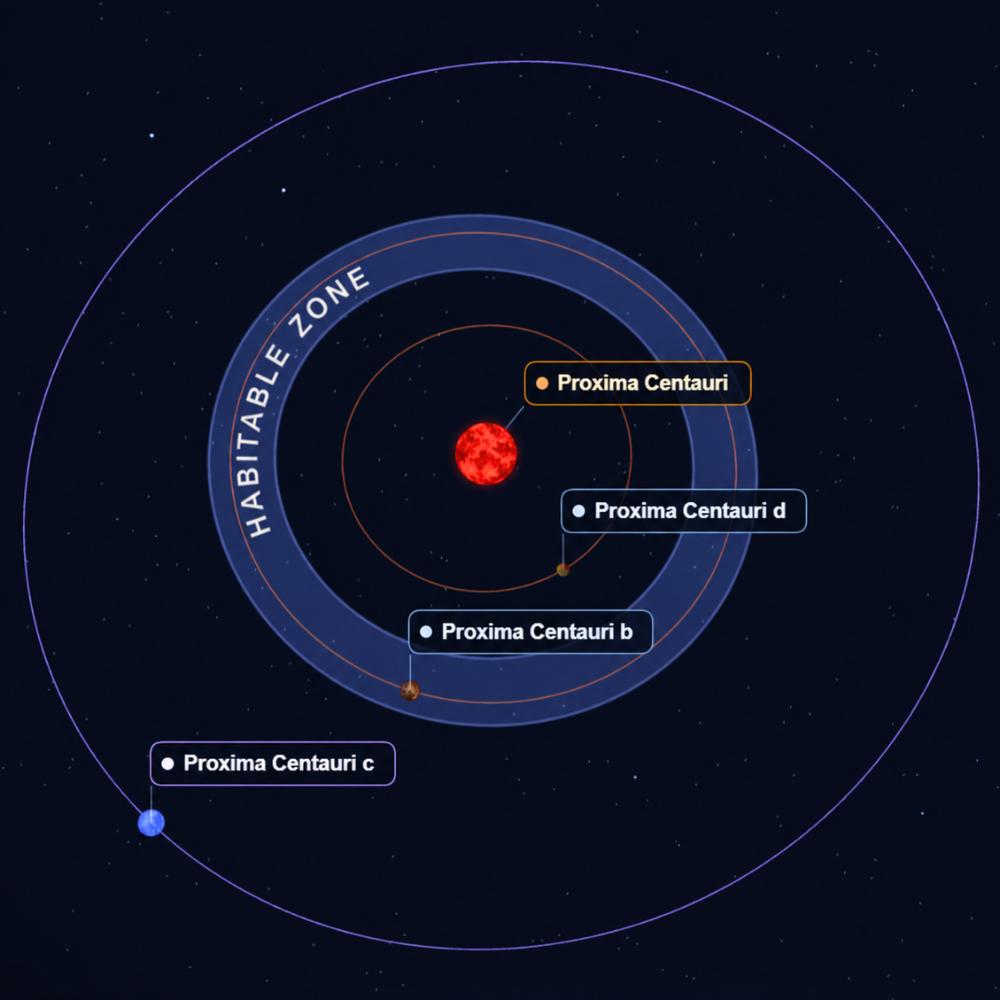
Open the dedicated 3D map to rotate the system, focus on Proxima b, Proxima d, or the candidate Proxima c, and see how the habitable-zone orbit sits around the nearest star to the Sun.
Quick Facts About Proxima Centauri
Proxima Centauri is the nearest star to the Solar System. It is too faint to see without a telescope, but scientifically it is one of the most important stars in the sky because it gives astronomers a nearby laboratory for studying red dwarfs, stellar flares, and rocky exoplanets.
| Name | Proxima Centauri |
|---|---|
| Other designations | Alpha Centauri C, Gliese 551 |
| Star group | Alpha Centauri triple-star system |
| Spectral type | M5.5 V red dwarf |
| Distance from Earth | About 4.24 light-years |
| Mass | About 0.122 solar masses |
| Radius | About 0.154 solar radii |
| Luminosity | About 0.0016 to 0.0017 times the Sun's total luminosity |
| Age | About 4.8 billion years |
| Planetary system | Proxima Centauri b and d are confirmed; Proxima Centauri c remains a long-period candidate or disputed planet. |
Proxima Centauri System Map
A map of the Proxima Centauri system helps explain why this nearby red dwarf is so important. The inner system is compact: Proxima d orbits very close to the star, Proxima b orbits in the habitable-zone region, and the candidate Proxima c would orbit much farther out if its signal is confirmed.
The visual system map is educational, so planet sizes and orbital distances are adjusted for clarity. Real separations are much larger, especially for the possible outer orbit of Proxima c.
Where Is Proxima Centauri?
Proxima Centauri lies in the southern constellation Centaurus, close in the sky to Alpha Centauri A and Alpha Centauri B. It is part of the Milky Way's local stellar neighborhood and sits just over four light-years from the Sun.
Although it is the nearest star beyond the Sun, Proxima Centauri is not bright. Its apparent magnitude is around 11, far below naked-eye visibility. It appears near the Alpha Centauri region only through a telescope and accurate star chart.
What Type of Star Is Proxima Centauri?
Proxima Centauri is an M-type red dwarf, a small and cool main-sequence star. It has only about 12 percent of the Sun's mass and roughly 15 percent of the Sun's radius, yet it can remain stable for trillions of years because it burns hydrogen extremely slowly.
How Many Planets Does Proxima Centauri Have?
Current evidence supports two confirmed planets around Proxima Centauri, plus one long-period candidate or disputed planet. The confirmed planets are Proxima Centauri b and Proxima Centauri d. Proxima Centauri c remains scientifically uncertain because later observations have not consistently confirmed the original signal.
Proxima Centauri b: The Nearby Habitable-Zone World
Proxima Centauri b is the most famous planet in the system because it is the nearest known exoplanet with an Earth-like mass in the habitable zone of its star. NASA lists Proxima b with a mass close to Earth, an orbital period of about 11.2 days, and an orbital distance near 0.0485 AU.
Being in the habitable zone does not automatically mean a planet is habitable. Proxima b probably receives intense stellar radiation, may be tidally locked, and may have faced atmospheric erosion from Proxima's flares and stellar wind.
Proxima Centauri d and Proxima Centauri c
Proxima Centauri d
Proxima d is an inner sub-Earth planet. ESO first announced it as a candidate in 2022, and NASA Exoplanet Archive later highlighted Proxima Cen d as a confirmed planet in the closest star system. Its tight orbit makes it scientifically valuable, but not a promising habitable-world candidate.
Proxima Centauri c
Proxima c is the uncertain member of the system. It was proposed as a long-period planet candidate, but later high-precision studies have not securely confirmed the signal. For that reason, this article treats Proxima c as a candidate or disputed planet.
Mass, Radius, Luminosity, Temperature, and Age
Proxima Centauri is tiny compared with the Sun, but it is dense and long-lived. Its low mass and low luminosity mean it uses fuel slowly, while its fully convective interior helps mix hydrogen through the star.
| Mass of Proxima Centauri | About 0.122 solar masses, or roughly 12 percent of the Sun's mass. |
|---|---|
| Radius of Proxima Centauri | About 0.154 solar radii, close to one-seventh of the Sun's radius. |
| Luminosity of Proxima Centauri | About 0.0016 to 0.0017 times the Sun's total luminosity, with most energy emitted in infrared wavelengths. |
| Temperature of Proxima Centauri | About 3,050 K, giving it the cool reddish appearance typical of late M dwarfs. |
| Age of Proxima Centauri | About 4.8 billion years, broadly similar to the age of the Sun. |
Flares, Radiation, and Habitability
Proxima Centauri is a flare star. It can release bursts of ultraviolet and X-ray radiation that may affect the atmospheres and surfaces of nearby planets. This is the central habitability challenge for Proxima Centauri b.
- Flares: energetic events can temporarily raise radiation levels around the star.
- Tidal locking: close-in planets may keep one hemisphere facing the star.
- Stellar wind: charged particles may erode atmospheres unless a planet has protection.
- Possible survival paths: dense atmospheres, oceans, magnetic fields, or subsurface habitats could improve long-term prospects.
Habitability is not ruled out, but it is complicated. Proxima b remains a prime target because it is close enough for future telescopes to study in more detail.
Orbit Around Alpha Centauri A and B
Proxima Centauri is the third star in the Alpha Centauri system. It orbits the brighter Alpha Centauri A and B pair at a very large distance, roughly 13,000 AU, with an orbital period of about 550,000 years.
This wide orbit means Proxima belongs to the Alpha Centauri system while still sitting far from the central binary pair. The system is a nearby triple-star system: two bright Sun-like stars and one faint red dwarf.
Can You See Proxima Centauri?
You cannot see Proxima Centauri with the naked eye. Even though it is the closest star to the Sun, it is too dim because red dwarfs emit relatively little visible light.
A small telescope under dark southern skies can show Proxima as a faint point near the Alpha Centauri region, but finding it requires accurate coordinates or a detailed chart. Its proper motion is high enough that long-term observers can track its movement against background stars over many years.
Future Exploration
Proxima Centauri is the most realistic first target for future interstellar probes because it is the nearest star system. Concepts such as laser-driven light sails have proposed sending tiny spacecraft toward Proxima at a significant fraction of the speed of light.
Even before any probe arrives, future observatories may study Proxima b's atmosphere, temperature patterns, and signs of atmospheric escape. That makes Proxima Centauri a bridge between current exoplanet astronomy and the long-term dream of interstellar exploration.
FAQ
How many planets does Proxima Centauri have?
Proxima Centauri has two confirmed planets, Proxima Centauri b and Proxima Centauri d, plus one long-period candidate or disputed planet called Proxima Centauri c.
What is the mass of Proxima Centauri?
Proxima Centauri has about 0.122 times the mass of the Sun, making it a low-mass red dwarf star.
How old is Proxima Centauri?
Proxima Centauri is estimated to be about 4.8 billion years old, roughly comparable to the Sun's age.
What is the luminosity of Proxima Centauri?
Its total luminosity is about 0.0016 to 0.0017 times the Sun's luminosity, which is why it remains invisible to the naked eye despite being so close.
Which star group does Proxima Centauri belong to?
Proxima Centauri belongs to the Alpha Centauri triple-star system, together with Alpha Centauri A and Alpha Centauri B.
Where is Proxima Centauri in the Milky Way?
It is in the Milky Way's local stellar neighborhood, in the direction of the southern constellation Centaurus, about 4.24 light-years from Earth.
Is Proxima Centauri b habitable?
Possibly, but it is uncertain. Proxima b lies in the habitable-zone region, yet stellar flares, radiation, tidal locking, and atmospheric loss are serious challenges.