





Sirius
Sirius is the brightest star in Earth's night sky, a nearby binary system in Canis Major made of a brilliant A-type primary star and a faint white dwarf companion.
Its brightness comes from two advantages at once: it is intrinsically luminous and only about 8.6 light-years away. The system also gives astronomers one of the clearest nearby laboratories for white dwarf physics, stellar mass measurement, and binary-star evolution.
See Sirius A and B as a Binary Pair
This lightweight visual shows the essential idea: a bright blue-white primary dominates the view, while a much fainter white dwarf moves in a long elliptical orbit. The preview is educational, not to physical scale.
Sirius Quick Facts
The star is famous to casual skywatchers because it is easy to find and unmistakably bright. It is famous to astronomers because its companion helped prove that white dwarfs are small, dense stellar remnants.
| Attribute | Details |
|---|---|
| Primary name | Sirius, also known as Alpha Canis Majoris and the Dog Star |
| System type | Visual binary with a bright A-type main-sequence star and a faint white dwarf |
| Distance | About 8.6 light-years, or about 2.6 parsecs |
| Apparent brightness | About magnitude -1.46, making it the brightest star in Earth's night sky |
| Binary orbit | Roughly 50.1 years, with an average separation near 20 astronomical units |
| Why it matters | Benchmark for nearby stars, white dwarf physics, astrometry, and stellar evolution |
What Is Sirius?
Sirius is a nearby binary star system in the constellation Canis Major. The visible star is a hot, blue-white main-sequence star roughly twice the Sun's mass and many times more luminous than the Sun.
The companion is a white dwarf: the compact leftover core of a star that exhausted its nuclear fuel and collapsed to Earth-like size. The pair is close enough to be studied in exceptional detail, but the companion is difficult to see because the primary star is so bright.
Why Sirius Looks So Bright
The star appears so brilliant because proximity and real luminosity work together. Many stars are closer but dimmer, and many stars are more luminous but much farther away. This system sits in the rare sweet spot of being both nearby and powerful.
When it is low near the horizon, it often seems to flash blue, white, and red. That dramatic twinkling is mostly caused by Earth's atmosphere bending and scattering the light through moving layers of air.
Its brightness also makes it a useful seasonal landmark. In the Northern Hemisphere it dominates winter evenings, while in many southern skies it rises higher and can look even more intense.
Sirius A: The Bright Primary Star
The primary star is usually classified as an A-type main-sequence star. It is hotter, more massive, and more luminous than the Sun, giving it a blue-white color and a strong presence in visible-light observations.
Because it has more mass than the Sun, it burns fuel faster and will not live as long. It is still a hydrogen-burning star today, but its future path leads toward a red giant phase and eventually another white dwarf.
Sirius B: The White Dwarf Companion
The companion is much fainter than the primary, but scientifically it is the more extreme object. NASA describes it as a tiny white dwarf only about Earth-sized, yet with a mass close to the Sun's mass.
That combination means extraordinary density. Hubble measurements of its gravitational redshift helped test white dwarf mass estimates and the physics of compact stellar remnants.
The companion also tells a time story. It began as the more massive star in the system, evolved faster, shed its outer layers, and left behind the dense core seen today.
Sirius Binary Orbit
The two stars orbit each other in about 50.1 years. Their separation changes because the orbit is elliptical, ranging from a relatively close approach to a wider spacing across the orbit.
The average separation is often compared with the distance from the Sun to Uranus. That is wide by solar-system standards, but close enough for astronomers to track the motion and determine accurate dynamical masses.
That orbital solution is why the system is such a strong benchmark. In astronomy, a binary orbit is one of the cleanest ways to weigh stars.
How to Find Sirius in the Sky
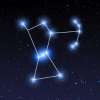
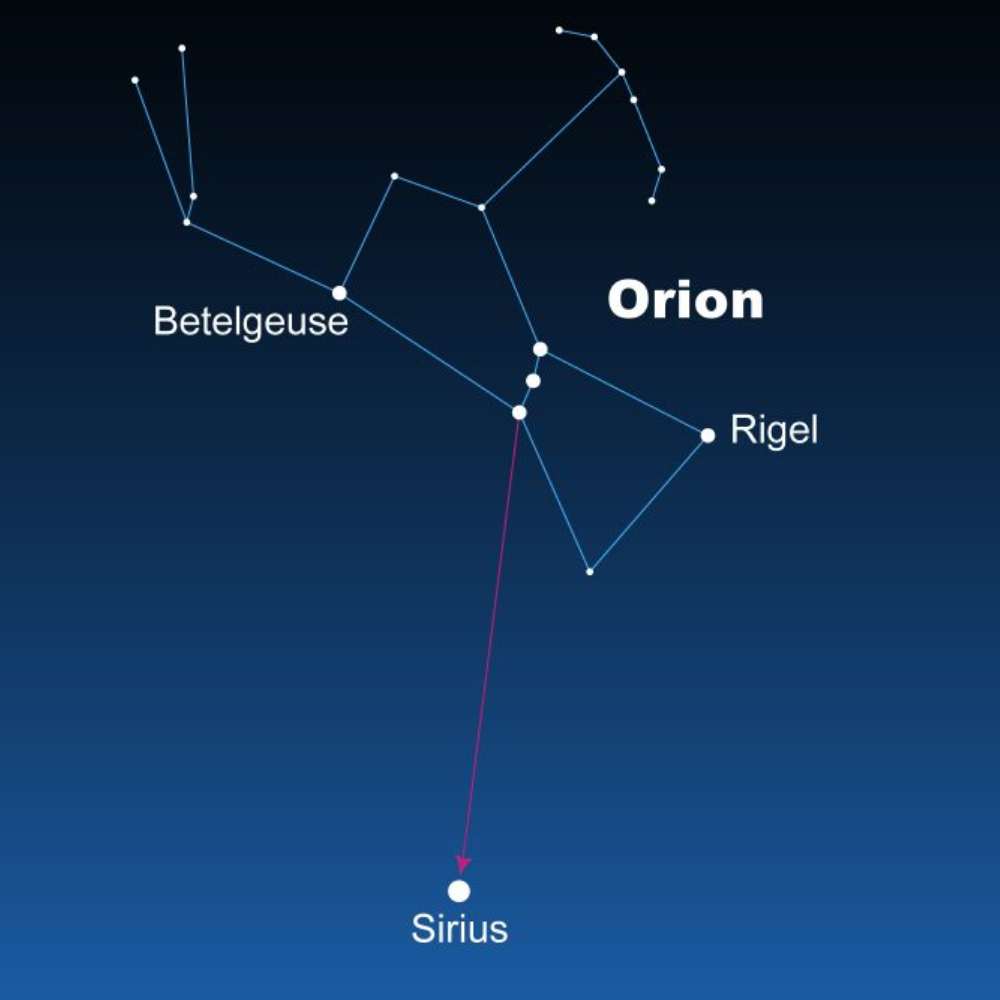
The easiest method is to use Orion's Belt. Follow the three belt stars downward and left in Northern Hemisphere winter skies, and the bright star you reach is the Dog Star in Canis Major.
It is visible from most inhabited parts of Earth, though the viewing season and altitude depend on latitude. From northern mid-latitudes, it is best seen during winter evenings and early spring nights.
Because it is so bright, it can stand out even in moderately light-polluted skies. A telescope is not needed to see the primary star, but resolving the white dwarf companion is difficult because of glare.
Sirius Distance and Proper Motion
The system lies about 8.6 light-years away, making it one of the nearest stellar systems to Earth. Its closeness is one reason the star looks so bright and why astronomers can measure it with high precision.
Like other nearby stars, it has measurable proper motion across the sky. Over long periods, its position shifts against the background star field, which is why ancient, modern, and future sky maps do not align perfectly forever.
The distance is short on galactic scales but enormous in ordinary terms. Light reaching us tonight left the star system more than eight years ago.
Sirius History and Discovery of the Companion
The bright star has been important for navigation, calendars, and seasonal observation for thousands of years. Ancient Egyptian skywatchers associated its heliacal rising with the Nile flood season, while many cultures treated it as a major sky marker.
The companion entered modern astronomy in the nineteenth century. Its existence was predicted from the wobble of the bright star and then visually observed in 1862 by Alvan Graham Clark.
That discovery turned a familiar sky object into a laboratory for unseen companions, orbital dynamics, and compact stellar remnants.
Why the White Dwarf Matters
White dwarfs are the final dense cores of stars that were not massive enough to explode as supernovae. They no longer create energy by ordinary nuclear fusion, so they gradually cool over immense spans of time.
The companion is important because it is nearby, measurable, and strongly affected by gravity. NASA's Hubble work used gravitational redshift to help measure its mass, supporting a key prediction of general relativity and compact-star physics.
It is also a reminder that brightness is not the same as importance. The faint object next to the glare helped build one of astronomy's most important stellar-evolution stories.
Are There Planets Around Sirius?
No confirmed planets are known in the system. Precise Hubble astrometry published in 2017 ruled out many possible massive third bodies, especially objects in the brown-dwarf or giant-planet range that would noticeably disturb the binary motion.
That does not prove tiny planets are impossible, but the system is not a clean exoplanet showcase. The past evolution of the white dwarf progenitor and the present binary orbit make long-term planetary stability a complex question.
For an educational page, the safest wording is simple: there are no confirmed planets, and strong constraints exist on massive unseen companions.
Sirius Compared With the Sun and Nearby Stars
The system is much closer than most stars visible to the naked eye, but the primary is also genuinely more luminous than the Sun. That is why it outshines closer red dwarfs such as Proxima Centauri.
| Object | Best comparison | Why it matters |
|---|---|---|
| Sun | Cooler, less massive G-type star | Useful baseline for mass, luminosity, and lifetime |
| Primary star | Hotter and brighter A-type star | Explains the strong night-sky brightness |
| White dwarf companion | Small, dense stellar remnant | Benchmark for compact-star physics |
| Proxima Centauri | Closer but far dimmer red dwarf | Shows why apparent brightness depends on both distance and luminosity |
How to Read the Sirius Map
The image on this page is a sky-finding diagram rather than a physical orbit map. It shows how Orion's Belt points toward the bright star in Canis Major, which is useful for visitors who want to identify it from the ground.
The binary companion is not shown at true scale in such a diagram. In real observations, the white dwarf sits very close to the glare of the primary and requires careful imaging to isolate.
Sirius FAQ
Why is Sirius so bright?
It is bright because the primary star is intrinsically luminous and the system is only about 8.6 light-years away.
Is it a binary star?
Yes. The system contains a bright A-type primary star and a faint white dwarf companion.
Can we see Sirius B with the naked eye?
No. The white dwarf is much too faint and too close to the glare of the primary star for naked-eye viewing.
How far away is the system?
It is about 8.6 light-years away, one of the nearest stellar systems to Earth.
Does Sirius have planets?
No confirmed planets are known. Modern astrometry places strong limits on massive unseen companions.