






Tau Ceti
Tau Ceti is one of the nearest Sun-like stars, a quiet G-type dwarf about 11.9 light-years away with a debris disk and reported super-Earth candidates.
It is smaller, cooler, and less luminous than the Sun, but its stability makes it unusually valuable. The system sits close enough for careful study, yet its planets remain difficult because their radial-velocity signals are tiny.
See Tau Ceti With Its Debris Belt
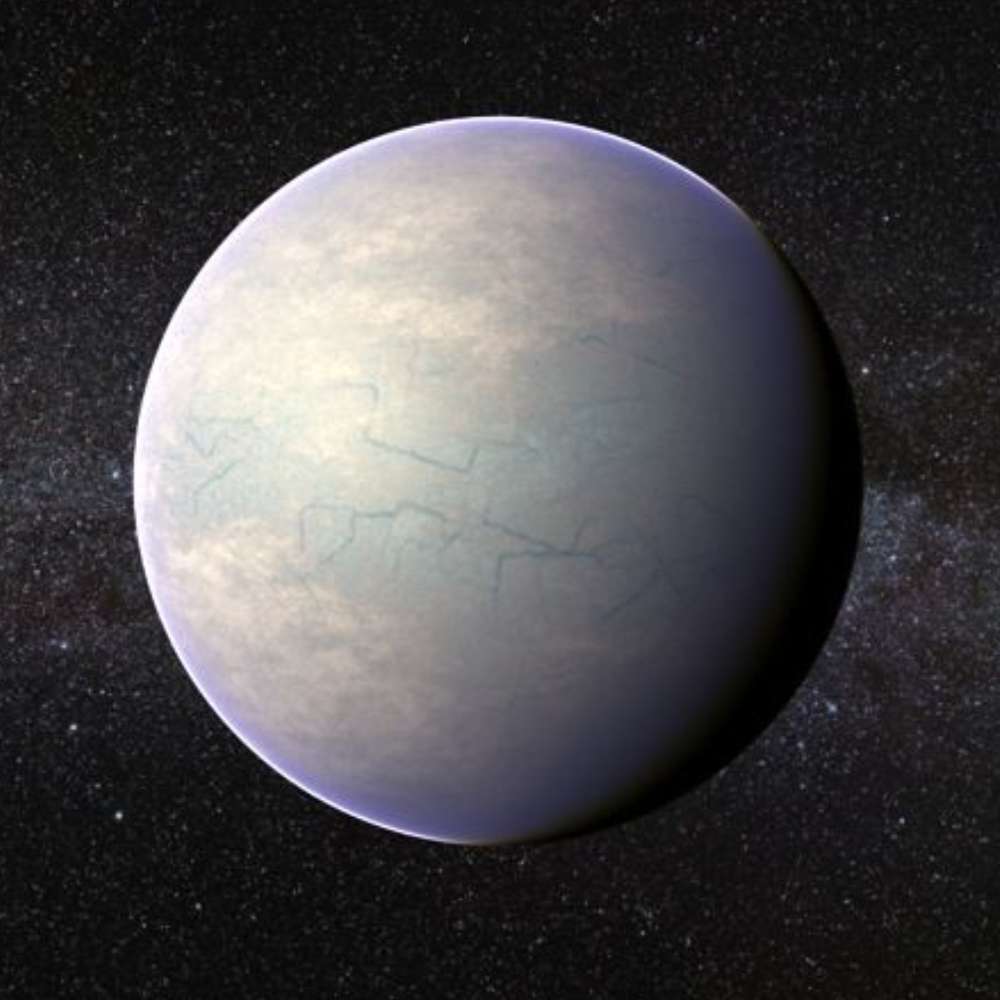
This lightweight visual shows a calm Sun-like star surrounded by broad debris belts and candidate orbit paths. The preview is educational, not to physical scale, and avoids presenting debated planets as directly imaged worlds.
Tau Ceti Quick Facts
This nearby star is a favorite target because it combines distance, stability, and possible rocky planets. The important caution is that most planet discussion comes from radial-velocity interpretation, not direct images.
| Attribute | Details |
|---|---|
| Name | Tau Ceti, also cataloged as HD 10700 |
| Star type | G8 V main-sequence star, slightly cooler and smaller than the Sun |
| Distance | About 11.9 light-years, or about 3.6 parsecs |
| Brightness | Visible to the naked eye from dark skies at about magnitude 3.5 |
| Known environment | Cold debris disk plus reported low-mass planet signals |
| Scientific value | Benchmark for quiet Sun-like stars, radial-velocity work, and habitability modeling |
What Is Tau Ceti?
Tau Ceti is a nearby G-type dwarf in the constellation Cetus. It is often called Sun-like because it is a stable hydrogen-burning star with broadly similar behavior, though it is cooler, dimmer, lower in mass, and more metal-poor than the Sun.
The star is not visually dramatic. It looks like a modest point of light from Earth. Its importance comes from the deeper measurements: low magnetic activity, close distance, a debris disk, and very small Doppler signals interpreted as planets by several analyses.
Tau Ceti as a Sun-Like Star
The star is less massive and less luminous than the Sun. Public catalogs and research papers place it near the cooler end of Sun-like main-sequence stars, with a spectral type around G8 V and a surface temperature a little above 5,200 kelvin.
Because it is dimmer, the habitable zone sits closer in than Earth's orbit around the Sun. A planet would need to orbit nearer to receive Earth-like energy, but not so near that greenhouse heating becomes excessive.
Its low activity is a major advantage. A calm star gives planets a better chance to keep stable climates, although planet composition, atmosphere, rotation, and impact history still matter.
Tau Ceti Distance and Visibility
At about 11.9 light-years away, the star is close on galactic scales. It is not as close as Alpha Centauri or Sirius, but it is near enough for high-precision spectroscopy and future direct-imaging concepts.
It can be seen without a telescope from dark locations, but it is not a showpiece star. In urban skies it may disappear into light pollution, while binoculars make it easier to identify in Cetus.
The closeness is why small signals matter. Tiny changes in radial velocity can reveal possible orbiting planets, while infrared and submillimeter observations can trace dust in the surrounding debris disk.
Tau Ceti Stellar Properties
The star has about four-fifths of the Sun's mass and radius, and roughly half the Sun's luminosity. Exact values vary by catalog and method, but the broad picture is stable: smaller, cooler, older, and quieter than our star.
Its metallicity is lower than the Sun's, meaning it contains fewer heavy elements relative to hydrogen and helium. That matters because heavy elements are the raw material for rocky planets, cores, dust, and much of planet-building chemistry.
Low metallicity does not rule out planets. It makes the system more interesting because reported planet signals and a debris disk exist around a star that is not especially rich in heavy elements.
Tau Ceti Planet Candidates
NASA Exoplanet Archive lists several planets for the system, including g, h, e, and f from Feng and collaborators' 2017 radial-velocity work. Many educational pages still use cautious language because the signals are small and come from precision Doppler measurements.
The reported planets are super-Earth mass objects rather than confirmed Earth twins. The long-period candidates, often discussed as e and f, fall near the inner and outer edges of the star's habitable zone in published models.
That does not mean either world is habitable. Minimum mass, atmosphere, surface pressure, water inventory, orbital stability, and impact environment are all unknown or uncertain.
| Candidate | Approximate period | Why it matters |
|---|---|---|
| g | About 20 days | Inner low-mass radial-velocity signal |
| h | About 49 days | Another compact inner-system signal |
| e | About 160 days | Often discussed near the warm inner edge of the habitable zone |
| f | About 636 days | Often discussed near the cooler outer edge of the habitable zone |
Tau Ceti Habitability: Promise and Caution
The system has a strong habitability appeal: the host star is nearby, quiet, and long-lived. Those traits are useful because extreme flares and strong stellar winds can damage planetary atmospheres around more active stars.
The caution comes from uncertainty. The planet signals do not tell us radius, density, atmosphere, clouds, oceans, geology, or magnetic shielding. Super-Earth mass alone can describe a rocky world, a mini-Neptune, or something in between.
The safest conclusion is that this is a priority target for habitability research, not proof of a habitable planet.
Tau Ceti Debris Disk
One of the most important features around the star is a cold debris disk. NASA's circumstellar disk catalog lists it as a debris system, and studies with Herschel and ALMA have examined dust around this nearby solar analog.
A debris disk can mean many small bodies are colliding and replenishing dust. For planet habitability, that is a mixed sign: planet formation may have been active, but impact rates could be higher than in today's Solar System.
The disk also gives astronomers an indirect way to think about planet architecture. Dust belts can be shaped by unseen planets, collisions, and gravitational stirring.
Tau Ceti Metallicity and Planet Formation
The star's low metallicity makes it a useful test case. Giant planets are more common around metal-rich stars, but smaller rocky planets can still exist around stars with lower heavy-element content.
If the reported worlds are real, they show that a metal-poor solar-type star can still produce low-mass planets. That matters for estimating how common rocky planets may be in older parts of the galaxy.
For visitors, the idea is simple: this star looks Sun-like in some ways, but its chemistry may have shaped a very different planetary system.
Tau Ceti Compared With the Sun
The star is older and quieter than the Sun, with lower mass, lower luminosity, and lower metallicity. Its planets, if confirmed in detail, would orbit closer to receive similar energy levels because the star produces less light.
How Astronomers Study Tau Ceti
Radial-velocity instruments watch for tiny shifts in starlight caused by orbiting planets. For this star, the signals are extremely small, so noise modeling, wavelength-dependent effects, and instrument stability are central to the debate.
Infrared and millimeter observations study the debris disk. Future telescopes may try to directly image nearby low-mass planets or measure atmospheric signatures, but that remains a hard technical challenge.
The system is therefore a bridge between current exoplanet detection and future characterization.
Tau Ceti in SETI and Interstellar Concepts
The star has appeared in SETI target lists and science fiction because it is nearby, relatively Sun-like, and scientifically plausible as a planetary system. That does not mean signals or life have been detected.
Its distance is still enormous for human travel. Light needs nearly twelve years to cross the gap, so even futuristic probes would require major propulsion breakthroughs.
As an educational destination, it works because it feels close enough to imagine and difficult enough to respect.
How to Read the Tau Ceti Image
The image used here is concept art. No telescope has photographed a detailed surface of any planet in the system. The artwork represents the idea of a cold candidate world and the star's exoplanet interest.
That distinction is important for trust. The scientific evidence comes from radial velocities, stellar measurements, and dust observations, while the image helps visitors imagine the scale and mood of a possible planetary environment.
Tau Ceti FAQ
Is Tau Ceti a Sun-like star?
Yes, but not a solar twin. It is a cooler, smaller, dimmer, quieter G-type main-sequence star.
How far away is it?
It is about 11.9 light-years from Earth, making it one of the nearer Sun-like stars.
Are there confirmed planets?
NASA Exoplanet Archive lists several planets, but many discussions still use cautious language because the evidence comes from very small radial-velocity signals.
Could any planet be habitable?
Possibly, but habitability is unknown. Candidate orbits, atmosphere, composition, water, and impact history all matter.
Can we see the star without a telescope?
Yes, from dark skies. It is modest but visible in the constellation Cetus.